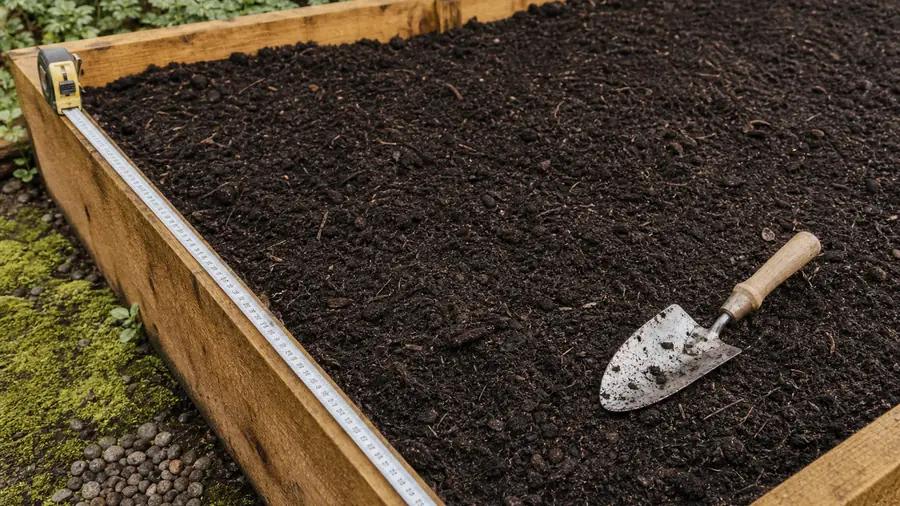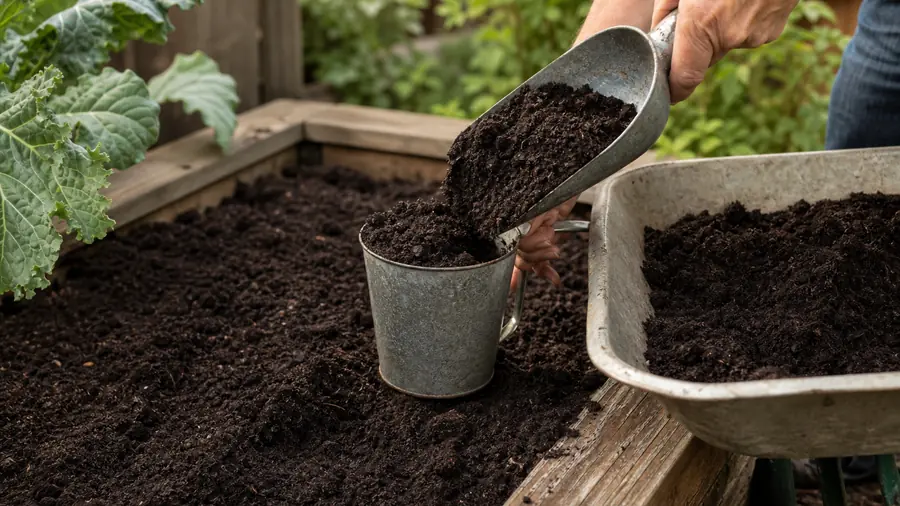

Most home landscape recommendations fall within a shallow range, but the correct number is not identical for seedlings, fine bark, coarse arborist chips, established beds, and specialized restoration work. First name the job and material; then select a source-backed target.
Treat depth as a settled layer over soil, not the height of a loose pile. Keep mulch away from stems, crowns, and trunks, and reduce or change the plan when drainage or local guidance makes a generic range unsuitable.
How deep should mulch be for your garden job?
For many established landscape beds, Extension guidance commonly spans about 2–4 inches, with narrower recommendations tied to the material and site. UF/IFAS limits mulch around seedlings and small vegetables or herbs to 1 inch, while Oregon State describes 3–4 inches for coarse arborist chips in tree and shrub beds. Do not turn a special 4–6 inch restoration treatment into a default for every garden.
Calculate volume after choosing depthUse a range that belongs to the actual garden job
Match the cited application, plant stage, and mulch material before copying its depth into a calculator.
| Documented context | Depth | Boundary |
|---|---|---|
| Small vegetables, herbs, or seedlings | 1 inch or less | UF/IFAS; avoid inhibiting small growth |
| Established trees, shrubs, and bedding plants | 2–3 inches | UF/IFAS general application |
| Home fruit plantings | 2–3 settled inches | Penn State; keep off stems and trunks |
| Screened, smaller organic material in woody beds | 3 inches | Oregon State, Western Oregon context |
| Arborist chips or ground wood in woody beds | 3–4 inches | Oregon State; do not exceed 4 inches |
| Low-irrigation restoration planting | 4–6 inches | Oregon State special case with coarse chips |
The table is not a menu where the largest value promises the strongest result. Iowa State University Extension says optimum depth depends on mulch type, soil texture, plant type, and other factors. On well-drained sites around trees and shrubs, it gives 3–4 inches for wood chips or shredded bark; poorly drained conditions can require a shallower approach.
University of Maryland Extension gives a shallower 1–3-inch range for tree mulch. That does not make one university “wrong.” The documents describe different locations and material boundaries. When local Extension guidance is available, use it ahead of a nationwide chart.
Fine material usually needs a thinner layer than coarse chips
Record the product's particle size and tendency to mat before selecting a depth.
Coarse wood chips leave larger spaces between pieces. Fine, uniform, or double-shredded material can pack more tightly and limit infiltration or air movement when applied too deeply. Oregon State therefore distinguishes 3 inches for smaller screened material from 3–4 inches for arborist chips or ground wood.
Grass clippings and other fine materials need particular restraint. Iowa State recommends fresh sawdust at 1 inch or less so it does not crust and interfere with water movement. It describes 2–3 inches for shredded bark, while loose grass clippings are placed in thinner increments instead of one wet, matted layer.
Product names do not reliably state particle size. Look at the actual load or bag, read the label, and ask a bulk supplier what the material contains. Do not substitute a depth printed for bark nuggets when the project uses fine compost or shredded leaves.
Small plants need room at the crown and stem
Use a shallow layer around seedlings and leave an open space where plant tissue meets the soil.
UF/IFAS limits mulch around seedlings or small vegetables and herbs to 1 inch or less, noting that a deeper layer can interfere with growth. Its established-plant guidance is 2–3 inches. This is why a vegetable bed containing newly emerged plants should not automatically receive the same layer as a mature shrub border.
Timing also matters. Organic mulch can delay soil warming, so several Extension sources advise waiting until the soil has warmed for active vegetable or flower growth. Keep the mulch loose enough to inspect irrigation and the soil surface rather than burying seedlings under a visually even blanket.
Leaves or coarse compost used as surface mulch are not the same as compost mixed into soil. Oregon State describes 1–2 inches of leaf mulch after the soil warms for drought-sensitive shrubs, vegetables, or flowers. Keep the application purpose written beside the depth.
Tree and shrub mulch should spread outward, not upward
Cover useful root-zone area while leaving the trunk flare, bark, and plant stems exposed.
A tall mound against a trunk is not a deeper version of correct mulching. Iowa State notes that mulch against trunks can favor cankers, root rots, and rodents. University of Minnesota Extension likewise warns that excessive depth can reduce oxygen, impede water movement, keep poor-draining soil too wet, and encourage roots to grow within the mulch.
Different authorities give different clearances around trunks. Use the tree mulch-ring layout guide to mark and subtract the clear center. For this depth decision, the non-negotiable point is that mulch does not touch the trunk or bury the flare.
If the ring is curved, use the irregular garden-bed measurement guide to find its surface area. Exclude the open trunk zone from that area rather than ordering mulch for space that must remain clear.
One extra inch can change the order by 50 percent
Because volume is directly proportional to depth, a 3-inch layer uses one-and-a-half times the material of a 2-inch layer over the same area.
Consider a new 240-square-foot bed with no existing mulch. At 2 inches, the required volume is 240 × 2 ÷ 12 = 40 cubic feet. Divide by 27 to get 1.48 cubic yards. At 3 inches, the same bed needs 60 cubic feet, or 2.22 cubic yards.
The third inch adds 20 cubic feet, equal to about 0.74 cubic yard.
That difference is not a waste allowance; it is a different installed layer. Enter the sourced depth in the Mulch Calculator, keep separate areas when they use different depths, and add any measurement allowance only after the raw requirement is visible.
Once volume is known, the bagged-versus-bulk mulch guide compares the complete purchase. If package labels use different units, the mulch and soil bag-size guide converts them before cost comparison.
Write down four decisions before calculating
Record the job, material, site condition, and no-mulch zone so the final quantity can be checked later.
First, name the job: small plants, an established ornamental bed, home fruit, a woody bed, or a documented restoration planting. Second, identify the mulch and its particle size. Third, note drainage, irrigation, slope, and applicable local advice. Fourth, mark stems, crowns, trunks, drains, and hardscape that will remain uncovered.
Do not select depth solely to use a supplier's minimum load. If the correct calculation is smaller, compare bags, share a delivery, or ask about a smaller increment. Changing the horticultural layer to fit the truck reverses the decision process.
Measure the finished layer at several points while spreading. Ridges around plants and low spots near edging can hide an uneven application. Stop at the documented depth instead of emptying every remaining bag into the bed.
When mulch is already present, do not calculate another complete layer. Use the old-mulch inspection and refresh guide to keep, loosen, redistribute, or thin the material before measuring only the missing depth.
Mulch depth questions
Is 3 inches of mulch always correct?
No. Three inches appears in several contexts, but seedlings, fine materials, poor drainage, existing layers, and specialized restoration work require a different decision.
Should coarse wood chips be deeper than fine mulch?
They often can be. Oregon State distinguishes 3–4 inches for arborist chips or ground wood from 3 inches for smaller screened material in woody beds. Use local guidance and the actual product.
Can mulch touch a plant stem?
No. Maintain an open zone at stems, crowns, and trunks. Mulch touching plant tissue can hold moisture where it should be able to dry.
Does a thicker layer save watering?
Mulch can reduce evaporation, but excessive depth can impede water and oxygen movement or keep poorly drained soil too wet. Use the documented range rather than maximizing thickness.
Sources and depth boundary
- Iowa State University Extension: Mulch Layer Depth Around Trees and Shrubs, for the material, soil, plant, and drainage boundary.
- University of Florida IFAS: Choosing and Installing Mulches, for established plants, seedlings, and small vegetables or herbs.
- Oregon State University Extension: Mulching Woody Ornamentals, for particle-size, leaf-mulch, and restoration contexts.
- University of Maryland Extension: Mulching Trees and Shrubs, for shallow application and trunk clearance.
- University of Minnesota Extension: Mulching for Soil and Garden Health, for general 2–4-inch guidance and material selection.
- Penn State Extension: Applying Mulches in Home Fruit Plantings, for settled depth and stem clearance.
- NIST Guide to the SI, Appendix B, for length and volume conversion factors.
Change log: Published July 28, 2026 with a source-context table, original cross-section diagram, and checked 240-square-foot example.
Last updated 11 November 2026