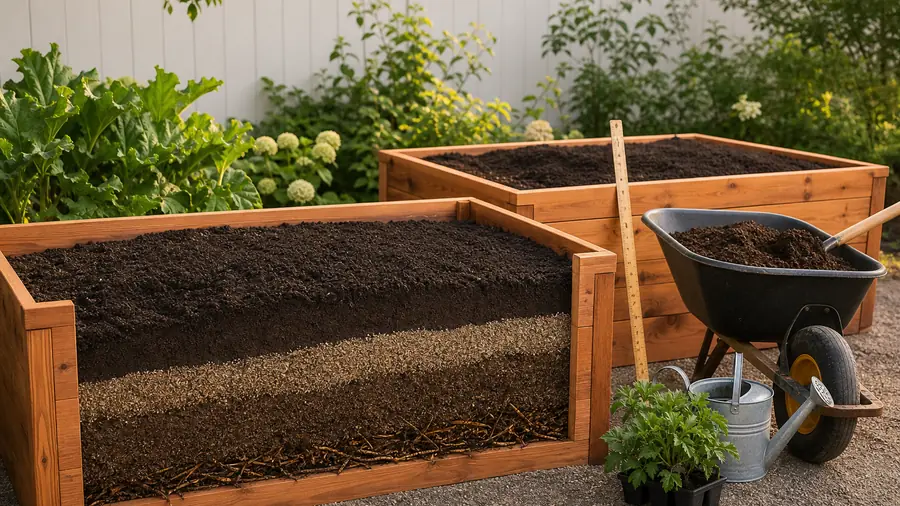
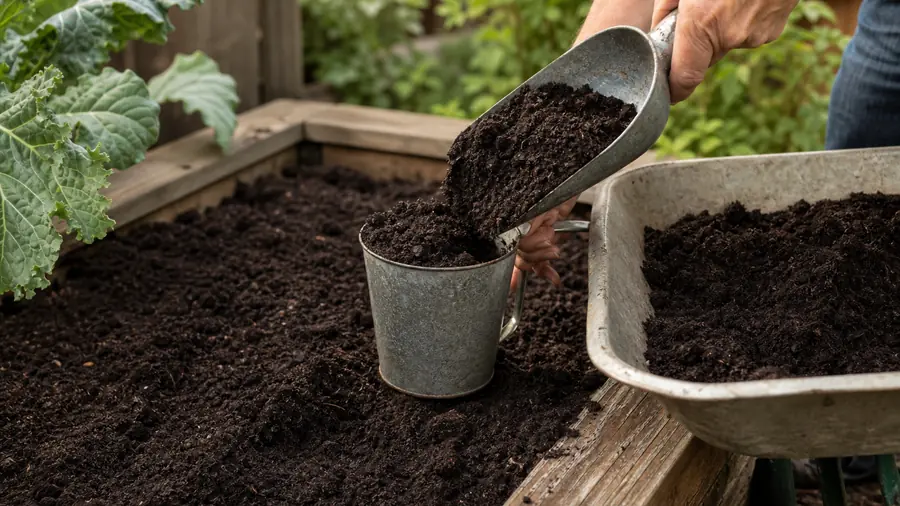
Measure inside the bed
Use the space soil will occupy. Subtract existing fill or use only the missing top-up depth.
Independent garden math Formulas and assumptions included
 GardenMeasureTry a calculator
Tool 02 / Soil
Measure soil for a garden bed, landscape area, or top-up layer. Compare whole bags with delivered bulk using your local prices.
Plan for about
1.63 yd³1.25 m³ after 10% allowance$240.00
$129.63
Bulk saves $110.37 with the prices you entered.
Enter the supplier's density to calculate weight.
Illustrative example from the weight guide: 1,944 lb per cubic yard, or 2,235.6 lb with the guide's +15% moisture example — not your product's weight.
Enter bag and bulk prices to find the break-even quantity.
Soil estimate: 1.63 cubic yards (1.25 cubic meters), 30 whole bags, bagged estimate $240.00, bulk delivered estimate $129.63.
Printed from GardenMeasure.
area × depth × quantity = volume; volume × allowance = order estimate
Bag counts round up. Bulk cost uses the exact calculated volume; ask your supplier about minimum orders and half-yard or whole-yard increments. Weight below uses only a density your supplier gives you. Without it, no weight is shown, because moisture and material density change it.
Know the boundary
Use the space soil will occupy. Subtract existing fill or use only the missing top-up depth.
Material and settling vary. The tool keeps raw volume visible and lets you decide the extra percentage.
Confirm bag volume, delivery fees, minimum bulk quantity, and order increments with the supplier.
Soil quantity guide
Multiply the bed's surface area by the depth of the empty space you need to fill. Convert that volume to the unit sold by your supplier, then round bags up to the next whole bag.
Content and source check completed July 28, 2026 GardenMeasure editorial method
How do you calculate soil volume?
Soil volume = area × fill depth × number of beds. For a rectangular bed, area is length × width. For a circular bed, area is π × radius². Keep every measurement in compatible units before multiplying.
The calculator is directly above this guide.The calculator finds the bed's area, multiplies it by fill depth, and repeats that volume for identical beds. Your chosen settling allowance is added afterward, so both raw volume and order volume remain visible.
A rectangle measuring 10 feet long and 8 feet wide has an area of 80 square feet. A 6-inch layer equals 0.5 feet, so the unadjusted volume is 80 × 0.5 = 40 cubic feet. Dividing by 27 gives about 1.48 cubic yards. A 10% allowance changes the order estimate to about 1.63 cubic yards.
That last percentage is not hidden inside the formula. Soil mixes, project conditions, compaction, and supplier increments differ, so the tool lets you choose the allowance instead of pretending one number suits every project.
| Bed shape | Area formula | Volume formula |
|---|---|---|
| Rectangle or square | length × width | length × width × depth |
| Circle | π × radius² | π × radius² × depth |
| Known area | entered square area | area × depth |
Measure the inside planting area and only the vertical space that still needs soil. Do not automatically use the full height of a raised-bed frame when existing soil, compost, roots, or another layer already occupies part of it.

Split an L-shaped or curved garden into smaller rectangles and circles, calculate each part, and add the results. This usually gives a more transparent estimate than forcing an awkward boundary into one oversized rectangle.
For a freeform edge, follow the field steps in How to Measure an Irregular Garden Bed, then enter the checked square footage through known area.
One cubic yard contains exactly 27 cubic feet. One cubic meter contains 1,000 liters, while one cubic yard equals about 0.7646 cubic meter or 764.6 liters.
GardenMeasure converts through a common base volume so the imperial and metric results describe the same physical space. The conversion constants follow the NIST Guide to the SI and NIST's volume tables. NIST defines the international foot as exactly 0.3048 meter; cubing that length gives the cubic-foot-to-cubic-meter relationship.
Keep area and depth in matching systems before doing the manual calculation. If your area is in square feet and depth is in inches, divide depth by 12 first. If area is in square meters and depth is in centimeters, divide depth by 100.
Compare the total project cost, not only the advertised unit price. Bagged soil needs whole-bag rounding; bulk soil may add delivery fees, minimum orders, and half-yard or whole-yard ordering rules.

The calculator multiplies bag price by the rounded-up bag count. It multiplies the exact adjusted volume by your bulk unit price and adds delivery. Before buying, replace that exact bulk result with the supplier's actual order increment. A calculated 1.63 cubic yards may need a 2-yard order if the yard only sells whole units.
Bulk wins only after the order is large enough to repay the delivery fee.
Break-even bags = delivery fee ÷ (price per bag − bag volume × bulk price per cubic yard), rounded up to whole bags. Break-even volume = break-even bags × bag volume. Below that volume, whole bags cost less. Above it, bulk delivered costs less. The calculator works this out live from your prices above.
| Example | Bag | Bulk price | Delivery | Break-even bags | Break-even volume | Check at break-even |
|---|---|---|---|---|---|---|
| 1 — this page's defaults | 1.5 cu ft bag, $8 | $55 / yd³ | $40 | 9 bags | 0.50 yd³ | 9 bags $72.00; bulk $67.50 |
| 2 — dearer bags, dearer delivery | 1.5 cu ft bag, $10 | $60 / yd³ | $75 | 12 bags | 0.67 yd³ | 12 bags $120.00; bulk $115.00 |
Supplier minimums, half-yard increments, taxes, and delivery zones are not in this sum. Confirm them with the supplier before ordering.
Topsoil generally refers to mineral soil, while bagged garden, raised-bed, and potting products can contain different blends. Choose the product for the site before calculating its volume.
The topsoil, garden soil, and compost comparison matches low spots, established beds, raised beds, lawns, and containers with the right starting material. It also lists the label, source, and supplier details to check.
Use the Raised Bed Soil Calculator when you buy separate components. This Soil Calculator remains the better choice for one complete blend used across a general garden area.
If compost is an amendment rather than the main fill, the compost topdressing and mixing guide explains when it belongs on the surface and when a pre-plant soil zone may be incorporated.
A custom allowance keeps the assumption visible. The correct extra amount depends on the blend, how loosely it arrives, how you place it, and whether organic components lose volume over time.
Enter zero when you want the pure geometric volume. Add a modest percentage only when your supplier, project experience, or material specification supports it. The raw result remains on screen so you can compare the mathematical volume with the shopping estimate.
An allowance is not a substitute for correct measuring. Adding 10% to an outside-frame measurement or the full frame height can simply make an already generous estimate larger.
Volume can be calculated from dimensions, but weight requires a reliable density for the exact material and its moisture condition. The calculator therefore shows weight only when you enter a supplier density, and shows no weight at all when the field is blank. A generic pounds-per-yard figure would create false precision.
The USDA Natural Resources Conservation Service treats bulk density and soil moisture as measured properties. Its educator material calculates dry bulk density from dry soil weight and core volume, while water content depends on the difference between moist and oven-dry weight.
Ask the seller for the material's current weight or density if you need to check trailer payload, vehicle limits, lifting safety, or structural loading. Those decisions should not rely on a universal topsoil-weight assumption.
The cubic-yard soil weight guide works one example through in full: at 72 pounds per cubic foot, one cubic yard weighs 27 × 72 = 1,944 pounds, and 1.5 cubic yards weigh 2,916 pounds. The same guide shows moisture adding 15 percent of dry mass in its example, taking 1,944 pounds to 2,235.6 pounds. Those are worked examples for one stated condition, not a weight for your soil. The calculator repeats the same two figures for your volume in the result above, labelled as an illustrative example.
A 12-by-4-foot raised bed filled to 10 inches needs about 40 cubic feet, or 1.48 cubic yards, before any allowance. The same volume is about 1.13 cubic meters or 1,133 liters.
If each bag contains 1.5 cubic feet, the adjusted 44 cubic feet requires 30 bags because 44 ÷ 1.5 = 29.33 and partial bags are not normally purchased. Enter the real bag volume and price printed by the seller to compare it with a delivered bulk quote.
One cubic yard contains exactly 27 cubic feet. A cube measuring 3 feet on each side has a volume of 3 × 3 × 3 = 27 cubic feet.
Divide 27 cubic feet by the volume printed on one bag, then round up. One cubic yard is 18 bags at 1.5 cubic feet each, or 14 bags at 2 cubic feet each because 13.5 bags must round up to 14.
Yes. Use the identical-areas field when every bed has the same length, width or radius, and fill depth. Calculate different bed sizes separately and add their adjusted volumes.
Only if the full internal height is empty and will be filled with the selected material. Otherwise, measure the missing space from the existing surface to your intended finish level.
The raw result does not. The order estimate includes only the percentage you enter in the settling-allowance field, keeping the adjustment explicit and editable.
The volume formula works for layers of many materials, but buying assumptions differ. Use the dedicated mulch calculator for mulch bag sizes, allowance, and cost, then return to the garden calculator collection for other project tools.
How this page connects
Start with the soil volume above, use the Mulch Calculator when planning a surface layer, open the Raised Bed Soil Calculator for multiple framed beds and a custom mix, and review our calculation methodology to see how formulas, assumptions, rounding, and gardening guidance are kept separate.
Last updated 11 November 2026