Different beds, one order
Add each unique size once and use quantity only for beds with the same inside dimensions and fill depth.
Independent garden math Formulas and assumptions included
 GardenMeasureTry a calculator
Tool 03 / Raised beds
Combine different raised-bed sizes, apply your own soil recipe, and turn each component into a checkable bag-and-cost list.
Example split only. Rename the components and enter the percentages from your soil plan or supplier.
100% totalCombined order volume
1.3 yd³1 m³ after 10% allowance21.1 ft³598 L
22 bags$88.00
10.6 ft³299 L
11 bags$66.00
3.5 ft³100 L
4 bags$36.00
Component bags round up separately, so their bag volumes can exceed the exact mix volume.
$192.00
Enter the supplier's density to calculate weight.
No verified density for this material is published on this site, so weight stays TBC until your supplier gives a density for this product and moisture condition.
Enter bag and bulk prices to find the break-even quantity.
Raised-bed soil estimate: 1.3 cubic yards (1 cubic meters) across 1 beds. Custom mix estimate $190.00; pre-blended estimate $192.00.
Printed from GardenMeasure.
sum(length × width × fill depth × quantity) × allowance = order volume; order volume × mix % = each component
Three honest controls
Add each unique size once and use quantity only for beds with the same inside dimensions and fill depth.
Rename all three components and enter the ratio from your local plan, soil test, extension advice, or supplier.
Component bags round up separately. The result explains why a custom shopping list may exceed the exact volume.
Raised-bed planning guide
Calculate each bed's inside volume, multiply identical beds by quantity, and add every group. Apply any justified order allowance, then split the adjusted total by your chosen soil-mix percentages.
Content and source check completed July 28, 2026 Geometry and rounding shown
How much soil does your raised bed need?
Total raised-bed soil = the sum of length × width × missing fill depth × quantity for every bed group. Multiply that total by your allowance, then multiply the adjusted volume by each component percentage.
The raised-bed calculator is directly above.Every rectangular bed uses length × width × fill depth. The calculator converts each group to one common volume, multiplies by its quantity, adds all groups, and only then applies the order allowance and custom mix.
For imperial measurements, depth entered in inches is divided by 12 before it is multiplied by length and width in feet. That produces cubic feet. Dividing cubic feet by 27 produces cubic yards. For metric measurements, depth in centimeters is divided by 100 before multiplication, producing cubic meters; one cubic meter equals 1,000 liters.
The conversion constants follow the NIST Guide to the SI. The tool calculates with full internal precision and rounds only the displayed values and final whole-bag quantities.
| Stage | Calculation | Why it matters |
|---|---|---|
| One bed | length × width × fill depth | Finds usable inside volume |
| Bed group | one-bed volume × quantity | Repeats only identical beds |
| Combined order | sum of groups × allowance | Keeps raw and adjusted totals separate |
| Mix component | adjusted volume × component % | Creates the component shopping target |
Put beds with matching inside dimensions and fill depth in one group, then create another group for every different size. This prevents an average measurement from hiding how much a taller or wider bed changes the total.
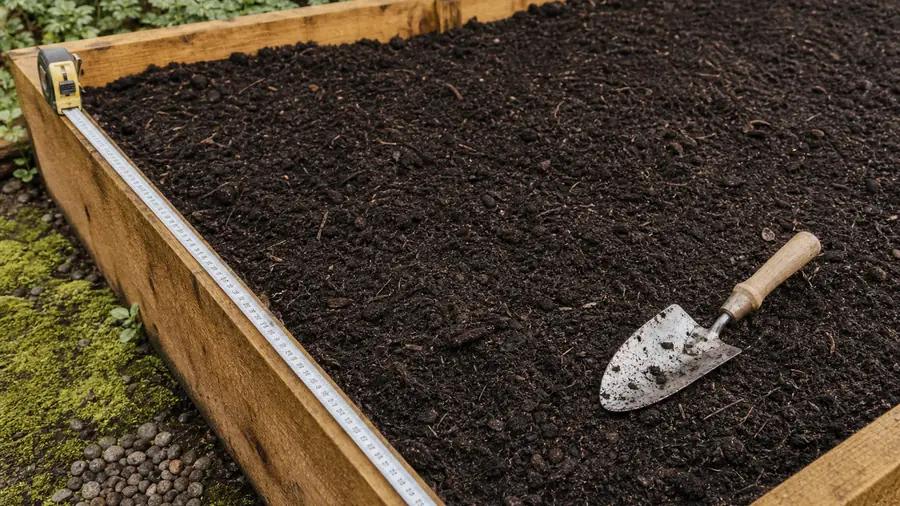
Measure inside the frame because timber, metal, masonry, and corner joints do not hold soil. Enter only the empty or missing fill depth. If a 24-inch-tall frame already contains 14 inches of safe, suitable fill and you are planning a 10-inch soil layer, use 10 inches—not the full frame height.
Quantity is useful for repeated modules: four identical 4-by-8-foot beds can be one group with quantity four. A separate 2-by-6-foot herb bed belongs in another group. The calculator totals both without forcing them into the same dimensions.
When boards bow or the ground is uneven, take more than one inside measurement and use a sensible working average. Record the numbers before shopping so a supplier can check your volume and delivery plan without relying on memory.
Enter a recipe supported by the site, named products, crop plan, soil test, local guidance, or supplier specification. The calculator does not choose a universal ratio.
The default 60/30/10 split is an editable demonstration, not a recommendation. You can rename “Base soil,” “Compost,” and “Aeration material” to match what you are actually buying. The three percentages must total 100% because they describe the entire adjusted order volume.
Use the raised-bed soil mix guide to compare extension examples, assess the bed base, inspect mineral soil and compost, and decide whether a third component has a defined job. Return here once you have selected the components and percentages.
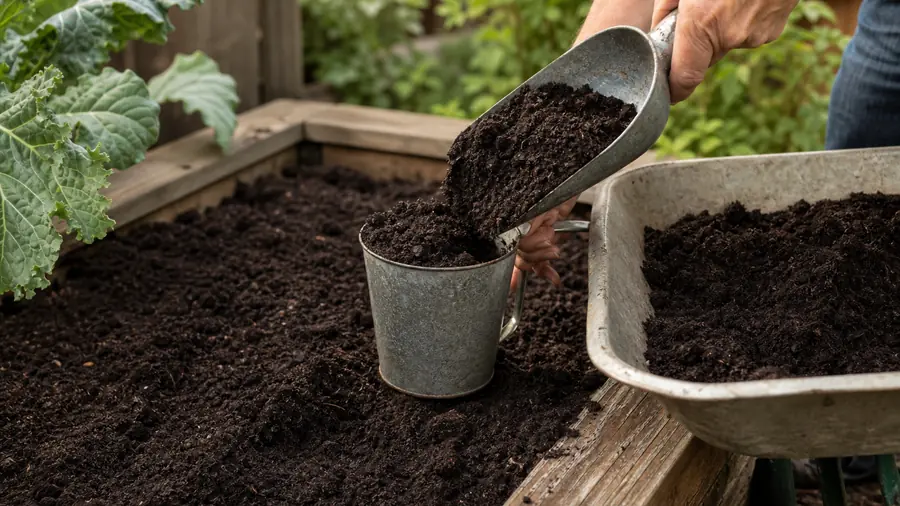
Each component receives its percentage of the adjusted volume. That component volume is divided by its own bag size, and the result rounds up to the next whole bag before cost is calculated.
Separate rounding is important. Suppose a recipe needs 10.2 bags of base soil, 5.1 bags of compost, and 1.7 bags of aeration material. The shopping list becomes 11, 6, and 2 bags. Those 19 physical bags contain more than the exact mix volume because three partial remainders were rounded independently.
Do not compare that 19-bag component total directly with a pre-blended bag count as though both bags were the same size. The tool shows a separate ready-mix alternative using the size and price you enter for one pre-blended product.

Compare the full cost and the suitability of the products, not only the number of bags. Separate components provide ratio control; ready-made mix reduces measuring and mixing work.
Prices in this calculator are local inputs, so the result does not claim one route is always cheaper. Component products may have different bag sizes, while ready-mix products can charge a premium for convenience. Bulk material may introduce delivery fees, minimum quantities, storage, and access requirements.
Bulk wins only after the order is large enough to repay the delivery fee.
Break-even bags = delivery fee ÷ (price per bag − bag volume × bulk price per cubic yard), rounded up to whole bags. Break-even volume = break-even bags × bag volume. Below that volume, whole bags cost less. Above it, bulk delivered costs less. The calculator works this out live from your prices above.
| Example | Bag | Bulk price | Delivery | Break-even bags | Break-even volume | Check at break-even |
|---|---|---|---|---|---|---|
| 1 — this page's defaults | 1.5 cu ft bag, $8 | $55 / yd³ | $40 | 9 bags | 0.50 yd³ | 9 bags $72.00; bulk $67.50 |
| 2 — two-cubic-foot bags | 2 cu ft bag, $10 | $60 / yd³ | $50 | 9 bags | 0.67 yd³ | 9 bags $90.00; bulk $90.00 |
Supplier minimums, half-yard increments, taxes, and delivery zones are not in this sum. Confirm them with the supplier before ordering.
A raised-bed mix has no single weight per cubic yard. Its components, moisture, and packing all change it.
This site publishes no verified weight per cubic yard for a raised-bed mix, so the calculator shows no weight until you enter a supplier density for this mix and moisture condition. The cubic-yard soil weight guide explains why one cubic yard has no single weight, and why a supplier figure or a loaded scale ticket is the only defensible input for a load.
Worked example with an example supplier figure: the default order is 1.30 cubic yards. At an example density of 1,800 lb per cubic yard, that is 1.30 × 1,800 = 2,347 lb, or 1.17 short tons. 1,800 is an example input, not a measured mix density.
Use an allowance only when the material, supplier, or your project experience justifies it. The calculator starts with an editable example and always displays the raw geometric volume beside the adjusted order volume.
Oregon State University Extension notes that newly filled beds can sink over time as compost in the mix continues to decompose. The amount is not universal, so GardenMeasure does not hide a fixed settling factor in the formula.
An allowance cannot correct a poor measurement. Measure the inside and use the missing depth first. Then ask the supplier whether the product is sold loose, screened, compacted, or in fixed order increments before deciding what extra margin is reasonable.
Use the raised-bed depth guide when you need to separate frame height, soil-chamber depth, and usable soil below the bed before measuring fill.
For an existing bed, the settled raised-bed top-up guide shows how to set a finish line, average several missing-depth readings, and avoid rebuying the original full fill.
One 4 × 8-foot bed at 12 inches deep plus two 6 × 3-foot beds at 10 inches deep need 62 cubic feet before allowance. A 10% allowance changes the combined order to 68.2 cubic feet, or about 2.53 cubic yards.
With a 60/30/10 example split, the adjusted targets are 40.92 cubic feet of base soil, 20.46 cubic feet of compost, and 6.82 cubic feet of aeration material. Each target must then be divided by that component's actual bag volume and rounded up separately.
At 12 inches deep, the inside volume is 4 × 8 × 1 = 32 cubic feet, equal to about 1.19 cubic yards or 906 liters before any order allowance.
Yes. Select “Add a different bed” for each unique length, width, or fill depth. Use quantity only when several beds in that group are identical.
Yes. Rename the third component if needed and set its percentage to zero. The three displayed percentage fields must still total 100%.
Each material rounds up independently to a whole bag. Three separately rounded remainders can create more purchased volume than one pre-blended product rounded only once.
It calculates the soil layer you enter. Measure from the top of any existing safe filler or soil to the intended finish level and use that missing depth.
Use the general Soil Calculator for a circle or known area. This tool focuses on combining rectangular bed groups and splitting a custom mix.
Related calculations
Use the Soil Calculator for a single circle or known area, the Mulch Calculator for the surface layer, and our calculation methodology to review units, assumptions, and rounding.
Last updated 11 November 2026