
Search for the best soil mix for raised beds and you will find several confident ratios. One guide favors two ingredients, another adds a drainage component, and a third uses a soilless blend. Those recipes are not necessarily mistakes. They may answer different sites, products, crops, and climates.
A useful plan starts with what is below the frame, what the local “topsoil” and compost actually contain, and what a soil test or trusted local source says. Then the recipe becomes an explicit project choice that can be measured, priced, and revised.
What should go into a raised-bed soil mix?
Use suitable mineral soil plus finished compost as the starting structure, then change the shares—or add a third component—only when the site, products, crop, or test results justify it. Do not fill a framed bed with compost alone, and do not assume a front-label product name proves what is inside.
Calculate your selected raised-bed mixStart with four facts, not a famous ratio
Identify the bed base, mineral-soil source, compost properties, and evidence behind any amendment before choosing percentages. Missing information is a reason to ask questions, not to add more ingredients.
First, inspect the base. A bottomless frame over usable garden soil is connected to a different root zone from a bed over compacted subsoil, a paved surface, or ground with a contamination concern. University of Maryland Extension organizes its raised-bed fill guidance into separate scenarios for exactly this reason.
Use the raised-bed depth guide to separate exterior height, actual soil depth, and usable soil below the frame before assigning component volumes.
Next, define the materials. Ask whether the mineral soil is native, imported, screened, or already blended. Ask what produced the compost, whether it is finished, and whether the supplier has relevant test results. Finally, record the planned crop and local guidance. A vegetable bed, a bed for acid-loving plants, and a dry ornamental planting need not share one specification.
Extension recipes differ because their scenarios differ
University guidance supports several defensible starting points. Read each percentage with its stated material and situation rather than voting for the most repeated number.
| Source | Published example | Boundary to preserve |
|---|---|---|
| Penn State Extension | 70% soil and 30% compost | Use good-quality materials from reputable sources |
| Oregon State Extension | Up to 25% compost with excavated soil for one fill method | Also describes bulk three-way, four-way, and specialty mixes |
| Utah State Extension | 30–50% well-composted organic matter when amending existing topsoil | Also offers an equal-parts soil, compost, and drainage-material option |
| Maryland Extension | No single ratio across all scenarios | Existing soil, compaction, hard surfaces, purchased fill, and testing change the plan |
The disagreement is useful. Penn State provides a simple soil and compost recommendation. Oregon State ties a lower compost share to excavated soil and also lists commercial blends. Utah State gives alternatives that depend on whether existing topsoil is being amended or a new three-part mix is being built. Maryland starts with the site rather than a fixed formula.
Treat a ratio as a named assumption in your project notes. Record the source and date, the materials to which it applies, and why it fits your bed. That note is more useful next season than a recipe remembered only as “the standard mix.”
Choose mineral soil for structure and a known base
The mineral component should provide durable soil volume and a workable texture without introducing an avoidable contaminant, weed, salt, or drainage problem.
“Topsoil” is not a complete specification. For a bulk product, ask where it came from, whether it was screened, which particle sizes remain, and whether compost or sand is already included. Request a sample from the same material you would receive, if the supplier offers one. A dark appearance alone does not reveal texture, nutrient balance, or origin.
If safe native soil was excavated while the bed was installed, Oregon State says it can be mixed with compost and returned to the bed. If the existing soil is compacted, Maryland describes loosening it and blending the interface rather than leaving an abrupt layer. A bed built on pavement needs drainage and a complete imported growing layer; it cannot rely on soil below the frame.
Use the topsoil, garden soil, and compost comparison when supplier names are unclear. The goal is to identify the actual mineral base before assigning it a percentage.
Choose finished compost by properties, not color
Compost belongs in the mix as a measured organic amendment. Its feedstocks, maturity, salts, nutrients, screening, and intended use matter more than whether it looks uniformly dark.
Oregon State explicitly advises against filling raised beds with compost alone because compost lacks the mineral component of earthen soil and planting mixes. The source also notes that new beds can settle as compost continues to decompose. This supports a mixed fill and a realistic expectation of later maintenance; it does not supply one settling allowance for every product.
Ask a seller about feedstocks, processing, maturity, soluble-salt data, and recommended uses. Manure-based compost, yard-material compost, and mixed commercial compost are not interchangeable simply because all are sold by the cubic foot or yard. If you already have a soil-test recommendation for compost, preserve that application instead of adding another share by habit.
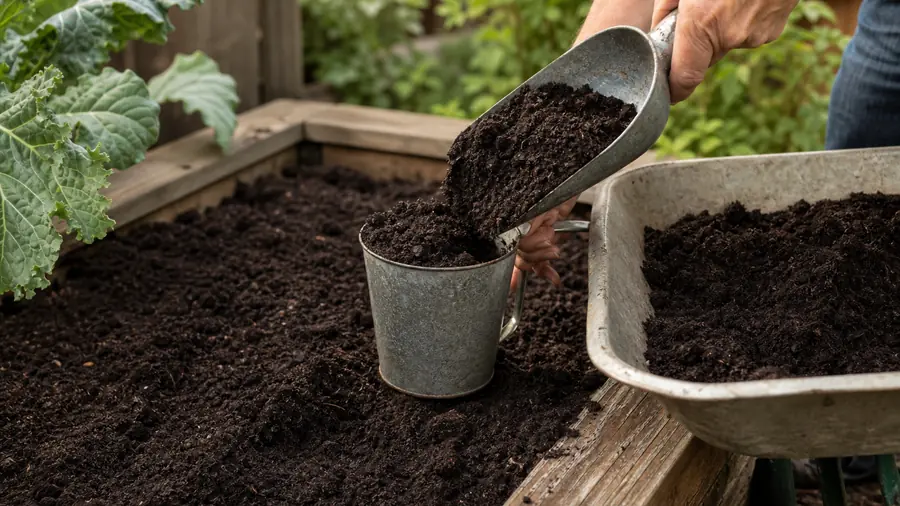
The Compost Calculator handles a standalone measured compost application. Use the raised-bed calculator when compost is one percentage of a complete new mix.
Add a third component only for a defined function
A drainage or water-holding ingredient is optional, not an automatic ten-percent slot. Add one when its properties correct a documented weakness in the soil-and-compost blend.
Utah State includes coarse sand, vermiculite, pumice, or perlite as possible drainage materials in one equal-parts blend. That is an example, not permission to substitute any sand into any soil. Particle size and the proportions of the full mix affect the result. Confirm the material and quantity with local guidance or a supplier who can describe the finished blend.
Before buying a third component, ask a direct question: which measured property is it meant to change? If the answer is only “raised beds always need it,” return to the base soil, compost, site drainage, and crop. A simpler two-component mix with known properties can be more defensible than a complicated recipe built from generic labels.
The same bed produces different component orders
Ratio choice changes the shopping list even when bed volume stays fixed. Compare component quantities as well as the total fill.
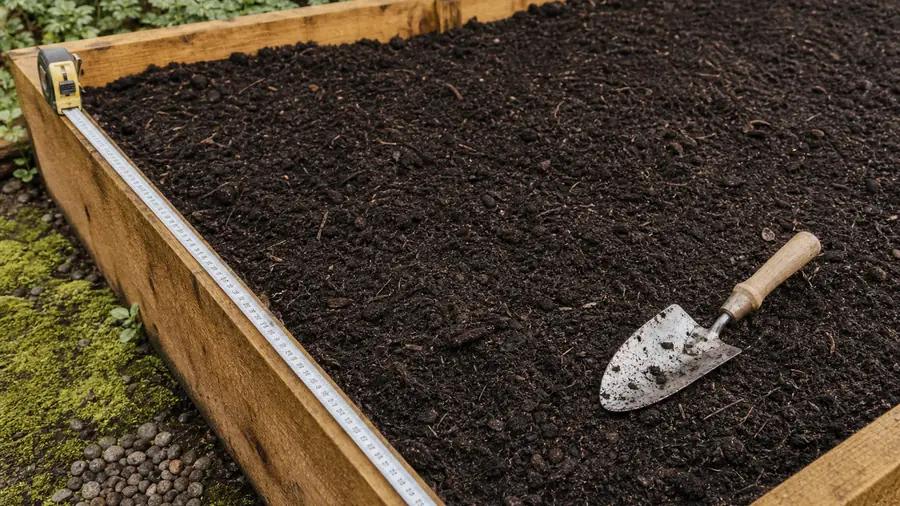
Consider a 4-foot by 8-foot bed with 12 inches of fill to add. Its measured volume is 32 cubic feet before any justified allowance. Following the Penn State 70/30 example produces these targets:
32 ft³ × 70% = 22.4 ft³ soil; 32 ft³ × 30% = 9.6 ft³ compost
If the excavated-soil scenario and materials support Oregon State's “up to 25% compost” example, selecting 25 percent produces a different list:
32 ft³ × 75% = 24 ft³ soil; 32 ft³ × 25% = 8 ft³ compost
Neither calculation proves which recipe fits the site. It shows why the decision must come before ordering. Enter the selected percentages in the Raised Bed Soil Calculator to combine multiple bed sizes, apply product-specific bag volumes, and compare a custom mix with a ready-made product.
Use a soil test to prevent unnecessary amendments
Test the material that plants will grow in when existing soil, repeated compost use, unusual growth, salinity, pH, or contamination is a concern.
University of Minnesota Extension explains that a laboratory soil test can report estimated texture, pH, organic matter, phosphorus, and potassium. Optional tests may cover soluble salts, lead, and trace elements. For established raised beds, its sampling guidance says to collect from the beds rather than the paths between them.
A routine fertility test does not automatically answer every contamination question. Tell the laboratory what you plan to grow, describe the site history, and ask which analysis is appropriate. Follow the lab's sampling and interpretation instructions. The purpose is to avoid guessing at lime, fertilizer, compost, or other amendments after the fill has already been purchased.
Inspect a supplier blend before accepting its recipe
A ready-made raised-bed mix can save labor, but its name does not replace a component list, intended-use statement, sample, or test information.
- Ask for the mineral soil, compost, and other components by name.
- Request percentages or the supplier's documented blend range.
- Confirm source, screening, visible debris, and consistency.
- Ask which crops and installations the product is intended for.
- Request relevant pH, nutrient, salt, maturity, or contaminant data.
- Confirm whether the quote uses bags, loose cubic yards, or another unit.
- Record delivery minimums, access needs, tax, fees, and order rounding.
Keep the specification and quote with the calculation. If the delivered load differs from the sample or written description, you can discuss a concrete discrepancy before filling every bed.
Raised-bed soil mix questions
Is 60/30/10 the best raised-bed soil mix?
No universal evidence makes that ratio best for every bed. It can be a calculator demonstration or a locally supported recipe, but the site, named materials, crop, supplier information, and test results must support it.
Can I fill a raised bed with compost only?
Oregon State Extension advises against compost-only fill. Use a suitable soil or planting mix with a mineral component, and keep compost at a share justified by the materials and application.
Do all raised-bed mixes need sand or perlite?
No. A third component should serve a defined drainage, aeration, or water-management function in the complete blend. Verify the product and proportion instead of adding a generic amendment automatically.
Should I mix new soil into the ground below the bed?
For a bottomless bed over usable ground, extension sources advise breaking up the surface and blending the interface to avoid an abrupt layer. A hard surface or contamination concern requires a different plan.
Can I use a bag labeled garden soil?
Only after its stated ingredients and intended use fit the raised bed. Compare its actual contents, volume, and test information with the specification you selected.
Sources and decision boundary
- University of Maryland Extension: Soil to Fill Raised Beds, for site scenarios, soil testing, purchased material, and bed-base decisions.
- Oregon State University Extension: How to Use Compost in Gardens and Landscapes, for the up-to-25-percent example, bulk blends, settling, and compost-only warning.
- Penn State Extension: Soil Health in Raised Beds, for the 70/30 soil-and-compost recommendation and source-quality reminder.
- Utah State University Extension: Raised Bed Gardening, for compost-enriched soil and alternative component ranges.
- University of Minnesota Extension: Soil Testing for Lawns and Gardens, for test scope and raised-bed sampling guidance.
Change log: Published July 28, 2026 with a four-input decision diagram, extension-source comparison, two checked component examples, and a supplier specification checklist.
Last updated 11 November 2026