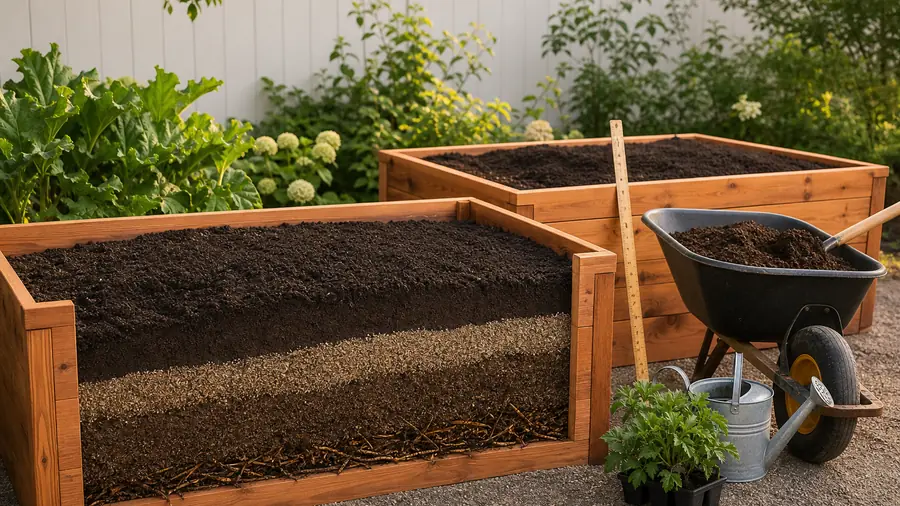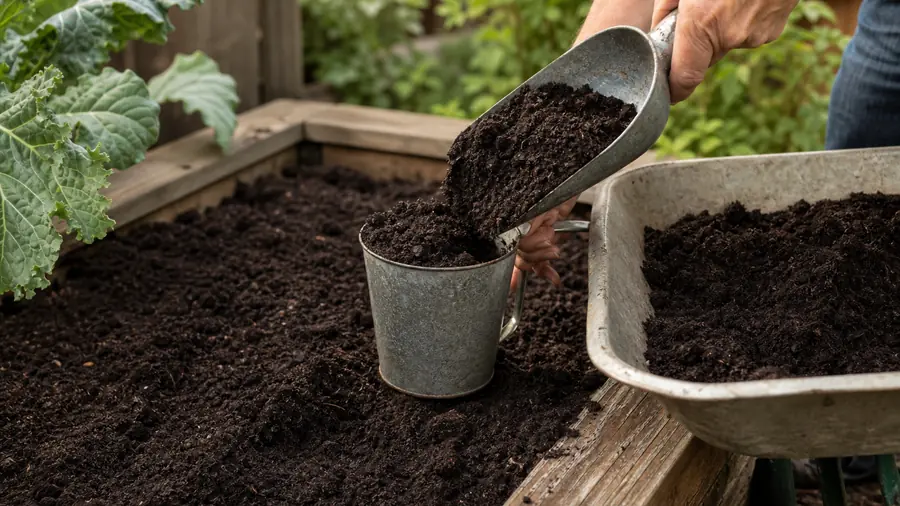

Topsoil, garden soil, and compost can sit beside each other at a store while serving different jobs. Topsoil usually supplies mineral soil and volume. Compost adds stable organic material to soil. A bag or supplier product called garden soil may combine several ingredients, so its name does not tell you the full mix.
Start with the site problem. A low spot needs fill. An established bed may need a measured amendment after a soil test. A raised bed needs a suitable soil mix, and a pot needs container growing media. Once you choose the material and application, GardenMeasure can calculate the quantity.
Should you use topsoil, garden soil, or compost?
Use verified topsoil when you need mineral volume or grade, compost when you need a measured amendment, and garden soil only after its ingredients match the planting job. A framed raised bed usually needs a soil mix rather than either straight topsoil or compost. Choose potting mix for containers.
Calculate a chosen material volumeThe three materials do different jobs
Match the purchase to the site change you need. A product that adds grade is not automatically the right amendment, and an amendment does not replace the mineral volume in a new bed.
| Project | Likely starting point | Check before buying |
|---|---|---|
| Fill a low spot or rebuild grade | Topsoil suited to grading or lawn repair | Source, texture, stones, screening, and finished level |
| Create a new in-ground planting bed | Existing soil plus a tested amendment plan | Native soil, drainage, pH, nutrients, and compost quality |
| Refresh an established bed | Measured compost application when appropriate | Past additions, soil test, salts, and target depth |
| Fill a framed raised bed | A documented soil mix or supplier blend | Mineral-soil share, compost share, drainage, and settling |
| Repair or establish a lawn area | Topsoil for lost volume; compost for a separate amendment job | Grade, seedbed, existing soil, and local turf guidance |
| Fill pots or planters | Container growing media or potting mix | Plant needs, drainage, ingredients, and included fertilizer |
This table narrows the first conversation with a supplier. It does not certify a particular bag or truckload. Two products carrying the same front-label name can contain different materials and suit different projects.
Let the project lead the product label
Describe the job in physical terms: replace missing depth, improve existing soil, create a planting blend, or fill a container. Then ask the seller which documented product meets that need.
Retail and bulk names overlap. “Garden soil,” “planting mix,” “three-way mix,” and “topsoil blend” can describe combinations of mineral soil, compost, bark, sand, peat, or other ingredients. University of Maryland Extension notes that commercial products advertised under several soil and planting names vary in composition and quality. Read the label or request the supplier specification instead of assigning a recipe to the name.
Topsoil supplies mineral volume, but quality varies
Topsoil is the first material to investigate when construction, erosion, excavation, or settling has removed mineral soil. Its name does not guarantee texture, organic matter, fertility, or freedom from contaminants.
The University of Connecticut Home Garden Education Office advises buyers to ask where topsoil came from, whether it was screened, which job it was prepared for, and whether compost is already included. UConn also notes that Connecticut has no state-run topsoil grading or certification system. That rule is state-specific, so ask what standards apply where you buy.
A 12-foot by 8-foot low spot filled to a measured 2-inch depth needs 16 cubic feet before allowance or supplier rounding:
12 ft × 8 ft × (2 ÷ 12 ft) = 16 ft³ = 0.59 yd³
Enter that geometry in the Topsoil Calculator. The calculator can compare a bag label with a bulk quote, but the supplier must confirm the material and valid order increment. Use the irregular garden bed guide when the repair area is not rectangular.
Compost amends soil; it does not replace every soil job
Compost adds processed organic material to soil. Choose the amount for the application and existing soil rather than using compost as a default fill material.
The U.S. Environmental Protection Agency defines compost as a biologically stable soil amendment produced through managed aerobic decomposition. That definition separates finished compost from raw or partly decomposed material.
Oregon State University Extension gives a 3-to-4-inch compost application for a new garden bed, with other amendments guided by a soil test. At the lower end of that sourced range, a 12-foot by 8-foot bed needs 24 cubic feet:
12 ft × 8 ft × (3 ÷ 12 ft) = 24 ft³ = 0.89 yd³
Treat 3 inches as this example's selected application, not a setting for every bed. Use the Compost Calculator after a soil test, extension recommendation, or product direction gives you a depth. OSU also warns that excess compost can add salts or move surplus nutrients beyond the root zone.
Finished compost varies with feedstocks and process. Ask about source materials, maturity, screening, test results, and intended uses. A dark color alone cannot confirm that the product is mature or suited to vegetables, lawns, or a sensitive planting.
Garden soil is useful only when the contents fit the job
Treat garden soil as a seller's product description. It can be convenient when the documented blend matches an in-ground bed, but the name cannot replace ingredient and use information.
Compare the product with what the project already has. A new bed over poor construction fill may need mineral volume and organic matter. An established bed with suitable structure may need no new soil at all. Adding a blended product each year can raise the grade or repeat amendments the soil does not need.
Ask for percentages or a clear component list when possible. Check whether the price covers loose cubic yards, bags, delivery, minimums, and taxes. Use the Soil Calculator for a complete blended product. If you will buy separate components, the Raised Bed Soil Calculator keeps the user-selected percentages visible.
Raised beds need a soil mix, not a universal recipe
A framed raised bed needs enough mineral soil for structure plus organic matter suited to the crop and site. Bed depth, native soil, drainage, and product properties can change the mix.
Penn State Extension gives 70 percent soil and 30 percent compost as one raised-bed recommendation. Oregon State advises using a soil mix and not filling a framed bed with compost alone. These sources support a soil-and-compost approach; they do not make every local product equivalent or remove the need to inspect the site.
Enter 70 and 30 in the raised-bed calculator when you choose to follow that Penn State example. Change the components when a local extension recommendation, supplier analysis, crop plan, or soil test supports another mix. Keep the selected recipe beside the quantity so the shopping list shows an assumption rather than a hidden default.
The raised-bed soil mix guide compares several extension examples and provides a site, material, and supplier checklist before you choose percentages.
Containers need growing media selected for pots
Choose a container growing medium or potting mix for ordinary pots and planters. Dense in-ground soil can restrict drainage and air in the limited root space.
University of Maryland Extension explains that garden soil is too dense for most containers and that commercial growing-media labels vary. Read the ingredient panel, drainage claims, and fertilizer information for the plant and container you will use.
For the container-specific decision, use the potting mix versus garden soil guide. It separates the confined root-zone requirements from broad material names and includes a bag-label audit.
Calculate liters, quarts, cubic feet, and whole bags with the Potting Soil Calculator. Do not move a garden-soil quantity into that shopping list until the product label states that it suits containers.
Inspect the product and quote before ordering
Record what the seller means by each product name. A reproducible order includes the source, components, intended use, billed unit, and delivery terms.
- Describe the project and the physical change you need.
- Ask where the mineral soil or compost feedstocks came from.
- Request ingredient percentages, screening size, and available test results.
- Check odor, visible debris, texture, moisture, and sample consistency.
- Confirm whether the product suits lawns, food gardens, raised beds, or containers.
- Record bag volume or bulk unit, minimum order, delivery, tax, and fees.
- Ask about contamination controls when past land use creates a concern.
Keep the supplier description with your measurement. If the delivered product does not match the sample or written specification, those records give you a clear basis for a conversation before spreading the load.
Topsoil, garden soil, and compost questions
Can compost replace topsoil in a new raised bed?
Extension guidance supports a soil mix rather than compost alone. Compost supplies organic material, while mineral soil contributes weight and structure. Choose a documented blend for the bed and site.
Is bagged garden soil the same as bulk garden soil?
The names can overlap, but the contents and units can differ. Compare the bag ingredient panel with the bulk supplier specification, then calculate each option from its stated volume.
Should a lawn low spot receive compost or topsoil?
A depression that needs grade restored calls for suitable mineral fill. Compost serves a separate amendment or topdressing purpose. Confirm the turf repair method and finished grade with local guidance.
Does screened topsoil mean tested topsoil?
No. Screening describes particle separation, not nutrient, salt, pH, pathogen, or contaminant testing. Ask which tests the supplier performed and request the results that matter for your project.
Sources and decision boundary
- University of Connecticut: What to Know Before You Buy Topsoil, for source, quality, testing, and intended-use checks.
- Oregon State University Extension: How to Use Compost in Gardens and Landscapes, for compost use, quality, and excess-application cautions.
- U.S. EPA: Composting, for the compost definition and process boundary.
- Penn State Extension: Soil Health in Raised Beds, for the clearly labeled 70/30 soil-and-compost example.
- University of Maryland Extension: Growing Media for Containers, for container-media selection and label variability.
Change log: Published July 28, 2026 with a project decision table, two checked quantity examples, an original choice diagram, and a supplier inspection checklist.
Last updated 11 November 2026