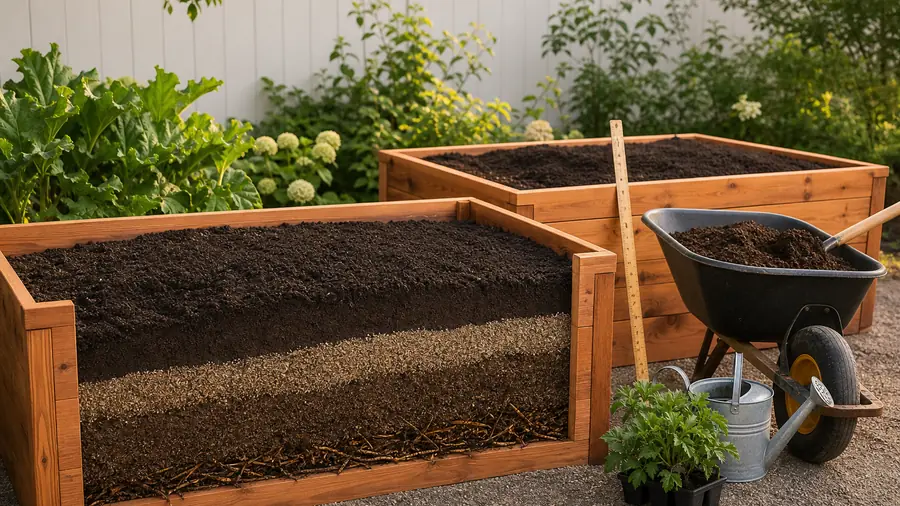

Use a growing medium labeled for containers in ordinary pots and planters. Garden soil belongs in the ground unless a reliable product label or local Extension recommendation describes a specific container use.
A pot gives roots a small chamber with one controlled drainage path. The medium must hold useful water while leaving air-filled pores after drainage. Dense mineral soil can lose that balance when a container wall confines it.
Should you use potting mix or garden soil in containers?
Potting mix is the usual choice for containers because producers select its components for a restricted root zone. Garden soil is made for in-ground use and may become dense, waterlogged, or poorly aerated in a pot. Read the use statement, ingredients, fertilizer note, and plant-specific directions on the bag rather than trusting the product name alone.
Measure the container mix quantityA container changes how the growing material must work
Roots in a pot cannot move around a dense patch or search a wider soil profile for air and water.
University of Maryland Extension explains that container media supplies nutrients, air, water, room for roots, and physical support. Roots and irrigation water use the spaces between particles. When excess water cannot drain, fresh air cannot return to those spaces.
Rutgers Cooperative Extension describes the same physical constraint in nursery production: the available volume per plant is limited, and physical properties become difficult to change after filling. Its fact sheet identifies water holding, aeration, drainage, permeability, and weight as separate media characteristics. One word on the front of a bag cannot report all of them.
An in-ground bed behaves differently. Roots can extend sideways and downward, while water moves into the surrounding profile. Garden soil can be useful there because it joins an existing body of mineral soil. Confining that same material inside a pot changes the drainage boundary without changing the particles.
Garden soil and potting mix are sold for different jobs
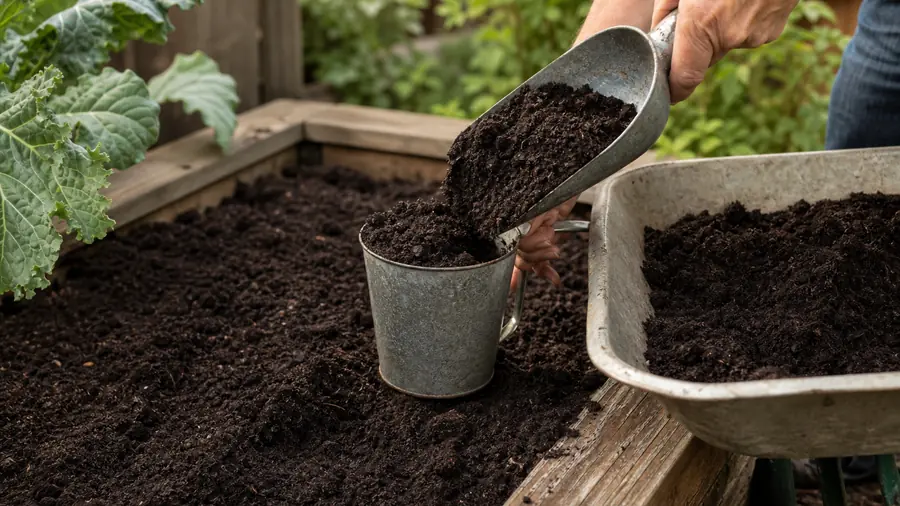
Choose garden soil for an in-ground improvement job and container mix for a freestanding pot, window box, hanging basket, or planter.
| Check | Container mix | Garden soil |
|---|---|---|
| Primary setting | Confined pots and planters | Existing in-ground soil |
| Physical priority | Air and water balance in limited volume | Fit with the surrounding soil profile |
| Typical label direction | Use alone in named container types | Mix into or spread over an in-ground area |
| Quantity tool | Container geometry and usable capacity | Surface area multiplied by layer or fill depth |
Retail terminology varies. A bag called “potting soil” may contain little or no mineral soil, while another product may combine several organic and mineral components. University of Maryland Extension notes that products sold as topsoil, planting soil, planting mix, or potting soil vary in composition and quality.
The use statement carries more weight than the large product name. Look for the exact setting: indoor containers, outdoor containers, raised beds, or in-ground planting. A product promoted for two settings still needs directions that explain how to use it in each one.
If your project is an open bed, compare topsoil, garden soil, and compost in the broader material-choice guide. Use the Soil Calculator for its area and depth. Those pages own in-ground choice and quantity; this guide stays with containers.
Read five parts of the bag before buying it
Check intended use, ingredients, included fertilizer, wetting treatment, and printed volume.
- Intended use: confirm that your pot type and indoor or outdoor setting appear in the directions.
- Ingredients: note the listed components instead of assuming all container mixes share one recipe.
- Added fertilizer: record whether the bag includes nutrients and how long its label says they last.
- Moisture treatment: check for a wetting agent or water-retaining treatment and match it to the plant directions.
- Net volume: compare liters, cubic feet, or dry quarts; do not use package weight as container volume.
University of New Hampshire Extension lists peat or coir, bark, perlite, vermiculite, sand, nutrients, and limestone among ingredients that may appear in mixes. The combinations vary. It also warns that general mixes can hold too much moisture for some cacti, succulents, and orchids, which is why plant context belongs beside the container decision.
An “organic” claim does not tell you the pore structure, drainage after watering, or fertilizer content. A light bag does not prove that the medium suits your plant. If the label omits a clear container use or ingredient list, ask the manufacturer or choose a product with enough information to make the decision.
Choose the plant category before choosing a specialty mix
Start with the plant label or a current Extension recommendation, then select a medium made for those water and air needs.
General container mixes cover many annual flowers and vegetables. Plants with unusual roots or moisture requirements may need a product labeled for their category. Orchid media may use coarse bark; succulent and cactus mixes often emphasize faster drainage. Seed-starting mix serves small cells and early roots rather than a mature patio container.
Container size and material also change management. A small pot holds less water than a large one. Porous and nonporous walls lose water differently, while sun and wind affect the rate again. These variables do not create one reliable homemade percentage for every project.
Avoid improving an unidentified dense product by adding a guessed scoop of perlite or compost. Mixing components changes several physical properties together, and a hand squeeze cannot confirm the air space left after irrigation. Use a published recipe for the plant and setting or buy a documented mix.
Measure volume only after selecting the right material
Container dimensions tell you how much to buy; they cannot tell you which growing medium belongs in the pot.
Suppose three identical planters each have 16 liters of usable capacity. Their combined geometric volume is 48 liters. That number stays 48 liters whether a bag contains container mix or garden soil, but only the suitable product belongs on the container shopping list.
Enter each shape and quantity in the Potting Soil Calculator. Set the planned fill level, account for any measured displacement, add an allowance that fits the job, and enter the bag's printed volume. NIST's exact conversion makes 48 liters about 1.70 cubic feet before those adjustments and whole-bag rounding.
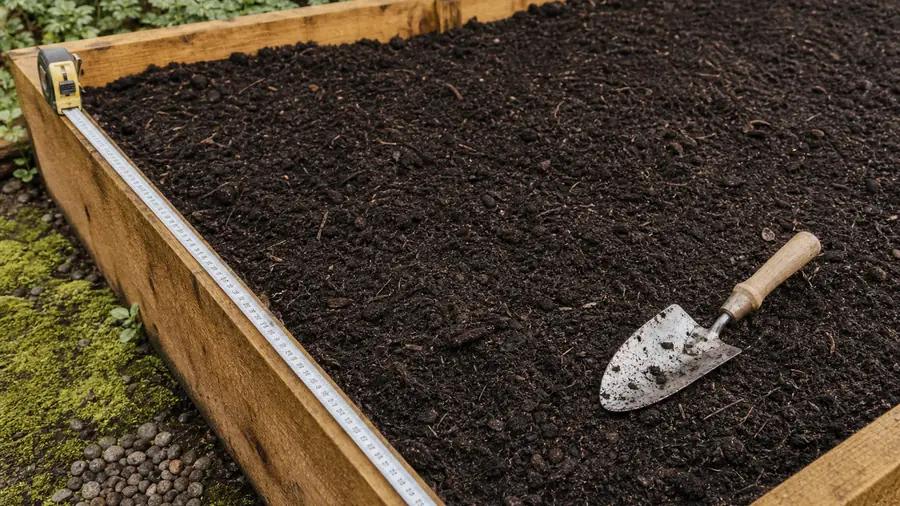
Measure tapered interiors instead of treating them as cylinders. The tapered-pot measuring guide marks the inside top, inside base, and usable vertical height. Repeat only identical containers; a shared retail size does not guarantee shared capacity.
Correct the purchase without inventing a rescue recipe
Return or redirect an unopened in-ground product; assess a planted pot before disturbing its roots.
If the bag is unopened, read the return terms or save it for the in-ground project named on its label. Recalculate the containers with a product intended for them. Keeping the two jobs separate preserves the volume record and avoids turning a price saving into an undocumented mix.
If the container is already planted, check whether water exits the drainage opening and whether the plant shows a problem. Do not diagnose every wilted leaf as dense soil: watering, temperature, root damage, pests, and disease can produce overlapping symptoms. Ask a local Extension service about the plant and conditions before repotting.
When repotting is recommended, choose a suitable fresh medium and a container with an open drainage path. Do not place rocks in the bottom as a substitute for selecting a medium that manages air and water throughout the root zone.
Potting mix and garden soil questions
Can I use garden soil in pots?
Use it only when a reliable label or relevant Extension recommendation gives a specific container method. Ordinary garden soil can become too dense for air and water movement in a confined pot.
Are potting soil and potting mix the same?
Stores often use the names interchangeably. Read the ingredients and use directions because the name does not guarantee one composition.
Can I mix garden soil with potting mix?
Do not assume one ratio works for every plant and container. Follow a relevant published recipe or product direction that accounts for the finished mix, not just one ingredient.
Does potting mix contain fertilizer?
Some products include fertilizer and some do not. The label should state what was added and provide directions.
Sources and decision boundary
- University of Maryland Extension: Growing Media for Containers, for media functions, garden-soil density, product variability, and container use.
- University of New Hampshire Extension: What Is the Best Soil for Potted Plants?, for air-space, ingredient, and plant-category guidance.
- Rutgers Cooperative Extension: Fundamentals of Container Media Management, Part I, for the restricted root-zone and physical-property boundary.
- NIST Guide to the SI, Appendix B, for the liter and cubic-foot conversion.
Change log: Published July 28, 2026 with an original root-zone cross-section, bag-label audit, same-volume example, and correction workflow.
Last updated 11 November 2026