
A tapered pot holds less mix than a straight cylinder with the same top diameter and height. Measuring only the rim therefore inflates the order. Thick walls, a raised base, a reservoir, and the empty watering space below the rim can reduce usable capacity again.
Measure the chamber the mix will occupy: top inside size, bottom inside size, and vertical usable height. Keep all three in the same unit.
How do you calculate the volume of a tapered pot?
For a round tapered pot, measure the inside diameter at the planned soil surface, the inside diameter near the usable base, and the vertical distance between those two levels. Use the truncated-cone formula or enter those measurements in the Potting Soil Calculator. A tapered rectangular planter needs top and bottom inside length and width instead.
Calculate the measured potMeasure the space that will actually hold mix
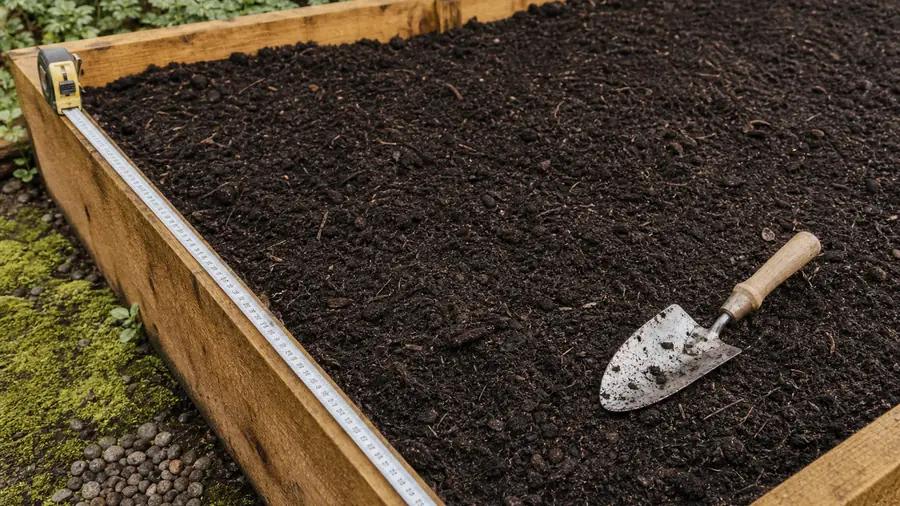
Put the tape inside the pot and set both measurement levels at the top and bottom of the usable soil chamber.
The USDA Risk Management Agency's current nursery handbook classifies container sizes on an actual-volume basis. That makes capacity, rather than a pot's retail size name, the useful reference. Taking measurements inside the usable chamber keeps the wall, lip, decorative shell, and hollow molded features out of that volume.
Set the top measurement at the planned mix surface, not automatically at the rim. Set the bottom measurement where usable mix begins, above any false floor or reservoir. Measure height vertically through the center. The sloping side length is not the height used by either formula.
A rigid ruler or inside caliper is easier to place at a narrow base than a loose tape. Take the bottom reading in two directions and repeat it before writing the value down. If the planted pot blocks access to the base, do not infer a precise diameter from the outside wall; use a manufacturer drawing or mark the result as an estimate until the container is empty.
Round and rectangular tapers use different inputs
A circular opening uses diameters; a rectangular opening needs length and width at both levels.
| Shape | Top | Bottom | Height |
|---|---|---|---|
| Round taper | inside diameter D₁ | inside diameter D₂ | vertical h |
| Square taper | inside side s₁ | inside side s₂ | vertical h |
| Rectangular taper | inside L₁ × W₁ | inside L₂ × W₂ | vertical h |
Check the opening from two directions before calling it round. An oval decorative pot can use two perpendicular diameters at the top and bottom, but that becomes an approximation. Deep fluting, bulging sides, an inward shoulder, or a curved bowl profile also departs from a straight-sided frustum.
When the walls are complex, divide the interior into shorter sections and total them, use a reliable manufacturer capacity, or measure water in an empty watertight pot that is safe to lift. Water testing is unsuitable for porous, installed, very heavy, or drainage-open containers unless the openings can be safely sealed.
The round-pot formula uses both inside diameters
Round tapered volume is πh(D₁² + D₁D₂ + D₂²) ÷ 12.
D₁ is the top inside diameter, D₂ is the bottom inside diameter, and h is usable vertical height. The result is cubic inches when every input is inches, or cubic centimeters when every input is centimeters. Do not mix the two systems inside one formula.
A 14-inch top diameter, 10-inch bottom diameter, and 12-inch height gives π × 12 × (14² + 14 × 10 + 10²) ÷ 12. That equals about 1,369.7 cubic inches. Using NIST's exact conversion of 0.016387064 liter per cubic inch, the geometric capacity is about 22.45 liters.
Treating the same pot as a 14-inch cylinder gives about 1,847.3 cubic inches, or 30.27 liters. That is about 7.82 liters and 34.9 percent higher than the tapered result. The comparison is specific to these dimensions; taper error changes with the relationship between top and bottom diameter.
A tapered rectangular planter uses its two end areas
Find top area A₁ and bottom area A₂, then calculate h(A₁ + A₂ + √(A₁A₂)) ÷ 3.
A₁ is top inside length multiplied by top inside width. A₂ is the same calculation at the usable base. This prismoidal formula fits a rectangular planter whose side faces taper evenly between similar, aligned rectangles.
Suppose the top measures 20 by 10 inches, the base measures 16 by 6 inches, and usable height is 8 inches. A₁ is 200 square inches, A₂ is 96 square inches, and √(200 × 96) is about 138.56. The volume is about 1,158.8 cubic inches, or 18.99 liters.
GardenMeasure's current rectangular calculator option assumes parallel walls. For a strongly tapered rectangular planter, calculate the prismoidal volume manually and enter 18.99 liters in known-volume mode. Do not enter only the large top length and width as a straight box.
Long containers add liners, reservoirs, rounded ends, and repeated units to the same problem. Use the window-box and trough measurement guide when those features determine the usable chamber.
Headspace and inserts change the measurement levels
Choose the soil surface and chamber base before placing the tape.
Headspace is the empty distance reserved for watering. It is not a universal percentage because pot shape, plant placement, watering method, and rim design vary. Measure down to the planned surface, or measure full geometry and use the calculator's fill-level control. Do not subtract the same space both ways.
A self-watering pot may have a reservoir, platform, and wicking columns. Exclude the reservoir from mix height, but include any chamber that actually receives mix. A tall decorative planter with a supported insert needs only the insert's capacity, not the outer shell.
Drainage holes remove negligible geometric volume, but rocks or a thick filler layer remove root space. Do not invent a routine drainage deduction. Record any deliberate solid insert or layer and measure from its upper surface.
Repeat only pots that share the same inside geometry
Measure one pot from each identical set, then give that set its own quantity.
Four round pots matching the 22.45-liter example have 89.8 liters of geometric capacity. Different molds, rim thicknesses, false bottoms, or planned fill levels require separate groups even when the pots share a retail size name. The nursery pot size versus actual volume guide explains why a # class or trade-gallon label is not an exact capacity.
Enter round measurements in the Potting Soil Calculator. It totals groups before applying fill level and allowance, then converts the adjusted volume into liters, cubic feet, U.S. dry quarts, bags, and cost. Use the bag volume printed on the product, not package weight.
Use a short check before accepting the result
Recheck units, inside boundaries, vertical height, shape, and quantity against the physical containers.
- Measure through the center and inside the walls.
- Mark the planned top surface and usable base.
- Use vertical height, not the sloping wall.
- Keep every dimension in inches or every dimension in centimeters.
- Separate unmatched pots rather than averaging them together.
- Compare the calculated liters with any trustworthy product specification.
Oklahoma State University Extension notes that manufacturers may provide fill charts and advises growers to double-check media calculations. A large disagreement between geometry and a documented capacity is a reason to inspect the measurement boundary, not a reason to quietly choose the preferred answer.
Tapered pot measurement questions
Do I measure a plant pot inside or outside?
Measure inside. Exterior dimensions include the wall, rim, and decorative structure that cannot hold potting mix.
Where do I measure the bottom diameter?
Measure across the inside at the bottom of the usable soil chamber, above a false floor or reservoir.
Can I use the average of the top and bottom diameters?
The exact frustum formula uses both diameters and their product. An average-diameter cylinder is only an approximation and is unnecessary when both measurements are available.
Can I fill the pot with water to check volume?
Only when it is empty, watertight, safe to lift, and the measured water reaches the planned mix level. Do not use this method for porous, installed, or unsafe containers.
Sources and calculation boundary
- USDA Risk Management Agency: Nursery Crop Insurance Standards Handbook, for actual-volume container sizing.
- Oklahoma State University Extension: Containers and Media for the Nursery, for measured media-volume planning and calculation checks.
- NIST Special Publication 1020, for cubic-inch, cubic-foot, and liter conversions.
Change log: Published July 28, 2026 with a paired inside-measurement diagram, checked round and rectangular examples, cylinder-error comparison, and complex-wall boundary.
Last updated 11 November 2026