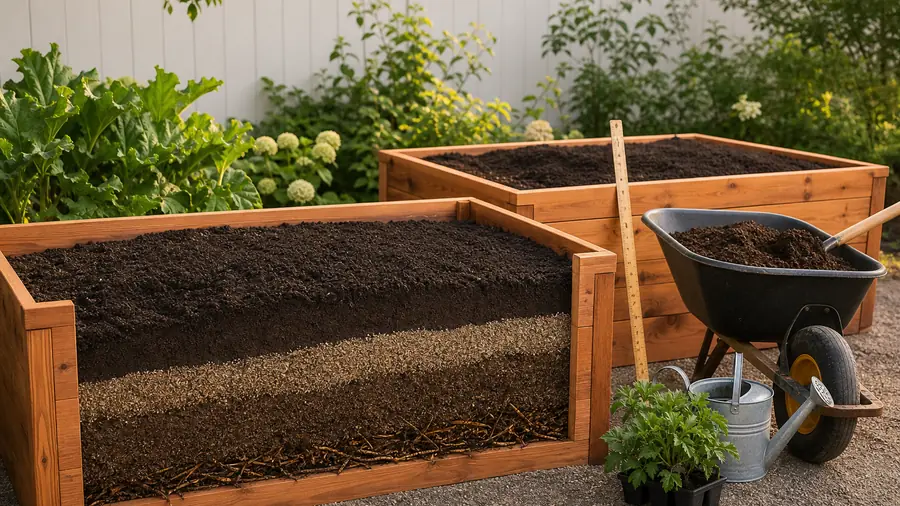

Window-box shopping often starts with a label such as 30 inches. That length describes only one dimension and may describe the outside. Potting-mix volume depends on the inside cross-section, usable fill height, taper, and anything permanently occupying the container.
Install the liner or reservoir first, measure the remaining chamber, choose the closest honest shape, and total only boxes that truly match.
How do you measure a window box or trough planter?
Measure inside length and width at the planned soil line, inside length and width at the chamber floor, and the vertical height between them. Use length × width × height only when the walls are effectively straight. For an evenly tapered rectangular trough, use both top and bottom areas. Measure after liners, false floors, and reservoirs are installed so their volume is excluded once.
Calculate potting-mix volumeWhich part of a window box should you measure?
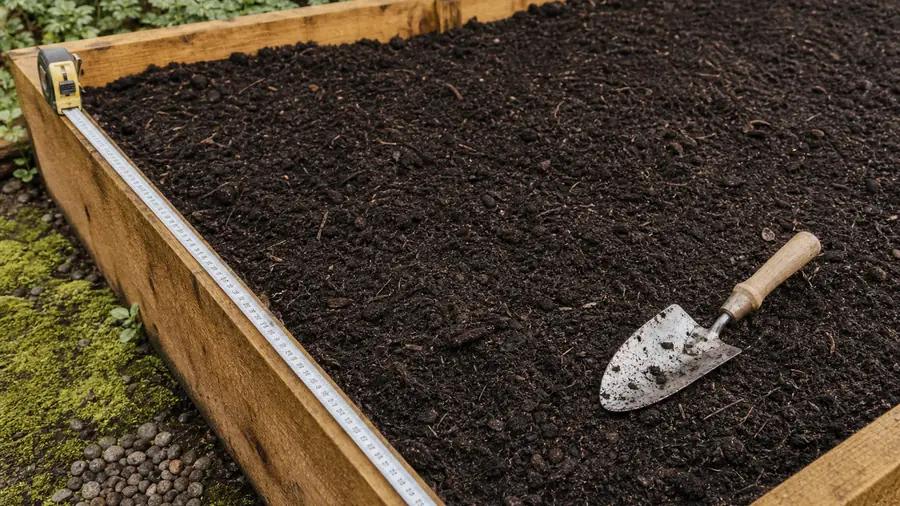
Put the tape against the surfaces that will touch the potting mix. Outside dimensions describe the shell, not its usable capacity.
A wooden or metal sleeve may contain a smaller plastic liner. Corner posts, molded ribs, wall thickness, and curved end caps also reduce the chamber. If the liner lifts out, fit it correctly before measuring rather than subtracting guessed wall thickness later.
Stop the height at the planned soil surface, not automatically at the rim. That single choice already excludes watering headspace. Do not calculate to the rim and subtract a second headspace percentage, or the gap is counted twice.
Use vertical height, not the sloping length of a side wall. Keep every dimension in inches, centimeters, or another single unit until the volume calculation is complete.
How do you calculate a straight rectangular window box?
When the inside length and width stay nearly constant from top to bottom, multiply inside length × inside width × usable height.
Suppose a lined chamber measures 30 inches long, 7 inches wide, and 7 inches vertically from its floor to the planned mix surface. The volume is 30 × 7 × 7 = 1,470 cubic inches.
That equals about 0.8507 cubic foot or 24.09 liters. NIST defines the liter as one cubic decimeter and lists one cubic inch as 16.3871 cubic centimeters. The conversion does not turn the measurements into perfect capacity; it preserves the precision of the measured shape.
Small molded features rarely justify tracing every curve. Record the result as an estimate and round the shopping quantity at the package stage. A ruler reading to a fraction of an inch does not support a bag decision to four decimal places.
How do you measure an evenly tapered rectangular trough?
Measure top and bottom inside length and width because a tapered trough holds less than a top-sized rectangular box.
Let A₁ equal top length × top width and A₂ equal bottom length × bottom width. For straight, evenly tapering faces that form similar rectangles, volume is height ÷ 3 × (A₁ + A₂ + √(A₁ × A₂)).
In a checked example, the top is 30 × 8 inches, the bottom is 27 × 5 inches, and usable vertical height is 7 inches. The two areas are 240 and 135 square inches; their geometric middle term is 180 square inches.
The calculation is 7 ÷ 3 × (240 + 135 + 180) = 1,295 cubic inches, about 0.7494 cubic foot or 21.22 liters. Treating the top as a straight box gives 1,680 cubic inches. That overstates this example by 385 cubic inches, or 6.31 liters—29.7% of the correct tapered volume.
Those dimensions test the arithmetic; they do not represent a standard product or plant recommendation. The tapered-pot measurement guide explains the related round-frustum formula and the boundary between parallel and tapered rectangular modes.
What changes when the box has a liner or reservoir?
Measure the final chamber above and inside permanent components. This excludes their occupied space without an uncertain second deduction.
| Feature | Measure from | Avoid |
|---|---|---|
| Fitted liner | Its inside walls and floor | Outside shell dimensions |
| False floor | Top of the installed floor | Full exterior height |
| Water reservoir | Base of the growing chamber above it | Subtracting reservoir twice |
| Removable inner pots | Each pot's usable chamber | Treating the decorative box as one fill |
If the manufacturer publishes an exact growing-medium capacity for the installed configuration, that can be stronger evidence than reconstructing complex molded geometry. Confirm that the stated capacity excludes the reservoir and uses the same fill line.
A transplanted root ball removes additional fresh-mix space. First calculate the usable chamber, then apply the conditional method in the root-ball displacement guide. Do not hide a plant-specific displacement inside a generic “drainage allowance.”
How should you handle rounded ends or bowed sides?
Split a changing shape into short sections or measure known-volume fill directly. One arbitrary average width can conceal a large error.
For a long trough with two rounded end zones and a straight middle, calculate the center as its own rectangular or tapered section. Treat each end separately with a defensible geometric approximation, then add the three volumes.
Bowed sides can be sectioned along the length. Measure the inside cross-section at several stations, calculate shorter segments, and sum them. More stations help only when the measurements themselves are consistent; extra decimals cannot repair an uncertain outline.
For an empty, portable liner with complicated molding, a known-volume method may be simpler: add measured volumes of water to the intended fill line, if the product can safely hold water, then drain and dry it completely before planting. Never perform that test while the box is mounted or with materials that water could damage.
Myth versus reality: can one shortcut fit every trough?
No single average width, drainage percentage, or bag allowance describes every product. Keep geometry, horticulture, and buying decisions separate.
| Myth | Reality | Better action |
|---|---|---|
| The label length gives capacity | Width, height, taper, and inner parts also control volume | Measure the full chamber |
| Top width is close enough | A narrow base can remove several liters | Use both end areas |
| A gravel layer improves drainage | Container guidance emphasizes drainage holes and suitable media | Follow the planter and plant guidance |
| One fixed extra covers settling | Products and handling differ | Use package evidence or observe a later top-up |
Oklahoma State and Penn State Extension recommend suitable soilless container media and drainage openings rather than ordinary garden soil. Oklahoma State also notes that shallow containers can behave differently after irrigation. Volume tells you how much space exists; it does not select the right medium or plant depth by itself.
The potting mix versus garden soil guide explains why a container purchase should not be converted into bags of heavy field soil merely because both products include the word “soil.”
Does calculated soil volume prove a window box is safe to hang?
No. Capacity is not a structural load rating, and potting mix does not have one dependable wet weight.
The installed load can include the box, liner, saturated growing medium, retained reservoir water, mature plants, and temporary water during irrigation. Mix composition and moisture change mass, while bracket, fastener, sill, railing, and wall capacity depend on the exact installation.
Use the planter and hardware manufacturer's ratings and the requirements for the mounting surface. If those are missing or the location is overhead, obtain advice from a qualified installer. Do not multiply liters by a generic online density and call the result a safe load.
How do you total potting mix for several window boxes?
Calculate one representative box only after confirming that its model, liner, fill height, and planted condition match the group.
| Record | Group only when | Otherwise |
|---|---|---|
| Model and liner | Both are identical | Start a new group |
| Top and bottom dimensions | Spot checks agree | Calculate individually |
| Usable fill height | Same soil line is planned | Keep separate subtotals |
| Existing plants | Displacement method matches | Measure each prepared root ball |
Multiply the representative chamber volume by its confirmed quantity. Add group subtotals only when they will use the same product. Convert that final mix volume to the exact bag sizes on the shelf, rounding whole bags up only at the end.
Enter straight boxes separately from tapered or known-volume groups in the Potting Soil Calculator. Keep the measurement notes beside the result so a later replacement box does not inherit assumptions from a different model.
Window box measurement questions
Do I measure a window box inside or outside?
Measure the installed inner surfaces that will touch potting mix. Outside dimensions include wall thickness and may include a decorative shell around a smaller liner.
Should I include space above a reservoir?
Include only the growing-medium chamber above the installed reservoir or false floor. Starting height at that chamber floor avoids subtracting the component twice.
Can I use top length and width for a tapered box?
Not as a straight box. Measure both top and bottom inside length and width plus vertical fill height, then use a tapered rectangular calculation.
Can I multiply one result by every window box?
Only when model, liner, internal dimensions, fill height, and plant displacement match. Otherwise, create separate groups.
Sources and calculation boundary
- Oklahoma State University Extension: Container Gardening, for container size, moisture behavior, drainage, and soilless media.
- Oklahoma State University Extension: Containers and Media for the Nursery, for depth, volume, drainage, and media behavior.
- Penn State Extension: Container Vegetable Gardening—Four Keys to Success, for drainage holes and soilless mix.
- University of Maryland Extension: Growing Media for Containers, for the container root-zone and media boundary.
- University of Georgia Extension: Gardening in Containers, for container size, drainage, and potting mixtures.
- National Institute of Standards and Technology: SI Units—Volume, for volume and liter relationships.
Change log: Published July 28, 2026 with a shell-to-chamber diagram, checked straight and tapered examples, component decisions, irregular-shape workflow, load boundary, and repeated box worksheet.
Last updated 11 November 2026