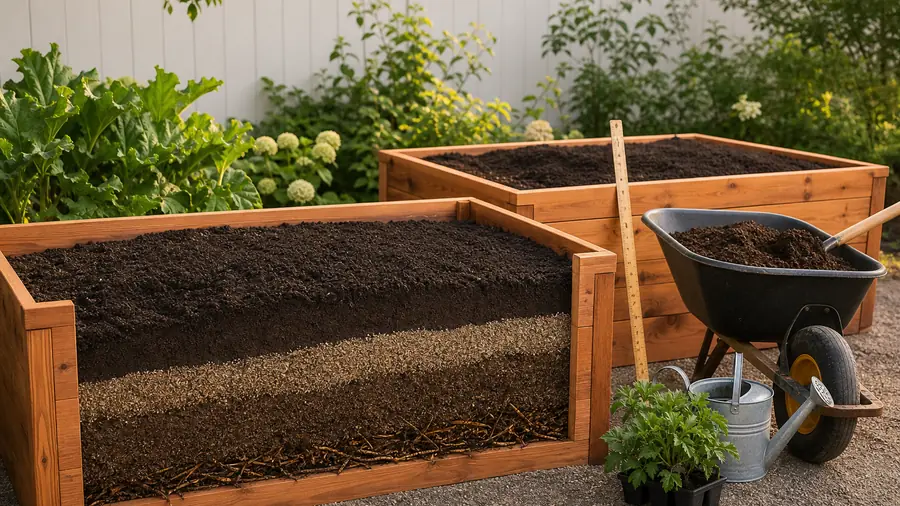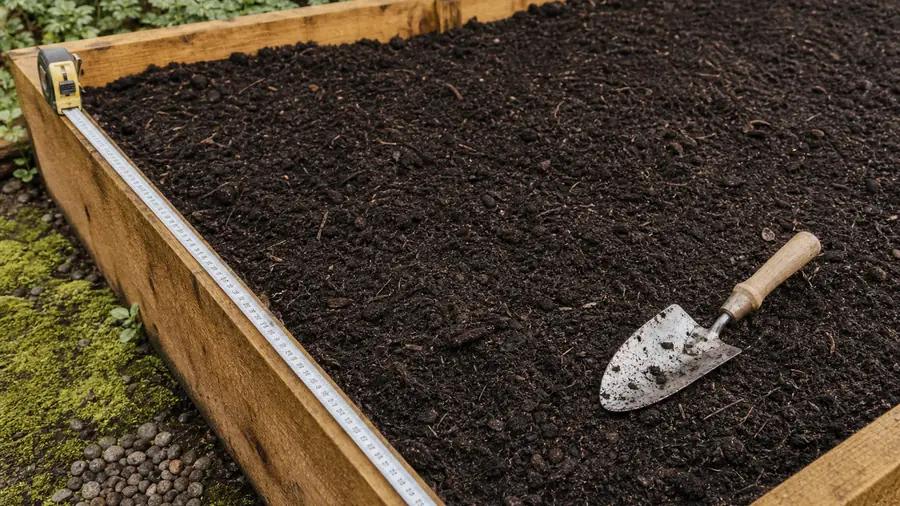

Filling an empty pot to estimate mix is useful for a new planting. It overstates a repotting job because the plant arrives with roots and existing medium. Subtracting the old pot can help, but only when that pot still describes the root ball after preparation.
Measure what will physically enter the new container. Keep plant care decisions separate from the volume calculation.
How much fresh mix do you need when repotting?
Fresh mix is approximately the usable new-pot volume minus the prepared root-ball envelope. Use the current pot as a proxy only if the root ball remains intact, closely matched that pot's inside shape, and keeps a comparable soil line. After division, root pruning, or substantial removal of old medium, remeasure the prepared ball. Do not use nominal gallon labels as exact capacities.
Calculate the usable new-pot volumeWhat volume should you subtract when repotting?
Subtract the space occupied by the prepared root ball, not the volume of roots alone and not automatically the label on the old container.
A root ball is a combined mass of roots and retained growing medium. For shopping math, its outer geometric envelope is the useful displacement. Measuring individual roots would be impractical and would ignore the medium that moves with them.
Penn State Extension describes placing mix beneath the root ball, setting its top below the pot lip, and adding mix around it. University of Maryland Extension gives the same physical sequence. Both workflows show why the fresh material occupies the bottom and side gap rather than the entire new container.
Express the calculation as: usable new-pot volume minus prepared root-ball volume. Exclude a permanent reservoir or insert from the usable chamber first so it is not subtracted twice.
When does new-pot volume minus old-pot volume work?
The shortcut works best when the root ball leaves the old pot intact and preserves its inside shape, height, and soil line.
| Check | Proxy can help | Remeasure instead |
|---|---|---|
| Ball condition | Comes out as one firm mass | Crumbles or sheds substantial medium |
| Preparation | Only minor surface loosening | Divided, root-pruned, or heavily teased |
| Old container | Exact capacity or inside geometry known | Only a nominal trade label is known |
| Soil line | Old fill height matched the ball | Large empty rim or false bottom distorted capacity |
Even a valid proxy remains an estimate because flexible pots, drainage features, small voids, and root-ball deformation can change the fit. Label the method in your worksheet instead of reporting false precision.
The nursery pot size versus actual volume guide explains current container classes and why “one gallon” or #3 cannot replace model capacity.
How do you measure the new pot and root-ball envelope?
Measure inside the new pot to the planned soil line, then measure the prepared root ball with the closest simple solid.
For a round tapered form, use top diameter, bottom diameter, and vertical height in the frustum formula. Keep all dimensions in one unit. Do not use the sloping side as height.
Suppose the new usable chamber has a 12-inch top diameter, 10-inch bottom diameter, and 11-inch vertical height. Its frustum volume is π × 11 ÷ 12 × (12² + 12 × 10 + 10²), or about 1,048.2 cubic inches—17.18 liters.
A prepared root-ball envelope measuring 8 inches across the top, 7 inches across the bottom, and 8 inches high has a volume of about 353.9 cubic inches—5.80 liters. The geometric gap is about 694.3 cubic inches, or 11.38 liters, before any product-specific settling allowance.
These dimensions illustrate arithmetic, not a recommended pot for a particular plant. The tapered-pot measurement guide covers round and rectangular shapes, inside boundaries, inserts, and known-volume mode.
Why can nominal gallon subtraction give the wrong answer?
Nursery labels identify classes or trade conventions; they do not guarantee the exact usable capacities in your calculation.
Calling the example containers “three gallon” and “one gallon” might suggest a two-gallon difference, or 7.57 liters. The measured geometric gap is 11.38 liters. That shortcut would understate this illustrative job by about 3.81 liters.
The comparison does not mean label subtraction always underestimates. Different molds, tapers, fill levels, and root-ball conditions can move the error either way. Its lesson is narrower: use exact model data or measurements when the purchase depends on capacity.
AmericanHort's current nursery standard assigns ranges to # classes and requires a True or T designation when exact gallon-equivalent class volume is specified. A plain class label cannot prove the displacement of the root ball in hand.
How does root preparation change the calculation?
Measure after any substantial change because the prepared ball, not its original silhouette, occupies the new container.
Penn State Extension advises examining dense or circling roots and gently teasing them during its houseplant repotting workflow. Some projects may involve removing loose exhausted medium, dividing a plant, or returning a size-controlled plant to the same pot.
This guide does not prescribe how much root material to remove. That decision depends on the plant, condition, season, and qualified care guidance. It only sets the measurement boundary: if preparation materially changes the envelope, the old pot is no longer a reliable displacement proxy.
A loose or irregular ball may not support a single precise value. Measure a reasonable lower and upper envelope, calculate both gaps, and keep the result as a range. Buying a smaller package first can be more honest than converting a guess into two decimal places.
Does a same-size repot need zero fresh mix?
No. Reusing the same pot can still require fresh mix when old medium or part of the outer root ball is removed.
If both empty-container capacities are equal, a simple new-minus-old-pot shortcut returns zero. The physical job does not: newly opened space around a smaller prepared ball still needs suitable medium.
Calculate same-size work as usable pot volume minus the prepared post-work root-ball envelope. Do not infer a pruning amount from the desired bag quantity. Plant health sets preparation; the resulting geometry sets volume.
Penn State notes that gardeners who want to restrict further plant growth may remove an outer section of roots, return the ball to the container with new mix, and balance top growth. Obtain plant-specific guidance before applying that workflow.
Myth versus reality: should you add a fixed extra percentage?
A universal allowance cannot represent every mix, moisture state, handling method, or root-ball fit.
| Myth | Reality | Action |
|---|---|---|
| Headspace is a later deduction | It is already excluded when height stops at the soil line | Count it once |
| Air pores are unfilled volume | They are part of a correctly placed growing medium | Do not pack them away |
| Every mix settles equally | Particle size, moisture, and handling change settlement | Use product evidence |
| More tamping improves accuracy | Excess compaction can restrict air and water movement | Firm only as guidance directs |
Penn State and Oklahoma State both caution against tightly packing container media. Watering helps settle mix around the ball, but a later top-up should come from observed settlement, not a fictional universal percentage.
How do you plan fresh mix for several plants?
Group only plants that share the same new-pot model, usable fill height, root-ball condition, and mix.
| Group | New-pot evidence | Ball evidence | Gap × quantity |
|---|---|---|---|
| A | Exact model capacity | Measured intact ball | Representative gap × matching pots |
| B | Inside geometry | Valid old-pot proxy | Proxy gap × matching pots |
| C | Inside geometry | Altered or uncertain range | Calculate each or retain a range |
Total compatible mix groups before converting to package sizes. Keep orchid bark, succulent mix, general houseplant mix, and other different products separate rather than averaging their volumes into one bag count.
Use the Potting Soil Calculator for new-pot capacity and grouped totals. Subtract the root-ball volumes in matching units, then compare the final fresh-mix subtotal with the exact volume printed on the bag. The potting mix versus garden soil guide helps keep container media distinct from field soil.
Root-ball displacement questions
Can I subtract the old pot from the new pot?
Yes, as a labeled proxy when the intact prepared root ball closely matches the old pot’s known inside capacity and soil line. Otherwise, remeasure the ball.
Do roots alone count as displacement?
The useful repotting displacement is the outer root-ball envelope, including retained medium, because that whole mass occupies the new pot.
Should I add a standard settling percentage?
No universal percentage fits every product and workflow. Use evidence from the exact mix or observe whether a later top-up is needed.
What if the root ball falls apart?
Use a measured lower-to-upper envelope after preparation and keep the result as a range instead of claiming false precision.
Sources and calculation boundary
- Penn State Extension: Repotting Houseplants, for pot-bound diagnosis, root preparation, placement, headspace, filling, and compaction.
- University of Maryland Extension: Potting and Repotting Indoor Plants, for bottom mix, root-ball position, and filling around the ball.
- Oklahoma State University Extension: Houseplant Care, for pot-bound inspection and modest container-size increases.
- University of Georgia Extension: Repotting Basics, for plant, growth, environment, drainage, and root-zone variables.
- AmericanHort: ANSI Z60.2-2025, for container-class ranges and container-grown root-system condition.
- National Institute of Standards and Technology: SI Units—Volume, for conversion context.
Change log: Published July 28, 2026 with a proxy decision diagram, checked two-frustum example, same-size boundary, myth table, and multi-plant worksheet.
Last updated 11 November 2026