
Nursery pots are often sold by a number, a gallon-like name, an outside diameter, or a product code. None of those labels alone tells you exactly how many liters of fresh mix a repotting job requires.
First identify the naming system. Then find the exact model capacity or measure the empty container. Account for the planned soil line and root ball only after that.
Does a nursery pot size equal its actual volume?
Treat #1, #2, #3, and similar nursery labels as container classes, not exact gallon capacities. The current American Standard for Nursery Stock assigns each class an allowed volume range. For mix planning, prefer the manufacturer's exact model specification; otherwise measure the pot's inside geometry. The amount of new mix will be less than empty capacity when a root ball, insert, or watering headspace occupies part of the container.
Calculate from known volume or measured dimensionsA nursery class is a range, not one exact gallon
The # symbol identifies a standardized container class whose acceptable capacity falls between a minimum and maximum.
AmericanHort's American Standard for Nursery Stock, ANSI Z60.2-2025, says containers marketed with a trade or # designation must fall within the applicable class range. It also says the classes are not limited to one volume expressed in gallons.
That means #3 does not prove that every compliant pot holds exactly three U.S. liquid gallons. Shape, height, taper, wall design, and manufacturer mold can vary while capacity remains inside the same class.
The standard allows an unclassified container when parties agree to use a volume outside the listed ranges. Therefore, do not assign a class merely from appearance. Read the molded mark, nursery specification, or manufacturer record.
Current class ranges show how much variation is allowed
Even common classes cover meaningful capacity ranges, especially when converted into gallons or liters.
| Class | Cubic inches | U.S. liquid gallons | Liters |
|---|---|---|---|
| #1 | 152–251 | 0.66–1.09 | 2.49–4.11 |
| #2 | 320–474 | 1.39–2.05 | 5.25–7.77 |
| #3 | 628–742 | 2.72–3.21 | 10.29–12.16 |
| #5 | 785–1,242 | 3.40–5.38 | 12.86–20.36 |
The gallon conversions divide cubic inches by 231, the relationship stated in the standard for true-size calculations. Metric values use the standard's cubic-centimeter ranges and convert 1,000 cubic centimeters to one liter. Rounded values are shown only to explain the range.
These are class boundaries, not a substitute for a model specification. A #5 pot near the minimum and another near the maximum could differ by hundreds of cubic inches while both remain in class.
“True to size” must be specified when exact gallons matter
The current standard requires an explicit True or T designation when the container must match the class number in gallons.
AmericanHort gives #5True and #5T as examples. It calculates true U.S. size as the number of gallons multiplied by 231 cubic inches. A plain #5 class and a #5T specification are therefore not interchangeable.
Manufacturer data makes the distinction concrete. Landmark Plastic lists one “Trade Gallon” model at 2.64 quarts, 2.5 liters, and 152.06 cubic inches of maximum dry volume. Its separate “True Gallon” model is listed at 1.01 liquid gallons and 232.38 cubic inches.
The same manufacturer lists a “Trade 3 Gallon” model at 2.79 liquid gallons, 10.6 liters, and 644.41 cubic inches. Those values belong to those named products. They do not establish universal capacities for every trade-gallon or #3 container.
Class alone does not promise plant height or maturity
A container class describes root-zone volume, not a universal plant height, age, branch count, or readiness for sale.
ANSI Z60.2-2025 says that where plant size is required, specifying only container class is incomplete, subject to stated exceptions for particular plant groups. Specifications may need height, spread, caliper, cane count, form, species, cultivar, or other applicable details.
Two plants in the same class can differ by species, production time, pruning, recent potting, and root development. When buying a plant, inspect the actual specimen and written plant specification rather than treating a larger class number as a complete quality grade.
The standard's general root-system requirement also matters: container-grown stock should have an established root system that maintains a firm ball without excessive roots circling inside the container. Pot volume cannot prove that condition by itself.
Use manufacturer model data before measuring the pot
A product code linked to current capacity data is stronger evidence than a generic name copied from a retail tag.
Look underneath the pot and around the rim for a molded model, class, manufacturer name, or volume mark. Search the maker's current technical page or catalog and confirm that dimensions and shape match the physical pot.
Record whether the published figure is maximum liquid volume, dry media volume, nominal class, or another measure. These bases can differ. Do not silently combine a liquid-capacity number from one model with the dimensions of another.
The USDA Risk Management Agency uses actual-volume size ranges for nursery crop insurance. Its categories are not a replacement for the ANSI class or a retail product specification; they demonstrate why the governing system and purpose must be named before a “three gallon” number is interpreted.
Measure inside taper when exact model data is unavailable
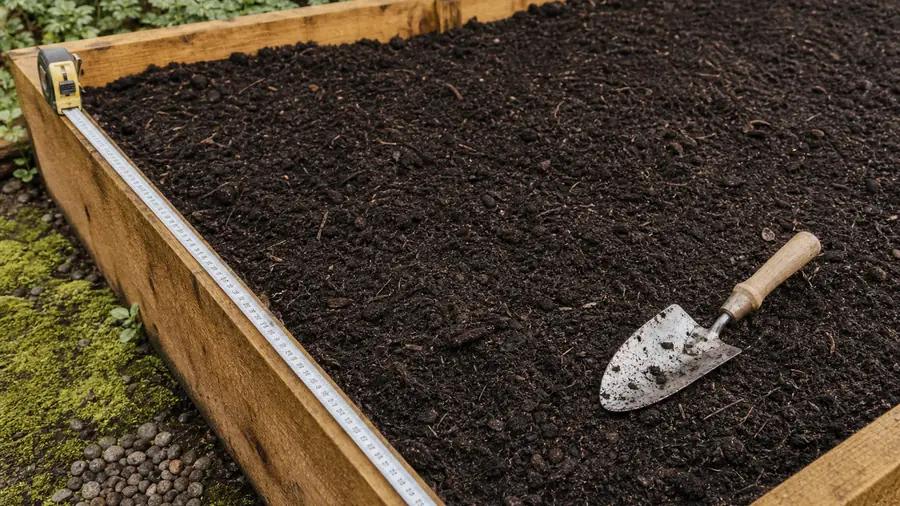
For a round tapered pot, use top inside diameter, bottom inside diameter, and vertical usable height in the frustum formula.
Suppose the inside top diameter is 10.5 inches, the inside bottom diameter is 9 inches, and vertical height to the planned soil line is 9.5 inches. The frustum volume is π × 9.5 ÷ 12 × (10.5² + 10.5 × 9 + 9²), or about 710.7 cubic inches.
That is about 3.08 U.S. liquid gallons or 11.65 liters of geometric capacity before subtracting a root ball or other occupied space. The numbers are an illustrative measured pot, not a standard #3 model.
Treating the same pot as a cylinder based on its top diameter would give about 822.6 cubic inches. That overstates the tapered result by about 111.9 cubic inches, or 15.8 percent. The tapered-pot measurement guide covers round and rectangular formulas, headspace, inserts, and measurement boundaries.
Empty capacity is not the fresh-mix requirement
Subtract only space you can justify: the existing root ball, permanent insert, reservoir, or measured watering headspace.
Do not fill a new container to the brim in a calculator and then apply a second headspace deduction while planting. Choose the planned soil line once. When repotting, preserve the root ball volume as its own measured or estimated input rather than applying a universal percentage.
Potting mix also settles after filling and watering, but the amount varies by product, moisture, handling, and container. Use a modest project-specific allowance only when evidence or prior use of that exact mix supports it. Avoid generic claims that every pot needs the same extra percentage.
The root-ball displacement guide shows when the old pot can represent an intact root ball and when preparation requires a new measurement.
When that volume reaches the store, the potting-mix bag-size guide converts dry quarts, liters, cubic feet, and declared compressed yields without assuming a standard package.
Use a medium designed for container aeration and drainage. The potting mix versus garden soil guide explains why field soil is not a like-for-like bag substitute.
Use one short workflow for buying plants and mix
Keep plant acceptance and potting-mix calculation as two connected but separate decisions.
- Record the # class, trade name, model, and any plant-size specification.
- Inspect the actual plant form, health, root ball, and root condition.
- Find current manufacturer capacity or measure inside geometry.
- Set the planned soil line and identify occupied volume.
- Calculate each distinct pot group, then total the groups.
- Convert the adjusted result using the bag's printed volume.
Enter a verified liter or cubic-foot capacity in known-volume mode, or enter measured round dimensions in the Potting Soil Calculator. Keep unlike models in separate groups even when the nursery called all of them “three gallon.”
Nursery pot size and volume questions
Does a #3 nursery pot hold exactly three gallons?
No. Under ANSI Z60.2-2025, #3 is a class spanning 628 to 742 cubic inches. Check the exact model or measure the pot.
What does #5T mean?
The current AmericanHort standard uses True or T when the specification requires exact gallon-equivalent volume for the class.
Can container class tell me how tall the plant will be?
Not by itself. Plant size and form may require separate specifications, and actual specimens still need inspection.
Should I buy mix equal to the empty pot capacity?
Not when an existing root ball, insert, reservoir, or headspace occupies part of the pot. Calculate those boundaries once and avoid duplicate deductions.
Sources and measurement boundary
- AmericanHort: American Standard for Nursery Stock, ANSI Z60.2-2025, for current class ranges, true-size designation, plant specifications, and root-system requirements.
- Oklahoma State University Extension: Containers and Media for the Nursery, for measured nursery-container media volume.
- Landmark Plastic: Trade Gallon Nursery Container and True Gallon Nursery Container, for model-specific capacity examples.
- USDA Risk Management Agency: Nursery Crop Insurance Standards Handbook, for purpose-specific actual-volume insurance categories.
- National Institute of Standards and Technology: SI Units—Volume, for unit relationships and conversion context.
Change log: Published July 28, 2026 using the current 2025 nursery standard, a four-layer label diagram, and a checked tapered-pot comparison.
Last updated 11 November 2026