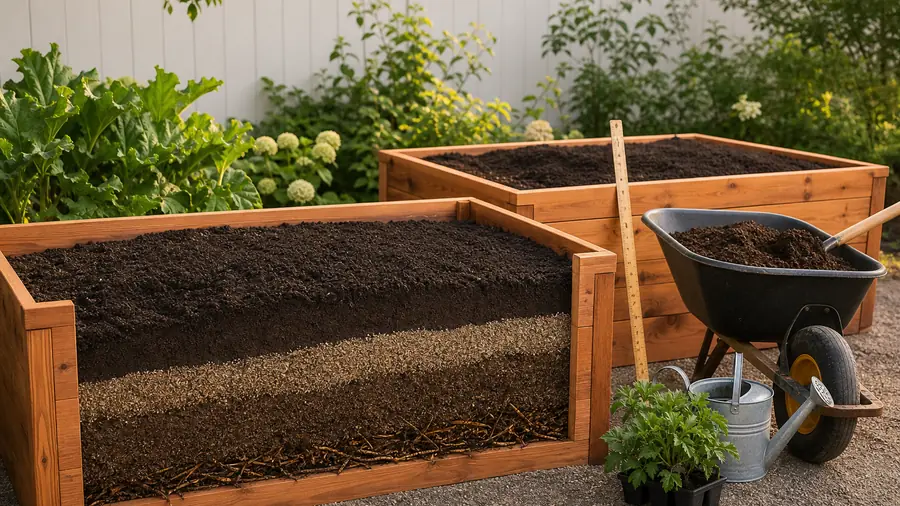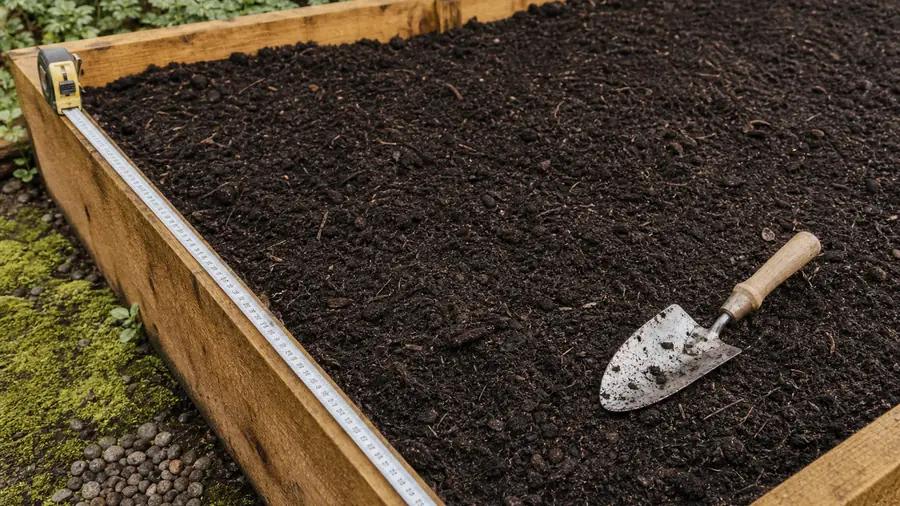

Potting mix is sold in several volume units, and the word “quart” can hide an important distinction. A U.S. dry quart is not a liquid quart. Some compressed products also declare a usable or expanded volume larger than the physical package.
Read the exact label first. Convert once, compare compatible products per common volume, and round only the final requirement to whole bags.
How do you compare potting-mix bag sizes?
One cubic foot equals 25.71405 U.S. dry quarts or 28.31685 liters. One U.S. dry quart equals 1.101221 liters. Use those factors only after confirming the label says dry quarts, liters, or cubic feet. For compressed mix, use the exact declared usable or expanded volume and its preparation directions—not the bag's apparent size or a universal expansion multiplier.
Convert your container total into bagsWhat potting-mix bag sizes are actually available?
There is no universal set of potting-mix bag sizes. Format varies by product, manufacturer, country, retailer, and current SKU.
Espoma's current item data, for example, lists all-purpose potting mix in 4-, 8-, and 16-quart packages plus 1- and 2-cubic-foot formats. That is evidence for those Espoma items, not a standard that every brand follows.
Store filters and calculators often offer convenient presets such as 8, 16, 25, 32, or 50 quarts. Treat a preset as a typing aid. Replace it with the volume printed on the exact product and size you intend to buy.
Weight does not replace volume. Two mixes can contain different ingredients, moisture, and particle structures, so equal pounds do not guarantee equal liters of usable growing medium.
Is a dry quart the same as a liquid quart?
No. U.S. dry and liquid quarts are different volumes, so the word “quart” must be identified before conversion.
NIST gives one U.S. dry quart as 1.101221 liters. A U.S. liquid quart is about 0.946353 liter. Using the kitchen or liquid factor for a dry-quart potting-mix label understates the labeled metric equivalent by roughly 14%.
If a bag shows both dry quarts and liters, transcribe both as printed. Do not silently “correct” a rounded metric declaration in your notes. Use the primary declared net quantity for shopping and the other unit as a reasonableness check.
Metric labels are simpler here: one liter equals one cubic decimeter. Liters describe volume whether the material is dry or liquid; they do not switch definition with the commodity.
How do common labels convert?
Convert every candidate to liters or cubic feet, then keep more digits in the worksheet than you display to the shopper.
| Label volume | Liters | Cubic feet | Dry quarts |
|---|---|---|---|
| 8 dry qt | 8.8098 L | 0.3111 ft³ | 8 |
| 16 dry qt | 17.6195 L | 0.6222 ft³ | 16 |
| 25 dry qt | 27.5305 L | 0.9722 ft³ | 25 |
| 32 dry qt | 35.2391 L | 1.2444 ft³ | 32 |
| 1 ft³ | 28.31685 L | 1 | 25.71405 |
| 1.5 ft³ | 42.47527 L | 1.5 | 38.57108 |
| 2 ft³ | 56.63369 L | 2 | 51.42810 |
Notice that 1.5 cubic feet is about 38.57 dry quarts, not 45 dry quarts or 45 liters. A manufacturer may sell a differently declared product, but an approximate retail table cannot redefine the units.
NIST Handbook 133 supplies the conversion basis used here. Round the displayed equivalents sensibly; keep the unrounded factor through bag-count arithmetic so repeated rounding does not change the whole-bag result.
How should you read a compressed potting-mix pack?
Use the product's declared usable or expanded volume and follow its directions. Never assume every compressed pack doubles.
PRO-MIX currently gives a concrete product-specific example: one official page says a 1-cubic-foot compressed pack contains 2 cubic feet of potting soil. Other PRO-MIX pages and regions show other formats. The exact SKU and declaration therefore matter more than the brand name alone.
Record three things: packed description, declared usable yield, and preparation method. If the package says to loosen or hydrate the material before use, follow those directions before judging volume or performance.
Do not measure the plastic bag as a rectangular solid. Packaging has folds, trapped air, compression, and an irregular outline; its outside dimensions are not the net-content declaration.
How do you calculate whole bags without rounding too early?
Divide the final compatible-mix requirement by one bag's declared usable volume, then round the bag count up once.
Suppose measured containers need 70 liters of one mix. A 16-dry-quart bag equals about 17.6195 liters, so 70 ÷ 17.6195 = 3.97 and the purchase is four whole bags. A 1-cubic-foot bag equals 28.31685 liters, so 70 ÷ 28.31685 = 2.47 and the purchase is three whole bags.
This example compares volume only; it does not say the products are interchangeable or which is cheaper. Check formulation and plant use before price. Then compare the total checkout cost and expected leftover, not just the number of bags.
For several pots, total their compatible fresh-mix needs first. Rounding each pot to a bag can create a comically large order. The root-ball displacement guide helps determine the fresh portion for repotting jobs.
Can mixed bag sizes reduce leftovers?
Yes, when the packages contain the same suitable product and the retailer offers more than one size.
Start with the total requirement. Test combinations of large and small packages, calculate their combined declared volume, and reject any combination below the need. Among the remaining choices, compare checkout cost, leftover volume, storage, and whether unopened bags can be returned under the retailer's current policy.
Do not combine similarly named products merely to make arithmetic neat. Indoor mix, cactus mix, orchid bark, and general outdoor potting mix can have different intended uses.
The broader bag-size comparison guide provides a worksheet for price per common volume across garden materials. This page keeps the potting-specific dry-quart and compressed-pack rules in view.
Myth versus reality: is the biggest bag always best value?
No. A lower price per liter matters only after product suitability, declared volume, and usable quantity are comparable.
| Shortcut | Why it fails | Better check |
|---|---|---|
| Largest-looking bag | Compression and packaging change appearance | Declared usable volume |
| Lowest bag price | Package volumes differ | Price per liter or ft³ |
| Lowest unit price | Mix may be unsuitable or excessive | Compatible product and checkout total |
| Fixed 10% extra | Mix, handling, and project uncertainty differ | Evidence-based allowance |
NIST uses packaged soil as an example in its unit-pricing guidance: a consistent shelf unit helps consumers compare quantity-price ratios independent of package size. Online listings can contain stale or mismatched variants, so confirm the selected SKU and label again before checkout.
What should an advanced label check record?
Save enough detail to reproduce the decision without treating a rounded dual-unit label as a legal finding.
- Brand, exact product name, SKU, and package variant.
- Primary net or usable volume exactly as printed.
- Secondary metric or customary declaration, if present.
- Whether “dry,” “compressed,” “expands to,” or “usable” appears.
- Price, date, seller, and the common unit used for comparison.
Convert the two label units independently as a sanity check. A small difference may reflect permitted display rounding. A large mismatch may indicate the wrong online variant, a transcription error, or different packed and usable quantities; inspect the physical label or ask the manufacturer rather than guessing.
Use the Potting Soil Calculator after measuring the containers. Enter the exact declared bag volume, not a memorized “standard” size. The nursery pot label guide applies the same evidence-first idea to container classes.
Potting-mix bag-size questions
How many dry quarts are in one cubic foot?
One cubic foot equals 25.71405 U.S. dry quarts according to NIST conversion tables.
Is 25 dry quarts one cubic foot?
Not exactly. Twenty-five dry quarts equal about 0.9722 cubic foot or 27.5305 liters.
Should I convert potting-mix quarts as liquid quarts?
No when the package declares U.S. dry quarts. One dry quart is 1.101221 liters, while a liquid quart is smaller.
Do all compressed bags expand by the same amount?
No. Use the exact product's declared usable or expanded volume and preparation directions.
Sources and calculation boundary
- NIST SP 811 Appendix B.8, for dry- and liquid-quart conversion factors.
- NIST Handbook 133, 2025 edition, for net-content checking and volume conversion context.
- NIST: Uniform Unit Pricing, for packaged-soil unit-price comparison.
- PRO-MIX Premium Moisture Potting Mix, as a current manufacturer example of a declared compressed-pack yield.
- Espoma Item Data Sheet, as a current manufacturer example of product-specific quart and cubic-foot formats.
Change log: Published July 28, 2026 with NIST conversions, a label-reading diagram, compressed-pack boundary, whole-bag example, combination workflow, value table, and label audit.
Last updated 11 November 2026