Compost planning guide
How much compost do you need?
A quarter-inch lawn dressing and a two-inch garden amendment can cover the same ground yet require eight times as much compost. Start with the job, verify the depth, then price the volume.
Content and source check completed July 28, 2026 Application and product checks included
First decide what the compost will do
Enter the layer you will spread before raking or incorporation. A lawn topdressing needs different horticultural judgment from a vegetable-bed amendment. The calculator handles volume; a soil test, product analysis, or local extension recommendation should guide the application.
Choose the job below after using the calculator.Match the compost calculation to the work on the ground
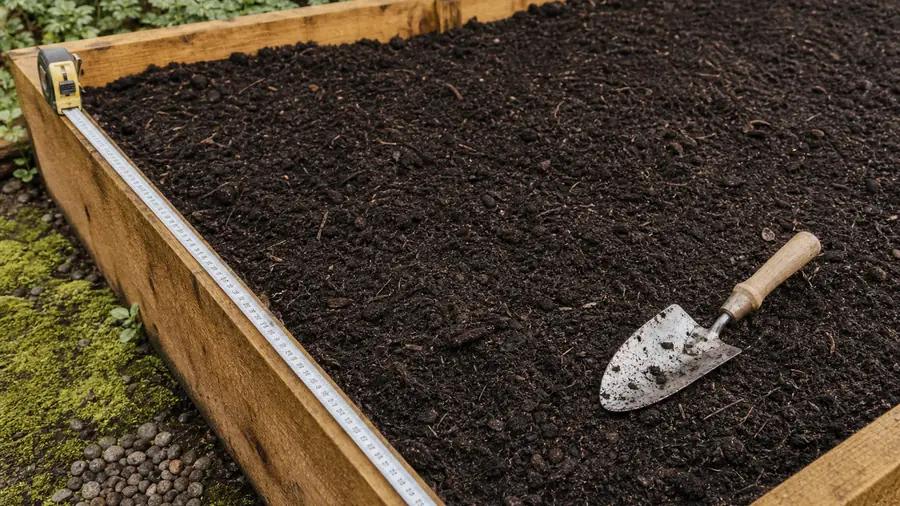
Measure the layer you plan to spread, not the depth of soil it may later be mixed into. Keep lawns, established beds, and new soil blends in separate groups when their application depths differ.
Surface application
- Measure the visible coverage area.
- Enter the thin layer spread over that surface.
- Keep turf crowns and existing plants in mind.
Soil incorporation
- Measure the compost layer before mixing.
- Do not enter the final tillage depth as compost depth.
- Use a soil test to guide repeated applications.
Ten identical beds can share one group with quantity ten. A lawn and three borders should remain separate because their shapes and intended layers may differ. You still receive one shopping total, but your notes show where each portion belongs.
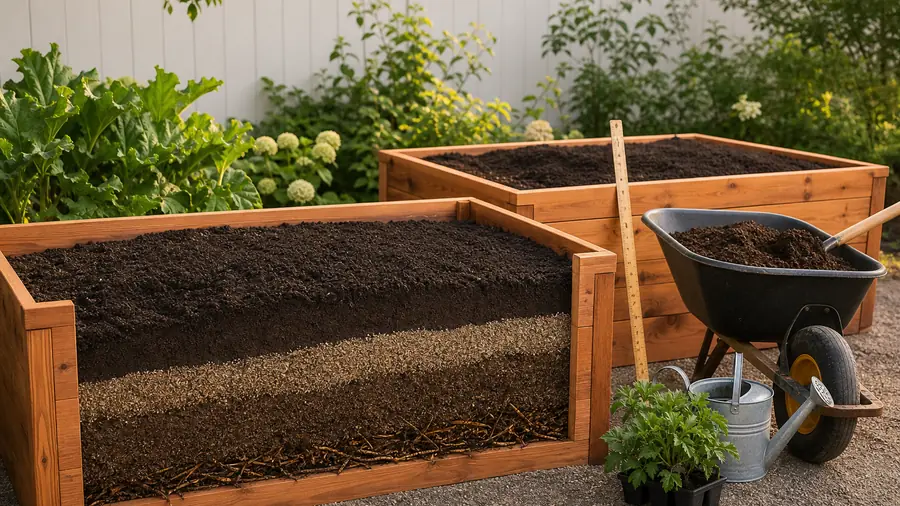
Compost used as one ingredient in a raised-bed recipe belongs in the Raised Bed Soil Calculator. It starts with missing bed volume and splits that volume by your chosen recipe. For a mineral soil layer, open the Topsoil Calculator.
If you have not chosen the material yet, compare the jobs in the topsoil, garden soil, and compost guide before entering an application depth.
Calculate the layer after you choose the application
Surface area × applied depth gives compost volume. GardenMeasure calculates each shape, repeats matching areas by quantity, and adds the groups before it applies your visible order allowance.
For a rectangular bed, surface area is length × width. For a round bed, area is π × radius²; radius is half the diameter. In imperial mode, depth is entered in inches and divided by 12 before it is multiplied by square feet. Dividing cubic feet by 27 gives cubic yards. Metric dimensions use meters and centimeters, producing cubic meters; one cubic meter contains 1,000 liters.
Conversion follows the NIST Guide to the SI. The bag count divides adjusted volume by the package volume you enter and rounds upward. The bag price uses that whole-package count. Bulk cost uses adjusted volume plus the delivery fee you entered.
| Step | Calculation | What to verify |
|---|---|---|
| Area | shape surface × quantity | no overlap between groups |
| Layer | area × compost depth | depth matches the project plan |
| Shopping volume | raw volume × allowance | percentage has a stated reason |
| Packages | shopping volume ÷ bag volume | bag label uses a volume unit |
Set depth from the application, soil, and product
Choose the layer from the job, existing soil, plant needs, compost analysis, and credible local advice. GardenMeasure leaves depth editable because a lawn and vegetable plot should not inherit the same preset.
Oregon State University Extension's guide to using compost in gardens and landscapes separates uses such as soil amendment, mulch, potting mixes, and lawn application. That distinction matters: the correct quantity depends on the layer being spread, while the agronomic result depends on material quality and how the layer is used.
The University of Minnesota Extension discusses incorporating one to two inches of compost into roughly six to eight inches of soil for flower and vegetable gardens. This is context, not an automatic setting. Local soil tests, salinity, phosphorus levels, crop needs, and municipal compost characteristics may justify a different plan.
Depth errors scale quickly. A 500-square-foot bed at one inch needs about 1.54 cubic yards. At two inches it needs about 3.09 cubic yards, exactly double. Measure at several points when the grade is uneven, and write the intended average depth beside the result before ordering.
Two compost examples with different applications
A 1,000-square-foot lawn topdressed at one-quarter inch needs about 0.77 cubic yard. A 100-square-foot existing garden bed receiving a one-inch layer needs about 0.31 cubic yard. These examples use two application depths described by Oregon State University Extension; they are not universal presets.
| Example | Calculation | Raw result |
|---|---|---|
| Existing lawn topdressing | 1,000 ft² × 0.25 in ÷ 12 | 20.83 ft³ = 0.77 yd³ |
| Existing garden bed | 100 ft² × 1 in ÷ 12 | 8.33 ft³ = 0.31 yd³ |
With 1-cubic-foot bags, those raw volumes become 21 bags for the lawn and 9 bags for the garden bed after whole-package rounding. Oregon State's compost application guide describes one-quarter to one-half inch for an existing lawn and one-quarter to one inch per year for an existing garden bed. Choose the depth supported by the actual soil, compost product, application history, and local guidance before using either calculation.
Look at the compost before you calculate a truckload
Correct volume cannot rescue an unsuitable product. Ask about feedstock, maturity, screening, test results, and recommended use before a large or sensitive application.
Compost varies with feedstock, processing, screening, moisture, particle size, soluble salts, nutrient content, stability, and maturity. Those properties affect plants and soil; they also explain why GardenMeasure does not publish a single default compost weight. Wet material and dry screened compost can occupy similar volume while their weight differs sharply.
The Washington State Department of Ecology Compost Use Guide describes compost quality and use considerations for different applications. For edible gardens, school grounds, or sites with unusual soil history, local extension or environmental guidance is more valuable than an uncited internet recipe.
Finished compost should not be confused with uncomposted organic material. If a supplier uses terms such as compost blend, soil conditioner, biosolids compost, or mushroom substrate, ask what the product is and whether its recommended application rate matches the project. The calculator can measure a specified layer, but it cannot inspect a pile through the screen. Gardening has not yet granted calculators a sense of smell.
Choose bags or bulk around access, storage, and the full quote
Compare your exact bag volume and price with a complete bulk quote. Then check minimum order, taxes, gate width, unloading location, and how soon you can spread the pile.

Bags are easier to transport in small quantities, move through narrow access, and store under cover. They also give a clear product label. Bulk can be practical for large lawns or many beds, but it needs a safe tipping location and a plan to protect the pile from runoff or contamination. Convenience is part of the decision even when the arithmetic favors one option.
Read volume from the package, not only weight. Liters, cubic feet, and dry quarts describe space and can be converted directly. Pounds or kilograms alone cannot become volume without a density for that exact material. If the bag gives only weight, ask the manufacturer for packaged volume rather than guessing.
The bulk result does not round to a truck size or half-yard increment automatically because supplier rules differ. Take the adjusted cubic-yard or cubic-meter result to the seller and request a complete delivered quote for the next available quantity. Then enter that price if you want a like-for-like comparison.
At what volume does bulk beat bags?
Bulk wins only after the order is large enough to repay the delivery fee.
Break-even bags = delivery fee ÷ (price per bag − bag volume × bulk price per cubic yard), rounded up to whole bags. Break-even volume = break-even bags × bag volume. Below that volume, whole bags cost less. Above it, bulk delivered costs less. The calculator works this out live from your prices above.
| Example | Bag | Bulk price | Delivery | Break-even bags | Break-even volume | Check at break-even |
|---|---|---|---|---|---|---|
| 1 — this page's defaults | 1.5 cu ft bag, $7 | $45 / yd³ | $75 | 17 bags | 0.94 yd³ | 17 bags $119.00; bulk $117.50 |
| 2 — smaller bags, cheaper bulk | 1 cu ft bag, $6 | $35 / yd³ | $50 | 11 bags | 0.41 yd³ | 11 bags $66.00; bulk $64.26 |
Supplier minimums, half-yard increments, taxes, and delivery zones are not in this sum. Confirm them with the supplier before ordering.
What does this order weigh?
Compost weight is not fixed by volume. It changes with feedstock, moisture, and how firmly it is packed.
This site publishes no verified weight per cubic yard for compost, so the calculator shows no weight until you enter a supplier density for this compost and moisture condition. The cubic-yard soil weight guide explains why one cubic yard has no single weight, and why a supplier figure or a loaded scale ticket is the only defensible input for a load.
Worked example with an example supplier figure: the default order is 0.34 cubic yards. At an example density of 1,000 lb per cubic yard, that is 0.34 × 1,000 = 340 lb, or 0.17 short tons. 1,000 is an example input, not a measured compost density.
How should irregular areas and order allowance be handled?
Divide an irregular area into small, non-overlapping shapes or use a measured known area. Add allowance only after all sections are totaled, and choose the percentage from real uncertainty rather than habit.
A curved border can be approximated with several short rectangles. A circular tree ring belongs in a circle group. If a path cuts through a lawn, subtract it by entering only the planted sections around it; the calculator currently adds positive groups and does not use negative areas. A site plan, mapping tool, or carefully measured square-foot total can go directly into known area.
Before selecting depth, use the compost topdressing and mixing guide to decide whether the measured layer belongs on an established surface or will be incorporated into bare soil.
The default allowance is visible and editable. Zero is allowed. Consider uncertainty in boundaries, uneven spreading, spillage, and supplier measurement, but do not treat leftover material as free: excess compost still needs an appropriate place and application rate. Better measurements usually beat a larger “just in case” percentage.
Save the raw volume and adjusted order separately. If the quote changes, you can replace price fields without remeasuring. If depth guidance changes, revise only depth and see the effect immediately. This audit trail is more useful than a mysterious single number copied into a shopping note.
Compost questions that change a real application
How many cubic feet are in a cubic yard of compost?
A cubic yard is a volume of exactly 27 cubic feet, regardless of the material placed inside that space.
Can I calculate lawn topdressing and garden beds together?
Yes. Add each distinct application as an area group and give each its own depth. The calculator totals the common volume.
Why does the calculator not show compost weight?
Compost bulk density varies with moisture, feedstock, processing, and compaction. Ask the supplier for weight if transport or a weight-based sale matters.
Is compost the same as potting mix?
No. Compost may be one potting-mix ingredient, but container media must provide appropriate air, drainage, water retention, and structure. Use the Potting Soil Calculator only for container volume, then choose a suitable product.
Should compost be counted as part of a raised-bed mix?
If it is part of your chosen recipe, yes. First use the raised-bed soil mix guide to choose documented components and percentages. The Raised Bed Soil Calculator can then split total volume and estimate each component's bags.
Sources and calculation references
- NIST Guide to the SI, Appendix B: exact unit conversions.
- Oregon State University Extension: How to Use Compost: application contexts and guidance.
- University of Minnesota Extension: Living Soil, Healthy Garden: garden amendment context.
- Washington Department of Ecology Compost Use Guide: compost quality and use considerations.