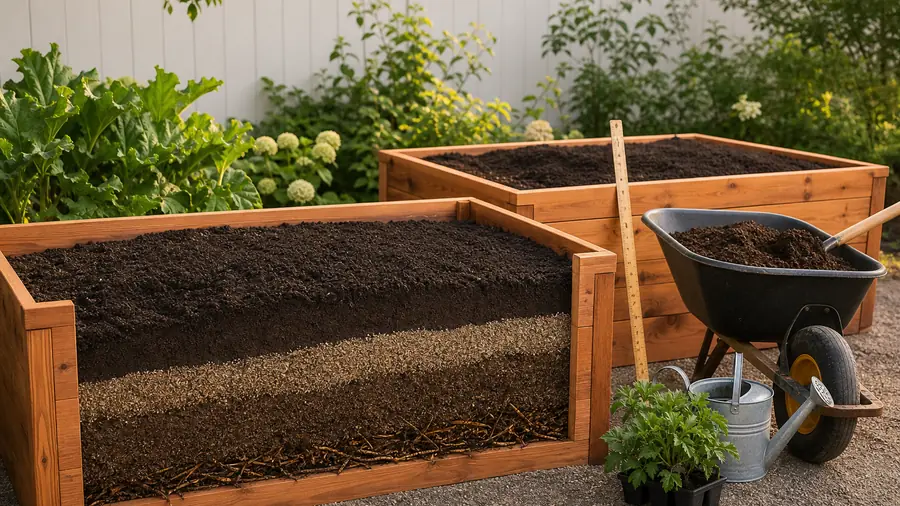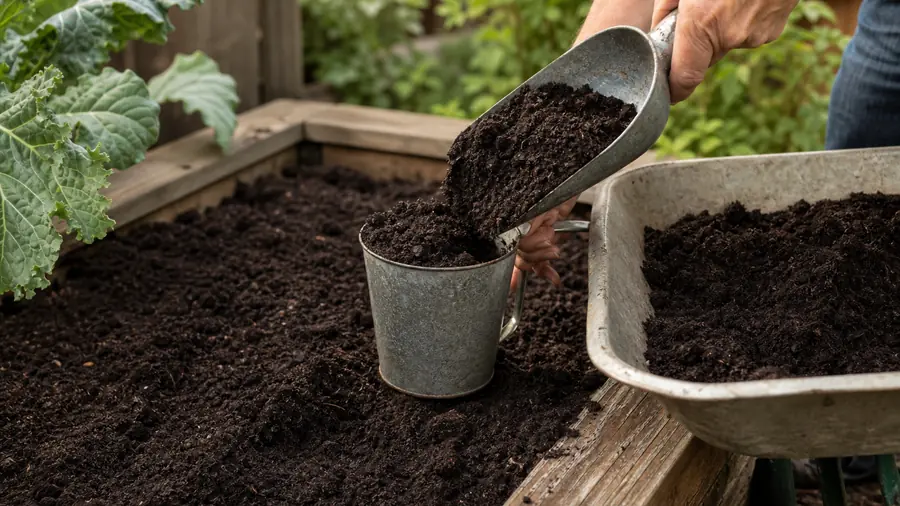

Search results give sharply different answers for the weight of a cubic yard of soil because “soil” and “yard” do not define a density condition. Screened mineral topsoil, a compost-rich blend, stony fill, and wet stockpile material can occupy equal volume while carrying different mass.
Use cubic yards to buy coverage. Use a product-specific, condition-specific density or an actual scale measurement to plan hauling, lifting, structural loading, and weight-based pricing.
How much does a cubic yard of soil weigh?
One cubic yard always equals 27 cubic feet, but it has no universal soil weight. The useful number depends on the named product, dry or wet basis, loose or compacted state, moisture at loading, and coarse material. Ask the supplier for the current pounds per cubic yard, tons per cubic yard, or loaded scale ticket. Do not use a generic internet range as permission to load a vehicle or structure.
Calculate soil volume before checking weightA cubic yard fixes volume, not mass
A yard of any material occupies a three-foot by three-foot by three-foot space; its weight comes from mass per unit volume.
Since 3 × 3 × 3 = 27, one cubic yard contains 27 cubic feet. NIST conversion factors support the underlying length and volume conversions. None of that geometry identifies the product inside the space.
Weight is volume multiplied by density. If a supplier states that a particular soil in its current loose condition is 72 pounds per cubic foot, the arithmetic is 27 × 72 = 1,944 pounds per cubic yard. An order of 1.5 cubic yards at that same stated condition is 1.5 × 1,944 = 2,916 pounds.
Those figures are an illustrative equation, not a claim that garden soil normally weighs 72 pounds per cubic foot. Substitute only a density that belongs to the actual product and condition. Changing the density changes the answer even though the cubic yards remain identical.
Bulk density includes solids and the spaces between them
Two soils made from similar minerals can have different dry mass per cubic foot because their pore space and packing differ.
The USDA Natural Resources Conservation Service defines soil bulk density as oven-dry soil mass divided by bulk volume at a specified moisture condition. Bulk volume includes the solids and the pore space between particles. The agency describes bulk density as an indicator of compaction.
NRCS also identifies texture, mineral arrangement, organic matter, and pore space as influences. Loose, well-aggregated, porous soils and soils high in organic matter generally have lower bulk density. Penn State Extension likewise explains that compaction increases bulk density.
University of Minnesota Extension notes that bulk density rises as pore space decreases and that texture affects the relationship. That is why a table organized only as “sand, loam, clay” cannot capture every commercial blend, screening process, stockpile, and loading condition.
Water adds mass without changing the order name
“One yard of topsoil” can be sold under the same product name before and after rain while its loaded mass changes.
Moisture can be stated on a dry-mass basis or a volumetric basis, so a percentage without its definition is incomplete. The NRCS educator guide calculates gravimetric water content as moist mass minus oven-dry mass, divided by oven-dry mass.
Suppose the dry soil mass in a particular one-yard example is 1,944 pounds and measured water equals 15 percent of dry mass. Water mass is 1,944 × 0.15 = 291.6 pounds, and wet mass is 1,944 + 291.6 = 2,235.6 pounds. This demonstrates the equation only; it does not assign 15-percent moisture to an unseen delivery.
Ask when and how the supplier's weight was obtained. A laboratory dry bulk-density result, a seasonal planning estimate, and a weighbridge ticket from today's loaded vehicle answer different questions.
Loose delivery and installed soil are different states
Record whether density describes loose stockpile material, a truckload, a firmed bed, or compacted in-place soil.
Disturbing soil can increase pore space and loose volume. Placing, watering, firming, or mechanical compaction can reduce the volume occupied by the same solids. The mass does not appear simply because soil settles; density increases as the material occupies less bulk volume.
Do not multiply an installed cubic-yard requirement by a loose density without confirming how the supplier sells and measures the product. Likewise, do not use an in-place engineering density as though it describes a freshly loaded, horticultural blend.
The lawn-leveling versus garden-fill guide separates installed depth conditions. Keep that volume record alongside, not merged into, the product's weight basis.
Ask for four labels beside every density number
A defensible conversion identifies product, moisture basis, packing state, and source date.
| Field | Record | Why it matters |
|---|---|---|
| Product | Exact blend or stockpile name | Composition and coarse fragments differ |
| Moisture basis | Dry, current wet, or defined test basis | Water contributes to loaded mass |
| Packing state | Loose, loaded, firmed, or in place | Pore space changes mass per volume |
| Evidence | Test, scale ticket, or dated supplier estimate | Conditions can change between loads |
Use the bulk-soil supplier question guide to request the volume increment, density basis, recent rain condition, scale availability, and quote units. If buying by ton, also ask how delivered volume will be documented.
Prefer a loaded scale ticket when weight is safety-critical
A scale measurement of the actual loaded vehicle is stronger evidence than a generic pounds-per-yard estimate.
A gross vehicle weight minus the verified empty or tare weight gives the loaded material and any other changed cargo. Confirm what each ticket includes, whether the tare condition is comparable, and whether the scale is suitable for the transaction. Preserve both values with the order.
A small container sample can help compare batches only if its internal volume, packing method, moisture, scale accuracy, and representativeness are controlled. Scaling a loosely scooped bucket to 27 cubic feet can magnify a small sampling error. It should not override a proper loaded weight for a hauling decision.
The bagged-versus-bulk soil guide explains why product fit, equal volume, full-order cost, access, and handling should be compared before deciding which purchase format to move.
Vehicle payload must come from the vehicle, not the soil table
Start with the specific vehicle's labelled occupant-and-cargo limit, then subtract every person and item already carried.
NHTSA directs owners to the driver-side Tire and Loading Information label or the owner's manual for vehicle-specific information. The label states the combined weight of occupants and cargo that should not be exceeded. Tire-sidewall numbers are not a substitute for the vehicle label.
From that labelled limit, subtract the driver, passengers, tools, liner, hitch or added equipment where applicable, and other cargo. Compare the remaining capacity with a current, product-specific loaded weight. Axle, tire, bed, trailer, distribution, securement, braking, and local-law limits still apply; payload alone is not a complete loading approval.
If the current load cannot be weighed or remains close to any limit, use supplier delivery or a smaller verified load. Do not choose the lowest number in an online range because it makes the arithmetic fit.
Keep volume, estimated weight, and measured weight separate
The order record should show what was calculated, what was estimated, and what was actually weighed.
First use the Soil Calculator to establish geometric volume from measured area and depth. Save the raw cubic yards before rounding to supplier increments. Next, attach the supplier's dated density condition and calculate an estimated load range only if one is needed.
Finally, record the scale ticket or delivered quantity separately. A difference between estimated and measured weight does not by itself prove that volume was short; density and moisture may have changed. A volume dispute needs volume evidence, while a weight dispute needs comparable scale and condition evidence.
Volume answers “how much space?” Density connects that space to an estimated mass. A scale answers “what did this load weigh?”
Cubic-yard soil weight questions
How much does one cubic yard of topsoil weigh?
There is no single reliable value without the exact product, moisture, packing state, and evidence basis. Ask the supplier for a current product-specific figure or loaded scale ticket.
Does wet soil weigh more than dry soil?
Yes. Water contributes mass. The size of the increase depends on how moisture is defined and how much water the particular soil contains.
Does compacting soil add weight?
Compaction generally reduces pore space and bulk volume; it does not create soil mass. The same mass occupying less volume has a higher bulk density.
Can a calculator tell me whether my pickup can carry a yard?
No generic calculator can approve the load. Use the vehicle-specific label and manual, subtract occupants and all other cargo, obtain current load evidence, and comply with every applicable axle, tire, securement, and legal limit.
Sources and safety boundary
- USDA NRCS: Soil Bulk Density, Moisture, Aeration, for bulk-density definition, measurement, pore space, texture, organic matter, and water-content context.
- USDA NRCS: Soil Health Educators Guide, for bulk-density and moisture measurement resources.
- Penn State Extension: Effects of Soil Compaction, for oven-dry bulk density and compaction effects.
- University of Minnesota Extension: Soil Compaction, for pore-space, texture, and bulk-density relationships.
- National Highway Traffic Safety Administration: Tire Safety and vehicle capacity-weight interpretation, for vehicle-specific loading labels and combined occupant-and-cargo limits.
- NIST Guide to the SI, Appendix B, for volume and mass conversion factors.
Change log: Published July 28, 2026 with a condition-chain diagram, four-field density record, checked conversion examples, and vehicle-load safety boundary.
Last updated 11 November 2026