
A shallow dip beneath living grass is not the same project as a bare new lawn or an empty garden bed. One must keep turf crowns exposed; another builds a root zone; the third follows the plants, base, drainage, and design.
Map each condition separately. Select a material and depth for that condition, preserve the new-to-existing soil transition, and only then calculate cubic yards or bags.
Should lawn leveling and garden fill use the same topsoil?
Use a shallow, compatible topdressing only for minor corrections over living turf; remove or renovate grass for deeper changes; and treat garden fill as a separate root-zone design. Fix runoff, compaction, settlement, or grading causes before covering them. Do not average lawn and garden depths into one order or assume that one topsoil product suits both.
Calculate each topsoil zone separatelyStart with the surface condition, not a topsoil depth chart
Mark living turf, bare lawn reconstruction, and garden fill as separate zones before measuring area or depth.
Living turf has crowns and leaves that must remain exposed. A bare lawn has no grass to preserve, so grading, compaction relief, soil preparation, and a root-zone transition can be addressed directly. A garden bed may contain existing soil and roots, sit over compacted soil, or be isolated on a hard surface.
The University of Maryland Extension distinguishes shallow ruts from substantial vehicle ruts, erosion swales, and low areas caused by poor grading. It says the larger problems call for sod removal, regrading, and replanting. Adding a thin surface layer cannot correct a downspout that keeps eroding the same channel.
Walk after rain, but do not work saturated soil. Note standing water, flow paths, soft spots, utility trenches, construction settlement, roots, and slopes toward buildings. If the condition suggests drainage, structural grading, buried utilities, or subsidence rather than a simple surface dip, obtain appropriate local professional guidance before ordering. For a sloping site, follow the sloped garden-bed measurement guide before turning a changing grade into volume.
Established lawn correction must leave grass crowns uncovered
Use thin material only where living turf can remain visible and continue growing through the correction.
University of Maryland Extension says about 1/4 to 3/4 inch of topsoil or compost can usually fill a shallow rut without smothering the crown. That is a bounded repair range, not a promise that 3/4 inch is suitable for every grass, season, soil, or site.
Clemson Cooperative Extension defines topdressing as a thin layer placed over established turf. It advises matching topsoil or sand to the existing root-zone soil and using soil analysis when the purpose is to change soil conditions. A random sandy mix over a clay profile can create a different interface from the one the lawn already uses.
Measure only the low zones, not the entire lawn, unless a uniform topdressing is genuinely planned. For irregular patches, sketch rectangles, circles, triangles, or known areas with the irregular-area measurement guide. Keep each patch's maximum shallow correction visible in the notes.
Deep lawn depressions require a repair choice before volume
When the intended fill would bury living turf, choose staged thin passes or remove the turf and rebuild the low spot.
Repeated shallow applications can gradually change a minor area while grass remains active. A deeper depression may be faster and more reliable to repair by lifting sod, correcting the soil and compaction underneath, then replacing or reseeding. The correct method depends on the cause, turf condition, season, species, and local guidance.
Do not turn a broad grade change into dozens of isolated piles. Establish finished elevations and drainage direction first. The University of Maryland's new-lawn guidance specifies a slope away from buildings and advises using good-quality topsoil where existing bare soil cannot fill low points.
Record the repair boundary after sod removal, because its area may differ from the visible dip. Measure depth at a grid of points and split sharply different depths into separate zones. The sloped-bed guide covers variable fill in detail; here, the key is not to hide a deep repair inside a lawn-wide average.
A new lawn is a soil-preparation project, not topdressing
Bare-soil establishment allows the root zone and interface to be built before seed or sod is installed.
Penn State Extension says good-quality turf establishment typically needs 4–6 inches of settled topsoil. It recommends incorporating about 2 inches of that topsoil into the upper 2–3 inches of subsoil to form a gradual transition, reduce compaction at the interface, and improve drainage.
University of California IPM similarly advises against simply laying added topsoil over old soil. Its new-lawn guidance calls for mixing the topsoil into the existing surface so water and roots do not meet a sharp layered profile. These recommendations describe prepared bare sites, not established lawns whose crowns would be buried by several inches.
Use firmed or settled depth in the order record. A loose delivery pile is not the finished root-zone thickness. Confirm final grade, expected settling, transition work, and soil source before adding an allowance; do not simply increase every order by a generic percentage.
Garden fill follows the root zone, base, and existing soil
Select garden depth from the plants and site construction rather than borrowing a lawn-establishment number.
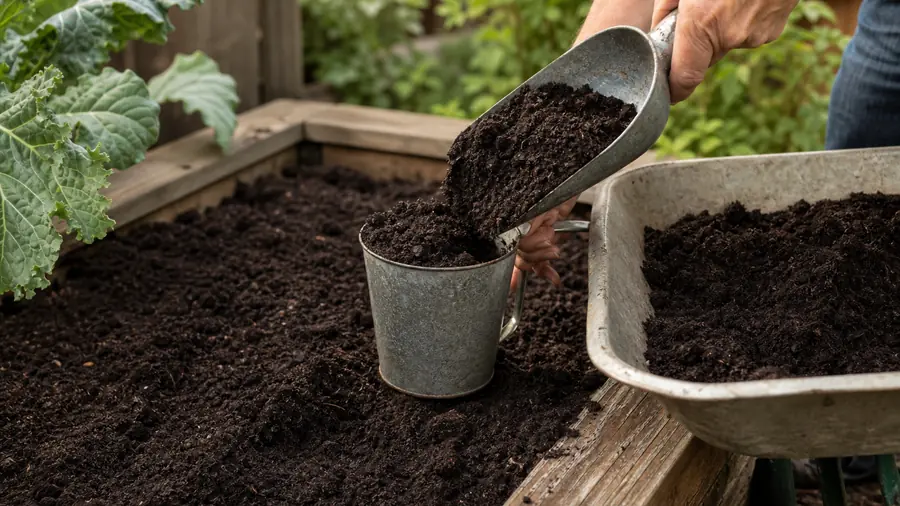
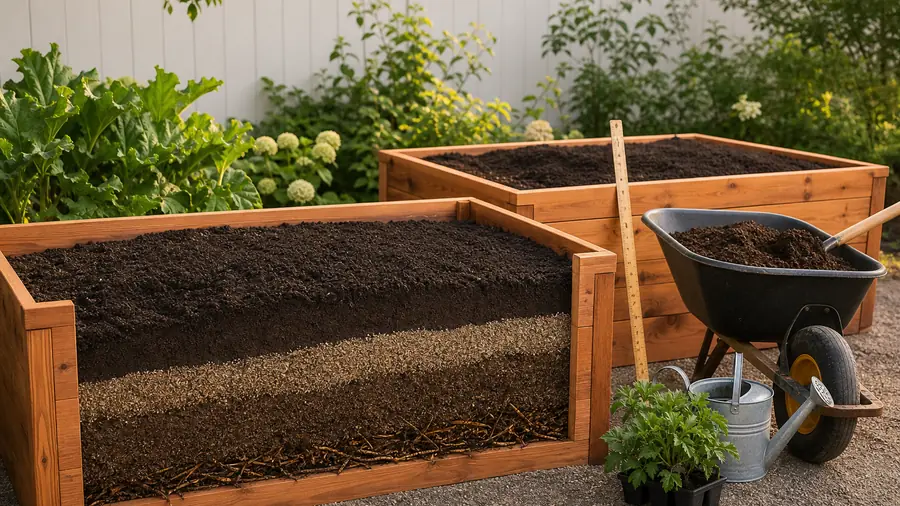
An in-ground bed over usable soil may need improvement rather than a wholesale imported layer. A framed bed on native soil can use that ground as part of its root zone, while a bed on pavement must contain the full usable depth and manage drainage within the frame.
Rutgers NJAES recommends blending imported soil with existing soil, or at least creating a transition layer from shallow portions of each. UF/IFAS gives the same interface principle: brought-in soil should be similar to or slightly coarser than existing soil, and several inches should be blended where practical to reduce drainage problems from layering.
Product choice is also separate. The topsoil, garden soil, and compost guide explains why mineral soil, blended products, and amendments are not interchangeable. This page calculates no universal garden mix and does not turn topsoil alone into a complete raised-bed recipe.
If the project also raises the lower grade, use the topsoil-versus-fill-dirt guide to separate the plant-supporting surface from project-specified lower fill, calculate both volumes, and verify imported-soil evidence.
Screening matters more as the layer becomes thinner
Large stones, roots, and clods consume a greater share of a shallow correction and interfere with final raking.
A thin lawn application needs a clear physical specification and compatible texture. A deeper garden fill still needs appropriate material, but it may tolerate a different visible particle range where the design allows. Neither job should accept trash, unexplained debris, or an unsuitable soil source.
Use the screened-versus-unscreened topsoil guide to record the actual screen opening, sample, visible oversize, and usable-volume cost. Screening controls particle size only; it does not certify texture, pH, nutrients, contaminants, or intended use.
Enter each job as its own calculator zone
Do not average a shallow lawn correction, bare reconstruction, and garden fill into one depth.
| Zone | Vegetation | Depth source | Interface action |
|---|---|---|---|
| Minor lawn correction | Living turf remains | Local turf guidance within crown-safe limit | Compatible thin topdressing |
| Deep lawn repair | Sod lifted or area replanted | Measured depression and repair design | Correct cause and prepare soil |
| Bare new lawn | No established turf | Settled root-zone specification | Blend new and existing soil |
| Garden fill | Project-dependent | Plants, base, existing soil, and design | Create a textural transition where appropriate |
Map each zone, calculate its area, and enter the selected depth in the Topsoil Calculator. Preserve the raw result for each zone before any purchase allowance. If different products are required, keep their totals separate through the quote and delivery plan.
Exclude paving, drains, tree-flare clearances, structures, and other no-fill areas. Recheck final elevations against edging, walks, irrigation heads, and building drainage so the material quantity does not create a new grade problem.
Measure depth from a fixed ground reference
Use the soil or intended finished-grade surface as the datum, not the top of grass blades, loose thatch, or an uncompacted pile.
For a living lawn, part the blades and place a straight reference across firm surrounding ground. Measure vertically to the low soil surface without compressing it. Record the deepest reading and the area that actually shares that depth; a single center reading should not define an entire irregular depression.
On bare soil, establish grade stakes, a taut level line, or a verified laser reference that reflects the drainage design. Take readings on a repeatable grid and mark locations that need removal separately from locations that need fill. Adding high and low differences together can conceal soil that should be moved within the site before anything is purchased.
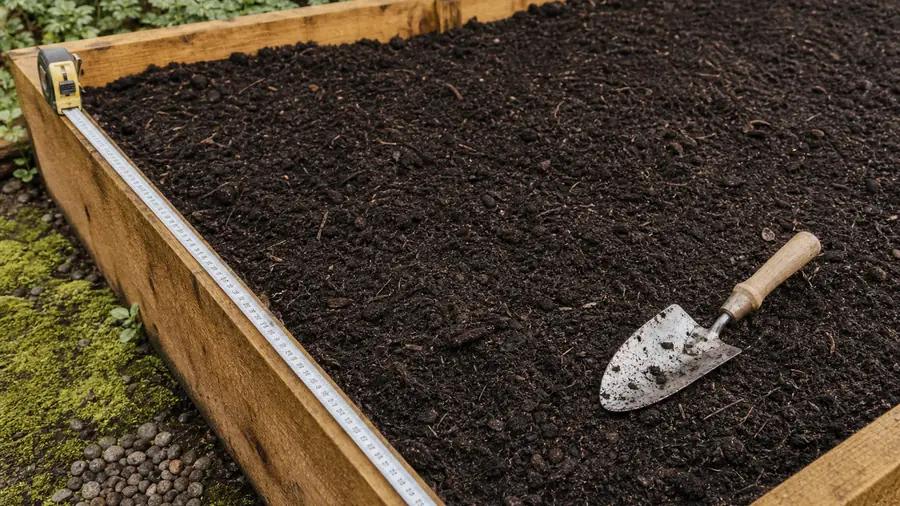
For garden fill, measure the interior usable chamber after accounting for the base, liner only where specified, edging, irrigation, and planned freeboard. Note whether the entered depth is loose, installed, firmed, or settled. The supplier quote and calculator record should use the same intended condition or state the allowance that connects them.
Label every sketch with date, unit, datum, zone name, material, selected depth source, and exclusions. This makes the quantity auditable when a contractor, supplier, or another household member checks the order.
The same area can require sixteen times as much material
Volume changes directly with depth, so correct classification can matter more than a small price difference.
Consider three separate 600-square-foot examples. A user-selected 0.5-inch established-lawn correction needs 600 × 0.5 ÷ 12 = 25 cubic feet, or 0.93 cubic yard. This depth falls within the University of Maryland's bounded shallow-rut range, but still requires site and turf judgment.
A bare new-lawn zone entered at 4 settled inches needs 600 × 4 ÷ 12 = 200 cubic feet, or 7.41 cubic yards. Four inches is the lower end of Penn State's stated 4–6-inch establishment range, not a recommendation for every site.
A separate garden design using an illustrative, user-selected 8-inch fill needs 600 × 8 ÷ 12 = 400 cubic feet, or 14.81 cubic yards. The 8 inches is arithmetic input, not a universal garden depth. It must come from the actual root-zone and base design.
At equal area, 8 inches uses 16 times the volume of 0.5 inch.
NIST conversion factors support the inch-to-foot and cubic-volume conversions. Keep the three calculations on separate lines; their soils, preparation, timing, and installation methods can differ even when the square footage happens to match.
Lawn and garden topsoil questions
Can topsoil level an established lawn?
It can correct minor low areas when applied as a compatible shallow layer that does not smother turf crowns. Deeper problems require staged work or sod removal, regrading, and replanting.
Is a new lawn topdressed the same way?
No. A bare new lawn allows deeper root-zone preparation and blending at the subsoil interface before seed or sod is installed.
Can the same topsoil fill a garden bed?
Only if its source, texture, composition, test evidence, and intended use fit the garden design. The lawn and garden quantity calculations should remain separate.
Should I average several topsoil depths?
Split meaningfully different conditions into zones. One average can overfill living turf while underfilling a bare repair or garden bed.
Sources and application boundary
- University of Maryland Extension: Improving a Struggling Lawn and Repairing Damage, for shallow-rut and deeper-repair boundaries.
- Clemson Cooperative Extension: Topdressing a Home Lawn, for established-turf topdressing, compatible material, and soil-analysis context.
- Penn State Extension: Lawn Establishment, for settled new-lawn topsoil depth and interface preparation.
- University of California IPM: Healthy Lawns—Soil Amendments, for new-lawn topsoil and layering cautions.
- University of Maryland Extension: Starting a New Lawn, for bare-soil grading and low-point preparation.
- Rutgers NJAES: Soil for Raised Beds and UF/IFAS: Adding Fill Soil, for imported-soil transition principles.
- NIST Guide to the SI, Appendix B, for volume conversion factors.
Change log: Published July 28, 2026 with a three-job cross-section, zone table, and checked 600-square-foot depth comparison.
Last updated 11 November 2026