Screening passes soil through an opening and retains material too large to fit. It can make a load easier to spread and finish, but it does not turn unknown soil into fertile loam or prove that the product is safe for a vegetable garden.
Choose from the surface finish, acceptable particle size, removal work, and complete price. Then evaluate source, texture, recipe, tests, and intended use as separate purchasing questions.
Do you need screened or unscreened topsoil?
Choose screened topsoil when the finished work requires a stated maximum particle size and predictable spreading; consider unscreened material only when the job can accept visible oversize and you have inspected and priced the sorting work. Ask for the screen opening in writing. Neither format proves soil texture, pH, nutrients, organic matter, contaminant history, or fitness for the project.
Calculate the required topsoil volumeScreened topsoil has passed through a stated opening
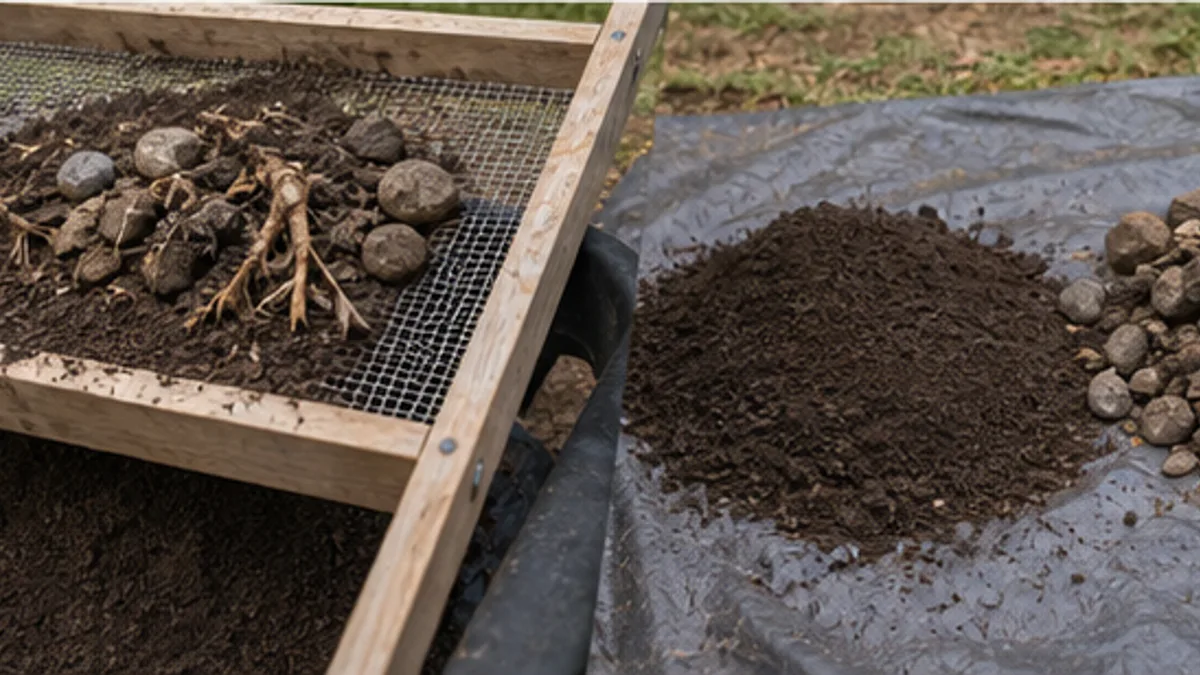
The screen retains pieces larger than its aperture while soil and smaller particles pass through.
Screening equipment may shake material across a deck or rotate it inside a drum. The mechanism matters less to a buyer than the largest agreed opening, the product sampled, and the condition of the delivered load. “Double screened,” “fine,” and “premium” do not state a measurement by themselves.
The University of Connecticut Soil Nutrient Analysis Laboratory says most soil in its market context is screened through a 3/4-inch mesh. A Michigan State University construction specification uses a 1-inch screen for one defined material. Those different examples show why the aperture belongs in the quote; they are not a universal national grade.
Ask whether the opening describes the actual final pass, whether the quoted stockpile has already been processed, and whether wet clods change what can pass. Tie the sample and written specification to the pile that will supply the delivery.
Small stones, weed seeds, and unsuitable soil can still pass
Screening controls particle size; it does not identify everything smaller than the opening or change the soil's chemistry.
A stone smaller than the mesh can remain. So can fine roots, weed seeds, glass fragments smaller than the opening, and dissolved or microscopic contaminants. Screening also does not change the proportions of sand, silt, and clay that determine soil texture.
University of New Hampshire Extension says topsoil quality cannot be judged only by looking at a pile. It recommends asking for the source, amendment recipe, test data, screening status, and a sample. Its guidance treats screening as one question, not a substitute for pH and texture information.
The University of Connecticut Home Garden Education Office makes the same distinction in its 2026 buyer guidance: ask where the material came from, what job it is meant for, whether compost is included, and whether contamination history creates a reason for testing. Use the material-choice guide before deciding that any screened product is the right category.
Finish-sensitive work needs a clear particle-size limit
A final surface that must rake evenly or receive a thin layer benefits from a product whose maximum visible size is specified.
Large stones, roots, sticks, and hard clods can interrupt a smooth grade, snag a rake, and consume depth in a shallow application. Screened soil reduces that specific sorting burden. It does not guarantee that the remaining texture will drain, hold water, or support the intended planting.
Write the finish requirement in observable terms: the screen opening, allowed debris, target smoothness, and whether the product must spread in a thin lift. If the work has a designer, contractor, seed or sod specification, use that document instead of a generic supplier label.
The lawn-leveling versus garden-fill guide separately addresses application depth. This screening article does not prescribe a lawn mix; it asks whether the delivered material's size range supports the already-defined finish.
Unscreened soil can work when oversize is acceptable and planned
As-dug material is a viable option only when the project can accept its variability or the buyer has a realistic sorting process.
University of New Hampshire Extension warns that unseen unscreened topsoil can contain rocks and roots. It notes that a buyer may be willing to rake them out when the price makes sense, but the condition should be known before purchase.
Rough volume work may tolerate particles that a final seedbed or thin topdressing cannot. Even then, “unscreened topsoil” is not the same as clean structural fill, and it is not permission to accept trash, construction debris, an incompatible texture, or unexplained material. The intended growing zone and grading design still govern what belongs in the project.
Plan where removed stone, roots, clods, and debris will go. Sorting after delivery needs space, tools, handling, and disposal or reuse that complies with local rules. If there is no place to perform that work, the lower material price is not actionable.
Inspect a representative sample and record four facts
Link the sample to the exact product, note the aperture, separate visible oversize, and keep soil-test evidence on another line.
| Record | Question | What it does not prove |
|---|---|---|
| Product and pile | Will this exact source supply the load? | Future batches are identical |
| Screen opening | What final aperture was used? | All smaller material is desirable |
| Visible oversize | What must be removed for this finish? | The sample represents every yard |
| Separate evidence | What source, recipe, texture, pH, and tests apply? | Screening improved soil quality |
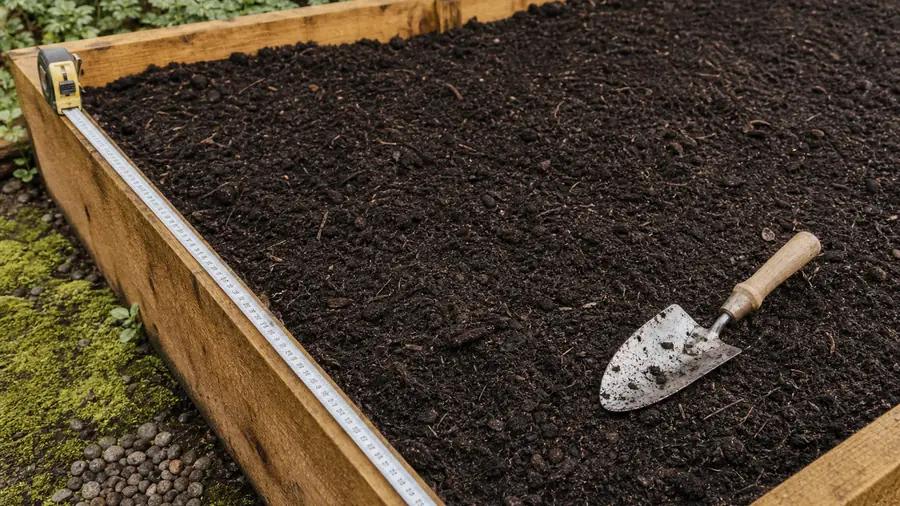
Take a photo with a ruler and the sample identifier. Break ordinary dry clods gently enough to distinguish compacted soil from stone, but do not discard material simply because it looks unfamiliar. Ask the supplier how the sample was collected and whether the pile was recently blended.
The bulk soil supplier question guide expands the record to origin, amendments, biosolids, pesticide history, test reports, selling unit, and delivery. University of Idaho Extension includes screening among those broader questions.
Compare cost per usable yard, not the delivered label
If the unscreened option requires measurable removal, account for lost usable volume as well as labor, equipment, and disposal.
Consider an illustrative 5.5-cubic-yard requirement. A screened quote at $44 per yard plus $70 delivery totals 5.5 × $44 + $70 = $312.00. An unscreened quote at $31 per yard with the same delivery totals $240.50. The visible sticker difference is $71.50.
Suppose a representative sample—not a generic assumption—suggests that 4% of the unscreened volume would be removed to meet this project's finish. A 5.5-yard delivery would leave 5.5 × 0.96 = 5.28 usable yards, creating a 0.22-yard shortfall.
To obtain 5.5 usable yards at that measured removal fraction, the arithmetic requirement is 5.5 ÷ 0.96 = 5.73 raw yards. If the supplier sells half-yard increments, the order rounds to 6 yards. Recalculate that order, delivery minimum, and excess-removal plan before comparing totals.
Required raw volume = required usable volume ÷ usable fraction
The 4% figure and prices are illustrative inputs, not claims about all unscreened soil. Enter actual quantities and quotes in the Topsoil Calculator. The bagged-versus-bulk soil guide then compares delivery, order increments, staging, and handling.
Reject a load for the agreed mismatch, not a vague expectation
Put the product name, source or pile, screen opening, allowed material, quantity, and remedies in the order record.
Inspect before the soil is spread or mixed with existing ground. Photograph the delivered pile and ticket. If large fragments exceed the agreed opening or the material differs from the sampled product, contact the supplier promptly and keep the load isolated while the written remedy is discussed.
A few small stones do not automatically prove an aperture failure, and an attractive fine load does not prove horticultural quality. Compare the observable condition with the actual agreement. Keep separate concerns—wrong product, oversize, debris, odor, texture, or missing evidence—on separate lines.
Do not spread first and ask for rejection later. Once mixed into a bed, the original delivery is harder to document and recover. A clear specification and pre-spreading inspection protect both the buyer and a supplier who delivered what was ordered.
Write an acceptance record that someone else can check
Put the physical screening requirement and the separate soil evidence into one dated order record before payment or delivery.
Name the product, intended project, source or stockpile, final screen opening, quoted volume, price unit, delivery fee, minimum, and promised sample. Add the supplier's description of permitted stone, roots, sticks, clods, and other visible material. If no numerical debris limit is offered, retain photos of the accepted sample beside a ruler and label them with the quote date.
Keep texture, pH, nutrient, organic-matter, soluble-salt, and contaminant information under a separate evidence heading. “Screened through 3/4 inch” cannot fill those fields. Conversely, a soil test does not confirm that a delivered load passed the agreed physical opening. The two checks answer different questions.
At delivery, compare the ticket, product name, pile condition, and representative visible material with that record before the truck leaves when the supplier's process allows. Note weather and moisture condition without assuming that either excuses a different product. If an inspection method or remedy matters to the purchase, agree to it in advance rather than inventing it beside the pile.
Screened topsoil questions
Is screened topsoil always better?
No. It is better for a project that needs its stated particle-size limit. Screening alone does not prove suitable texture, chemistry, cleanliness, or intended use.
What screen size should topsoil use?
There is no single universal aperture. Ask what the project specification requires and what final opening the supplier used, then inspect the tied sample.
Does screened soil contain no rocks?
Not necessarily. Particles smaller than the opening can pass through. The written specification must define what size and visible material are acceptable.
Can I screen topsoil after delivery?
Yes, when there is suitable equipment, space, labor, weather control, and a plan for retained material. Price those requirements and the loss of usable volume before ordering.
Sources and screening boundary
- University of Connecticut Soil Nutrient Analysis Laboratory: Purchasing Topsoil, for stockpile inspection, screening context, coarse fragments, texture, testing, and volume.
- University of New Hampshire Extension: Purchasing Top Soil, for the screened-status question, rocks and roots, source, recipe, test data, and sample.
- University of Connecticut Home Garden Education Office: What to Know Before You Buy Topsoil, for the distinction between screening, intended use, composition, and contamination questions.
- University of Idaho Extension: Questions to Ask Before Buying Topsoil, for the broader supplier checklist.
- Michigan State University: Topsoil Construction Specification, as an institutional example of a stated screen opening rather than a universal grade.
- NIST Guide to the SI, Appendix B, for volume conversion factors used in the checked example.
Change log: Published July 28, 2026 with a screening-boundary diagram, sample record, and checked 5.5-yard usable-volume example.
Last updated 11 November 2026