
Use is the cleanest dividing line. A surface intended to support plants needs a documented growing soil suited to that use. Material below it must meet the site's fill, grading, drainage, and any structural requirements. One sales label cannot prove both.
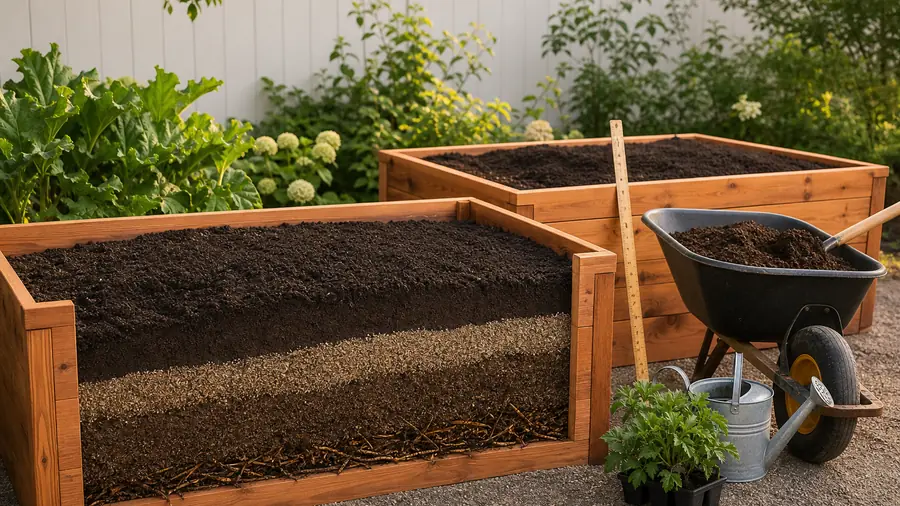
Many projects need separate layers rather than a winner. Mark the existing and final elevations, define the upper growing zone, assign the remaining lower volume, and obtain a written specification and acceptance record for each material.
Does your project need topsoil, fill dirt, or both?
Choose an accepted topsoil or planting soil for the final root-supporting layer; use specified fill below that layer when the project needs bulk elevation or grade. Do not assume “topsoil” proves fertility or “clean fill” proves garden safety. For loads tied to structures, retaining walls, foundations, utilities, drainage systems, or regulated grading, follow the design professional and local authority—not a garden article.
Calculate the upper topsoil layerWhat is the practical difference between topsoil and fill dirt?
Topsoil is bought for a plant-supporting surface; fill dirt is bought to occupy lower space or establish a specified grade. Those are intended functions, not guaranteed compositions.
USDA Natural Resources Conservation Service describes a natural soil profile with a surface A horizon, subsoil B horizon, and substratum C horizon. Their color, texture, structure, thickness, chemistry, and mineral content vary by soil and location.
A commercial product called topsoil may be stripped surface soil, screened mineral soil, a manufactured blend, or another source accepted under a seller's naming system. Fill may be excavation soil, subsoil, or a specified blend. Ask what the load is; do not reverse-engineer it from color.
Oregon State University Extension warns that purchased “topsoil” might actually be natural topsoil, river silt, clean fill from a deep pit, sandy loam, or synthesized soil. The name alone cannot establish fertility, texture, organic matter, weeds, contaminants, or how the material will behave after placement.
When does a project need topsoil, fill dirt, or both?
Start at the final surface and work downward. If plants will occupy the surface, define their growing zone; if the site below must be raised, define a separate lower fill zone.
| Project zone | Starting material question | Evidence owner |
|---|---|---|
| Lawn or planted surface | Which tested soil supports this plant use? | Soil plan, lab guidance, supplier data |
| Lower non-growing volume | Which fill meets the site specification? | Project plan, local rules, qualified professional |
| Small planting-area correction | Is existing soil improved, replaced, or topped? | Site inspection and soil test |
| Structure or drainage interface | What material and placement are designed? | Design professional and authority |
The lawn-leveling-versus-garden-fill guide separates shallow correction, new-lawn preparation, and deeper garden projects. It should define the planting-layer input before this article divides the order.
Never bury an unresolved drainage, utility, foundation, retaining, or settlement problem under imported soil. Material choice and final slope are parts of a site system, not cosmetic fixes.
Why is the product name not enough evidence?
Retail adjectives describe an offer; measurable properties and a written acceptance standard determine whether it fits the job.
| Label or claim | What it does not prove | Ask for |
|---|---|---|
| Topsoil | Texture, fertility, organic matter, or safe use | Source, current analysis, sample, intended-use specification |
| Screened | Opening size, cleanliness, or plant suitability | Stated screen opening and oversize tolerance |
| Clean fill | Food-garden safety or horticultural quality | Local definition, origin, certification or tests for intended exposure |
| Compactable | Project-specific performance after placement | Required classification, testing, placement, and acceptance criteria |
Oregon State says there are no standards for topsoil quality and that imported topsoil may not improve the existing soil. Inspect a representative sample and request evidence matched to the use. The screened-versus-unscreened topsoil guide explains why screen size answers only one part of acceptance.
For a growing layer, relevant evidence can include source history, texture, pH, organic matter, soluble salts, nutrients, weeds, debris, and contaminants selected for the site and use. University of Minnesota Extension explains that test menus differ; a standard lawn-and-garden test does not silently include every contaminant.
Does “clean fill” mean the soil is safe for a garden?
No. Treat “clean fill” as a term that needs a local definition and supporting evidence, not as a universal gardening-safety seal.
The U.S. Environmental Protection Agency warns community-garden planners that construction use of “clean fill” can mean material screened to remove chunks of concrete or asphalt. EPA explicitly says that wording does not establish soil that is safe and healthy for gardening.
Ask where the soil originated, what previous activities occurred there, whether loads are mixed, which local definition applies, which analytes were tested, how the sample represents the offered stockpile, and whether the evidence covers residential contact, food growing, children, or another intended exposure.
If history is uncertain or the site is urban, industrial, roadside, demolition-related, fire-affected, or otherwise suspect, consult the appropriate environmental or public-health program before moving or importing soil. A pleasant smell, dark color, or debris-free handful cannot clear invisible contaminants.
How do you calculate separate topsoil and fill layers?
Calculate the complete elevation change, subtract the defined upper layer, and apply the remaining depth to the lower fill area.
Consider an illustrative 20-foot by 15-foot area, or 300 square feet, that will rise 12 inches. Assume only for this arithmetic that the project defines a 4-inch upper planting layer. The lower fill depth is 12 − 4 = 8 inches.
| Layer | Calculation | Raw volume |
|---|---|---|
| Lower fill | 300 ft² × 8/12 ft | 200 ft³ = 7.4074 yd³ |
| Upper topsoil | 300 ft² × 4/12 ft | 100 ft³ = 3.7037 yd³ |
| Total check | 300 ft² × 12/12 ft | 300 ft³ = 11.1111 yd³ |
The lower result is 200 cubic feet, or 7.4074 cubic yards. The upper result is 100 cubic feet, or 3.7037 cubic yards. Together they reproduce the total of 300 cubic feet, or 11.1111 cubic yards, so no depth has been omitted or counted twice.
The 4-inch top layer is an input, not a recommendation. Actual depth comes from the plant use, existing soil, root zone, site plan, final elevation, and local guidance. Compaction, settlement, grading tolerance, and supplier sales increments also require project-specific treatment before ordering.
Use the Soil Calculator for the lower measured zone and the Topsoil Calculator for the upper zone. Keep both raw results in the ledger; do not merge them into one unnamed cubic-yard total.
Can you choose drainage or stability from the soil name?
No. Water movement and support depend on the actual material, placement, compaction, slope, interfaces, and the wider drainage design.
A clay-rich fill, sandy fill, mixed excavation soil, and specified granular material do not behave alike. Topsoils also vary in sand, silt, clay, organic matter, aggregation, moisture, and handling. “Fill drains” and “topsoil holds water” are unsafe shortcuts.
Oregon State notes that a thin good topsoil layer over compacted subsoil may still restrict roots, water, and air. A sharp layer boundary can remain a limitation even when the upper material passes its own soil test.
For patios, slabs, walls, foundations, pools, utility trenches, steep slopes, drainage works, or loads that require controlled compaction, obtain the material classification, placement method, testing frequency, target, and acceptance decision from the qualified project team. Do not substitute a landscape supplier description for that design.
Myth versus reality: which shortcuts cause wrong orders?
The common mistakes come from treating a category tendency as a tested property or treating a layered project as one material.
| Myth | Reality | Better action |
|---|---|---|
| Dark soil is good topsoil | Color cannot prove texture, fertility, contaminants, or source. | Inspect and test for the use. |
| Clean fill is garden-safe | The term can address debris or regulatory categories, not horticultural safety. | Verify definition and evidence. |
| Fill always compacts well | Actual classification, moisture, placement, and project criteria control acceptance. | Follow the project specification. |
| Topsoil should fill the whole depth | A deep grade change may contain a separate lower layer. | Draw and calculate each zone. |
Topsoil is not automatically a complete raised-bed mix, container medium, or amendment. The topsoil, garden soil, and compost guide separates those planting-material roles.
How should you quote and accept two separate soil loads?
Give each material a product code, intended zone, specification, raw volume, ordered quantity, evidence set, and rejection rule.
Before ordering, record source location, product name, current sample or report, units, supplier minimum and increment, allowance basis, delivery vehicle, split-load controls, drop location, and what happens if the source or material changes.
At delivery, match the ticket to the quote. Photograph the load and a sample with a scale reference. Note source, time, weather, moisture, visible debris, stones, roots, odor, and consistency. Keep lower fill away from the approved growing-soil pile and mark which zone receives each product.
The bulk supplier question guide covers quote evidence, while the multiple-bed delivery guide shows how to preserve separate order lines. If a quote includes weight, use the cubic-yard soil weight guide rather than a universal conversion.
Topsoil and fill dirt questions
Can I plant grass directly in fill dirt?
Do not decide from the name. Test the actual material and define the lawn growing zone from local guidance and site conditions. Many grade-building projects place an accepted growing soil above a separately specified lower fill.
Can topsoil be used as fill dirt?
It can occupy volume, but that does not mean it meets a structural, grading, drainage, cost, or settlement requirement. Follow the project specification and reserve accepted growing soil for the zone that needs it.
How deep should topsoil go over fill?
There is no universal answer. Plant use, existing soil, root zone, compaction, final elevation, local guidance, and the project design determine the thickness.
Does screened topsoil contain no rocks or debris?
No. A screen separates material around a stated opening; it does not guarantee zero oversize, zero contaminants, or plant suitability. Confirm the opening and acceptance tolerance.
Sources and professional boundary
- USDA Natural Resources Conservation Service: A Soil Profile, for variable surface, subsoil, and substratum horizons and their measurable properties.
- Oregon State University Extension: Improving garden soils with organic matter, for the lack of a topsoil quality standard and the topsoil-over-compacted-subsoil limitation.
- Oregon State University Extension: Practical Lawn Establishment and Renovation, for purchased-topsoil variability and testing context.
- U.S. EPA: Steps to Creating a Community Garden or Expand Urban Agriculture at a Brownfields Site, for the clean-fill gardening-safety distinction and certified-source context.
- University of Minnesota Extension: Soil testing for lawns and gardens, for use-specific tests covering texture, pH, organic matter, nutrients, salts, lead, and selected trace elements.
- National Institute of Standards and Technology: SI Units — Volume, for the layer-volume measurement boundary.
This guide does not design structural fill, foundations, retaining systems, drainage, slopes, compaction, or regulated grading. Those decisions belong to the qualified project team and authority with jurisdiction.
Change log: Published July 28, 2026 with a two-layer decision diagram, label-evidence table, imported-soil safety gate, checked split-volume example, myth review, and delivery acceptance steps.
Last updated 11 November 2026