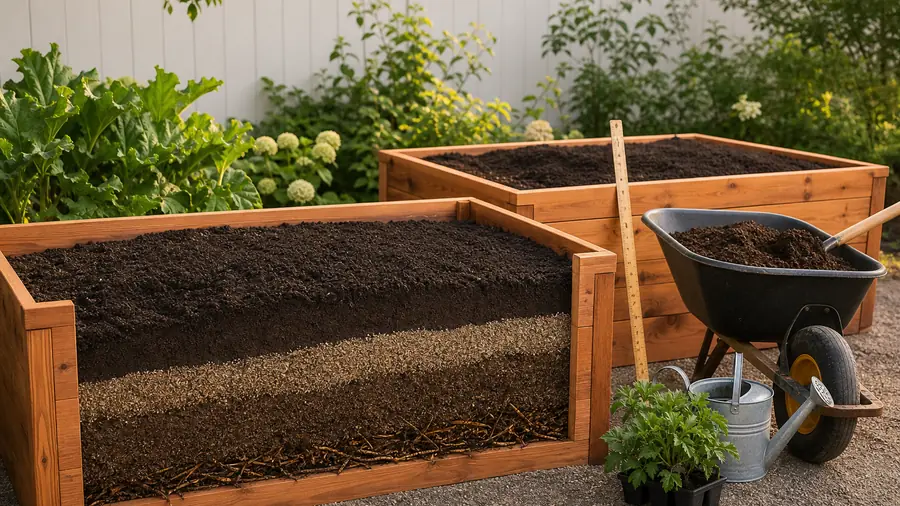

A calculator can add several volumes. The harder part comes before and after that addition: deciding which space each bed needs filled, which product belongs there, and how the raw subtotal maps to the supplier's minimum and sales increment.
Record each bed as a separate row. Group rows only when they need the same product, total the raw volumes, then apply the supplier-specific ordering rule once.
How do you total several beds for one delivery?
Calculate volume for every named bed, assign a product code, and sum only rows that use the same material. Keep cubic feet until each group subtotal is complete, divide by 27 for cubic yards, and round that subtotal to the supplier's confirmed increment. Do not merge compost, topsoil, raised-bed mix, or mulch into one order quantity because one truck may carry them.
Calculate each garden-bed volumeWhat should you record for every garden bed?
Give each bed a stable name and record its shape, usable area, missing depth, intended material, and measurement notes.
Names such as “north vegetable bed” and “patio border” make later checks possible. “Bed 1” works until someone reorders the rows or adds another bed between them.
Measure the inside boundary that material will occupy. For a top-up, record the vertical gap from the current surface to the target line, not the frame height. Take several readings when the existing surface varies and keep the readings or zones in the notes.
| Bed | Area evidence | Depth evidence | Product code | Raw ft³ |
|---|---|---|---|---|
| North A | 8 × 4 ft inside | 5 in missing | RBM | 13.3333 |
| North B | 8 × 4 ft inside | 5 in missing | RBM | 13.3333 |
| Patio | 6 × 3 ft inside | 8 in missing | RBM | 12.0000 |
| Perennial 1–3 | 3 × 40 ft² | 0.5 in layer | COM | 5.0000 |
The product codes in this illustration mean raised-bed mix and compost. They do not prescribe either product. Choose material from the project, soil evidence, plant needs, and supplier specification before grouping.
How do you calculate each bed without losing its shape?
Calculate every area with the shape that fits it, then multiply by that bed's fill depth in the same unit system.
Iowa State University Extension expresses material volume as area multiplied by depth in feet. Convert inches to feet before multiplying. Divide the completed cubic-foot volume by 27 to obtain cubic yards.
Rectangles use length × width. Circles use π × radius². Split an L-shaped or curved boundary into measurable pieces rather than forcing it into an oversized rectangle. The irregular garden-bed guide covers field sketches, split shapes, offsets, and accuracy checks.
A sloped surface needs a different boundary. Measure horizontal plan area for an even surface layer and use depth zones when a fill wedge changes thickness. The sloped-bed measurement guide explains that distinction.
Which beds can share one material subtotal?
Group beds only when they require the same product specification and the same treatment of allowances and delivery.
Two raised beds can share a subtotal even when their dimensions differ. A compost topdressing row belongs in another group because its material and application purpose differ.
Penn State Extension tells soil-test users to label the sample by the area it represents. Its Master Gardener guidance also notes that vegetable gardens, flower beds, lawns, and other planting areas can have different needs. University of Minnesota Extension warns that combining samples from areas with different soil types or management can create an inaccurate representation.
Those sampling rules do not calculate delivery volume. They support the grouping principle: a convenient yard-wide average should not erase meaningful site differences.
| Situation | Same subtotal? | Reason |
|---|---|---|
| Different bed size, same exact mix | Yes | Product is compatible |
| Topsoil and compost | No | Separate products and uses |
| Same name, different supplier grade | No | Specification changed |
| One split-load truck | Still separate | Truck count does not blend order lines |
How does the checked multi-bed example total?
The three raised-bed-mix rows total 38.6667 cubic feet, or 1.4321 cubic yards. The compost stays in its own 0.1852-cubic-yard group.
Each 8 × 4-foot bed with 5 inches missing needs 8 × 4 × 5/12 = 13.3333 cubic feet. Two matching beds need 26.6667 cubic feet. The 6 × 3-foot bed at 8 inches needs 12 cubic feet.
Add the compatible rows: 26.6667 + 12 = 38.6667 cubic feet. Divide by 27 to get 1.4321 cubic yards before any supported allowance or supplier increment.
Three separate 4 × 10-foot beds receiving 0.5 inch of compost need 3 × 40 × 0.5/12 = 5 cubic feet, or 0.1852 cubic yard. Adding that number to the raised-bed-mix subtotal would create 1.6173 cubic yards of no single product.
These dimensions test the workflow. They do not recommend an application depth, recipe, allowance, or supplier quantity.
Can a weighted average depth check the total?
Yes, within one compatible material group. Use an area-weighted depth as an audit, then keep the original bed rows.
The raised-bed-mix group covers 64 square feet across the two large beds plus 18 square feet in the patio bed, for 82 square feet. Its 38.6667 cubic feet spread across that area represents an average depth of 38.6667 ÷ 82 × 12 = 5.6585 inches.
A plain average of 5, 5, and 8 inches gives 6 inches and ignores that the 8-inch bed has less area. The weighted figure reproduces the volume because larger areas carry more weight.
Do not use this shortcut across compost and soil groups or across sloped fill zones that need different geometry. The audit checks a compatible subtotal; it does not replace the measurements that created it.
Myth versus reality: should you round every bed up?
Round the compatible group subtotal once. Rounding every row can inflate a bulk order before the supplier sees it.
| Shortcut | Problem | Better action |
|---|---|---|
| Round each bed | Repeats the increment several times | Total compatible rows first |
| Add a fixed percentage | Uncertainty differs by project and material | Name the evidence |
| Assume half-yard sales | Supplier increments vary | Confirm the actual increment |
| Convert units in every row | Repeated rounding can drift | Keep one working unit |
Consider four compatible small beds that each calculate to 0.14 cubic yard. Their raw subtotal is 0.56 cubic yard. If a supplier sells in half-yard increments, rounding every bed separately produces 2 cubic yards, while subtotal-first rounding produces 1 cubic yard.
The half-yard increment is illustrative. Ask the supplier for its current minimum, sales increment, and whether mixed products require separate loads or compartments.
How do existing beds change the order?
Existing material reduces the open volume. Measure the missing layer instead of rebuying the frame's full capacity.
Mark a target line, take several vertical gap readings, and split the bed into zones when settlement varies. Exclude a permanent false floor or insert by measuring from the surface that new material will touch.
The settled raised-bed top-up guide covers before-and-after measurements, variable gaps, plant crowns, and the boundary between top-up volume and a complete refill.
Record whether each ledger row represents full fill, top-up, or a surface layer. That label helps catch a 12-inch frame mistakenly entered where only 3 inches are missing.
How should you reconcile the supplier quote?
Compare each quoted order line with its requested product, raw subtotal, allowance basis, unit, minimum, and sales increment.
| Field | Your request | Supplier quote | Resolve |
|---|---|---|---|
| Product | Exact name or specification | Quoted SKU or blend | Any substitution |
| Raw volume | Unrounded subtotal | Quoted order quantity | Difference and basis |
| Sales rule | Expected unit | Minimum and increment | Final rounding |
| Delivery | One requested visit | Load or compartment plan | Separation and fees |
A supplier may recommend a different quantity because of a minimum order, product-specific compaction, available scoop size, or a changed material. Capture the reason. Do not overwrite the raw measurement, because you need both numbers to audit the delivery.
Use the bulk supplier question guide for product source, screening, test data, density, moisture, and quote terms. Then use the delivery checklist for truck access, drop location, surface protection, weather, and invoice checks.
Which calculator should handle the final groups?
Use the calculator that matches each product and project, then preserve its result as a ledger subtotal.
The Raised Bed Soil Calculator supports several raised-bed groups and missing fill. The Soil Calculator handles general garden-bed fill. Compost, topsoil, and mulch should remain in their corresponding calculators and order lines.
Calculators reduce arithmetic errors. The ledger preserves the decisions they cannot prove: product suitability, field boundary, allowance evidence, supplier increment, and delivery separation.
Multiple-bed delivery questions
Can I add all garden-bed cubic yards together?
Only rows that require the same exact material can share a product subtotal. Keep compost, topsoil, raised-bed mix, and mulch separate.
Should I round each bed to the nearest half yard?
No. Keep raw volumes, total compatible rows, confirm the supplier's actual increment, and round the group subtotal once.
Can I use one average depth for different beds?
An area-weighted depth can audit a compatible group. Keep each original depth and do not use a plain average when bed areas differ.
Does one delivery mean the supplier can mix products?
No. Confirm whether separate products require compartments, separate loads, or separate delivery visits, and keep each order line distinct.
Sources and calculation boundary
- Iowa State University Extension: Success With Your Vegetable Garden, for raised-bed volume and cubic-foot-to-yard calculation.
- Iowa State University Extension: Determine the Amount of Mulch Needed, for area × depth and divide-by-27 method.
- Penn State Extension: Soil Testing, for representative area samples and area labels.
- Penn State Extension Master Gardener: Separate Garden Needs, for distinguishing planting areas during soil testing.
- University of Minnesota Extension: Test, Don't Guess, for keeping unlike soil or management areas separate.
- National Institute of Standards and Technology: SI Units, Volume, for metric volume relationships.
Change log: Published July 28, 2026 with a bed-to-quote diagram, checked material-group example, weighted-depth audit, subtotal-first rounding test, and quote reconciliation worksheet.
Last updated 11 November 2026