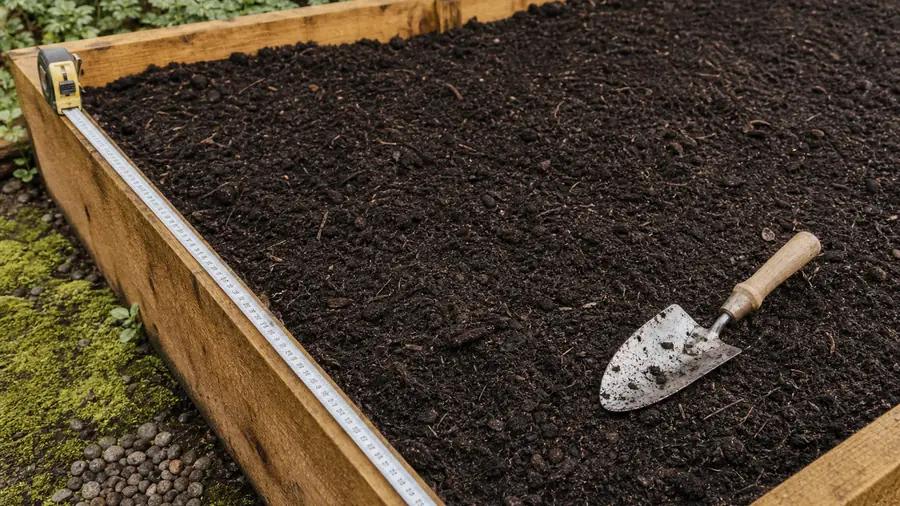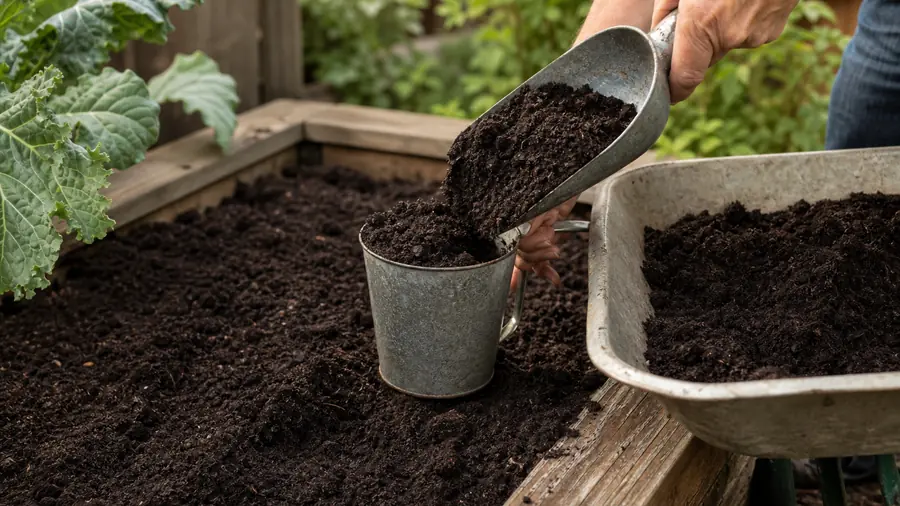

A settled raised bed needs the volume between its current soil surface and the finish line you choose. It does not need the original length by width by full frame height calculation again.
Measure that missing depth across the bed, inspect why the level dropped, and choose the refill material before ordering. Compost can be one part of the plan, but a deep deficit is not a reason to fill the whole space with compost.
How much soil is needed to top up a settled raised bed?
Mark the intended soil surface, take several vertical readings down to the settled surface, and use their working average as the missing fill depth. Multiply inside length by inside width by that depth. Keep a planned compost application separate from the larger soil-mix refill, then enter only the missing depth in the Raised Bed Soil Calculator.
Calculate the measured top-upInspect the bed before treating every drop as settling
Look for decomposition, erosion, wall movement, voids, and removed roots before placing a straightedge.
Oregon State University Extension notes that newly filled beds can sink as compost in the mix continues to decompose. Watering also rearranges loose particles after an initial fill. Those changes often produce a broad drop across the surface.
A low channel beside a leaking corner, soil outside the frame, a bowed board, or one sudden hollow needs a physical repair first. Check that the frame remains stable and that no animal tunnel or decayed filler has opened a void. Adding material over an active loss hides the symptom without fixing it.
Remove loose annual crop debris, but do not pull established roots merely to make measurement easy. Mark perennial crowns, woody stems, irrigation lines, and graft unions that must remain above the finished surface. Take a nearby reading when a plant blocks a sample point.
Set one finish line and measure missing depth on a grid
Stretch a level string or rest a straight board at the planned surface, then measure vertically at several locations.
The frame top is a convenient reference, but it does not have to be the finish line. Reserve the watering, mulch, and stem clearance required by the planting plan. Measure the vertical gap from that line rather than the sloped distance along a board.
Use at least the four quarters of a small bed. Add center and edge readings when the surface varies or the bed is long. Rake loose peaks gently, then record the surface without stepping inside and compressing it.
Take every reading during the same visit. Saturated, frozen, or freshly worked soil does not provide the same reference as a drained, settled surface. If recent weather makes the surface unstable, mark the finish line and return when the bed can support a ruler without sinking.
Average the samples when they describe one gradual surface. Split the bed into separate rectangles when one section stays much deeper. Separate groups preserve the extra volume instead of letting one average hide a distinct low zone.
A 4 by 8 bed with a 2.75-inch gap needs 7.33 cubic feet
The readings 2, 3, 2.5, and 3.5 inches average 2.75 inches.
Convert depth to feet: 2.75 divided by 12 equals 0.2292 foot. Multiply 4 feet by 8 feet by 0.2292 foot. The top-up is about 7.33 cubic feet, 0.27 cubic yard, or 208 liters before allowance and whole-package rounding.
| Order basis | Depth | Volume |
|---|---|---|
| Original full fill | 12 inches | 32.00 ft³ |
| Current top-up | 2.75 inches | 7.33 ft³ |
| Not repurchased | 9.25 inches present | 24.67 ft³ |
Enter 4-foot length, 8-foot width, and 2.75-inch fill depth in the Raised Bed Soil Calculator. Its grouped-bed mode can total matching beds or preserve different dimensions. Add an allowance only when the product, supplier, or job conditions justify one.
NIST's exact conversion makes 7.33 cubic feet about 207.6 liters; 208 liters is rounded. Eight one-cubic-foot bags contain enough nominal volume before product directions, consolidation, and any material reserved after filling.
Separate structural refill from a compost application
Use suitable soil or a documented raised-bed mix for lost bulk, and count compost only at a supported depth.
Oregon State Extension recommends a quarter-inch to 1-inch annual compost layer for existing vegetable beds and says framed raised beds should not be filled with compost alone. A 2.75-inch deficit should not become an automatic 2.75-inch compost application.
Suppose a soil test, local recommendation, and product analysis support a 0.5-inch compost layer in the example. That layer is 1.33 cubic feet. The remaining 2.25 inches is 6 cubic feet of suitable soil mix. This arithmetic explains a documented plan; it does not prescribe 0.5 inch for every bed.
A 2025 Ask Extension response for a settled Colorado bed says topsoil from the yard or bagged garden soil can restore level and warns about salts in purchased materials. Rutgers Cooperative Extension says mineral soil provides structural support and advises buyers to read ingredients and request supplier soil-test reports.
Use the raised-bed soil mix guide to choose components for the current soil, crop, drainage, and test. When the selected top layer is compost, keep its volume separate in the Compost Calculator.
Avoid a sharp new layer and buried plant crowns
Follow the material guidance for the bed and feather new soil into the exposed surface where disturbance is appropriate.
Iowa State University Extension warns that distinct soil layers can impede water movement and discourage root growth. Its current guidance incorporates added mix into existing soil rather than leaving a sharp interface.
Work around established roots and minimum-till plans. Do not dig through a perennial crown or sever a dense root system to satisfy a generic instruction. Ask a local Extension service how the named plant tolerates added soil and disturbance.
Keep the final surface away from woody bark, crowns, graft unions, and foliage that sat above grade. A deep refill around established plants may require lifting and resetting a plant during its suitable transplanting period rather than burying its base.
Water, settle, and remeasure before buying another load
Place material in shallow lifts, level without hard packing, water as directed, and check the same sample points again.
Keep the first measurement sheet. Reusing one finish line and grid distinguishes a small post-fill adjustment from a fresh order. If one point drops again while the rest stays level, inspect that section for a leak or void.
Confirm that water leaves the bed and that the frame remains square. Restore mulch only after the soil surface is correct, and keep mulch thickness outside the soil-volume calculation. Soil, compost, and mulch occupy separate layers with separate purposes.
Use the raised-bed depth guide when the target line depends on root space below the frame. That guide separates frame height from usable soil depth; this guide measures only the missing band above an existing bed.
Settled raised-bed top-up questions
Why does raised-bed soil sink?
Organic components decompose, loose material consolidates, roots and harvest remove material, and soil can escape through damaged edges. Inspect the pattern before naming one cause.
Should I top up with compost only?
Do not use compost as automatic bulk fill. Select a supported application depth and use suitable soil or raised-bed mix for the remaining volume.
Can I add soil around existing plants?
A shallow addition may suit some plants, but do not bury crowns, graft unions, woody stems, or foliage. Check guidance for the named plant.
Do I enter the full frame height?
No. Enter only the vertical depth from the current soil surface to the planned finish line.
Sources and calculation boundary
- Ask Extension: What Do I Top Off My Raised Beds With?, for the soil and salt boundary.
- Iowa State University Extension: Raised-Bed Soil Mix, for drainage and layer guidance.
- Rutgers Cooperative Extension: Soil for Raised Beds, for structure, labels, and supplier reports.
- Oregon State University Extension: How to Use Compost, for compost depth and refill boundaries.
- NIST Guide to the SI, Appendix B, for volume conversions.
Change log: Published July 28, 2026 with a grid-depth diagram, full-fill comparison, material-split example, and planted-bed boundary.
Last updated 11 November 2026