Container measuring guide
How much potting soil do your containers need?
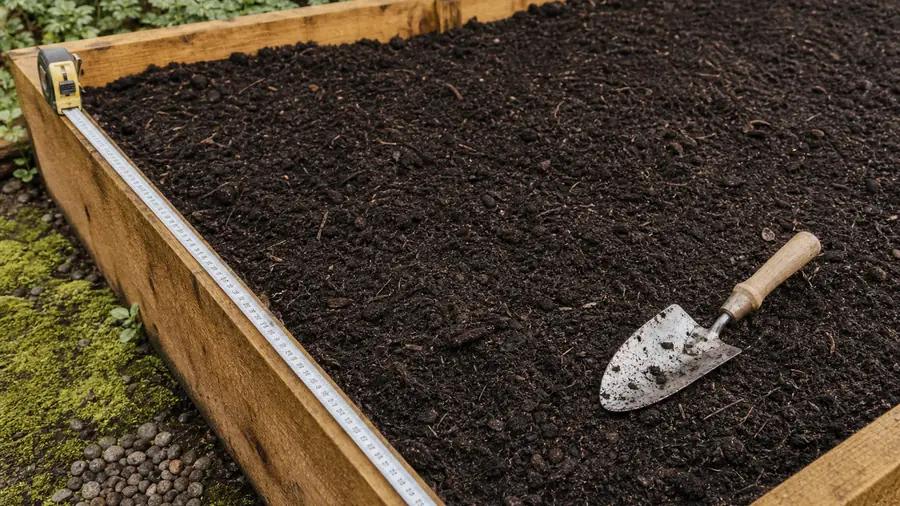
Put the tape inside the pot. A thick rim, narrow base, false bottom, or water reservoir can remove more capacity than the label suggests. This guide measures the space roots will use.
Content and source check completed July 28, 2026 Container geometry and media guidance
The useful measurement is inside capacity
Measure the space potting mix can occupy, then group only identical containers. Stop below the rim, stay above any reservoir or insert, and use the tapered option when the base is narrower than the opening. The calculator converts the combined capacity to your bag unit.
The potting soil calculator is directly above.Set the pot on a bench and choose its closest shape
Use straight round for parallel walls, tapered round for a narrower base, and rectangular for a box planter. Choose known volume only when the manufacturer states usable soil capacity in a clear unit.

Measure geometry
- Rigid round or rectangular planters
- Tapered pots with visible top and base
- Containers with a measurable soil chamber
Use stated capacity
- Flexible grow bags that change shape
- Complex self-watering planters
- Products with verified soil volume
The shape decides the geometry behind the result
A straight pot acts like a cylinder. A tapered pot uses a truncated-cone formula, and a box uses rectangular volume. The known-volume option skips geometry and converts the stated capacity.
A cylinder uses π × radius² × height. Radius is half the inside diameter. A rectangular planter uses inside length × inside width × usable inside height. A tapered pot is a frustum: π × height ÷ 12 × (top diameter² + top diameter × bottom diameter + bottom diameter²). The frustum formula matters because treating a narrow base as a straight cylinder overstates capacity.
Imperial dimensions are entered in inches and converted from cubic inches to liters. Metric dimensions are entered in centimeters and converted from cubic centimeters to liters. The exact conversion factors come from the National Institute of Standards and Technology. One cubic foot equals 28.316846592 liters, while a US dry quart and a US liquid quart are different units; this tool labels the dry-quart output explicitly.
| Shape | Required measurements | Formula |
|---|---|---|
| Straight round | inside diameter, usable height | πr²h |
| Tapered round | top and bottom inside diameters, height | πh(D₁² + D₁D₂ + D₂²) ÷ 12 |
| Rectangular | inside length, width, height | length × width × height |
| Known volume | manufacturer usable capacity | capacity × quantity |
Measure where the potting mix will sit
Measure inside the container at the space potting mix can occupy. Exclude wall thickness, a false bottom, reservoir, insert, drainage platform, and the headspace you plan to leave below the rim.
For a round pot, measure straight across the center rather than along the curved rim. If the walls are parallel, select straight round. If the base is noticeably narrower, select tapered and take a second inside diameter near the bottom of the usable soil space. Use the vertical usable height, not the pot's sloped wall length.
The tapered pot and planter measuring guide shows the inside measurement points, checked frustum example, and separate method for a rectangular taper.
For a window box, trough, or rectangular planter, measure inside length and width near the potting-mix level, then usable height. If the sides taper heavily in both directions, rectangular volume will be an approximation. Divide a complex planter into simpler sections or use a manufacturer's verified internal capacity.
Quantity should repeat only identical containers. Six matching nursery pots can be one group with quantity six. Two larger patio pots belong in another group. Combining them in one calculator avoids the common notebook ritual of adding four rounded answers and wondering where the extra half-bag came from.
Worked example: four tapered pots and two planters
Four matching tapered pots and two rectangular planters have about 140.1 liters of combined geometric capacity with the dimensions below. A 90% fill level and 5% order allowance produce a 132.4-liter shopping estimate, or four 40-liter bags.
| Container group | Inside measurements | Group volume |
|---|---|---|
| 4 tapered pots | 14 in top × 10 in base × 12 in high | 89.8 L |
| 2 rectangular planters | 24 in × 8 in × 8 in high | 50.3 L |
| Combined geometry | 89.8 L + 50.3 L | 140.1 L |
Applying the fill level gives 140.1 × 0.90 = 126.1 liters. Applying the allowance afterward gives 126.1 × 1.05 = 132.4 liters. Dividing by a 40-liter bag gives 3.31, so the purchase rounds up once to four bags. Keeping both groups in one calculation avoids rounding the tapered pots and planters separately.
Leave watering space once, not twice
Fill level is the percentage of geometric container volume you plan to occupy with potting mix. It accounts for headspace and other known exclusions without silently changing the measured shape.
A 100% setting means the full measured inside geometry. A 90% setting uses nine tenths of that capacity. If you already measured only the usable height, stopping below the rim and above a reservoir, you can use 100% and avoid subtracting the same space twice. Pick one method and record it.
University of Maryland Extension's container vegetable guidance recommends filling within roughly an inch of the rim so water has room to soak in without overflowing. It also advises against adding gravel, rocks, or pot shards as a routine bottom layer because they occupy root space and can worsen drainage. That guidance is why the calculator asks for usable mix space instead of proposing a generic filler deduction.
A self-watering planter needs special attention. Its water reservoir and platform are not potting-mix volume, though a wicking column may be. The known-volume mode is often best when the manufacturer gives a clear soil-capacity specification separate from reservoir capacity. Otherwise measure the actual soil chamber.
Turn combined container volume into bags
The calculator converts every container to liters, applies fill level and allowance, divides by the bag volume, and rounds up to a whole bag. Use volume from the product label, not package weight.
Potting mix may be sold in liters, cubic feet, or US dry quarts. Choose the label's unit and enter its number exactly. A bag labeled 1.5 cubic feet is not the same input as 1.5 liters, and a US dry quart is larger than a US liquid quart. GardenMeasure converts each supported volume to liters before comparing it with the container total.
Whole-bag rounding creates a small remainder. If the project requires 55 liters and bags contain 20 liters, the shopping count is three bags, providing 60 liters. The cost uses three bags. It does not pretend a retailer will open the third bag and charge only for the five liters needed.
The allowance is separate from fill level. Fill level describes planned container space; allowance covers reasonable loss or uncertainty. A small project with accurate inner dimensions may need little or no extra percentage because whole-bag rounding already provides reserve. For many irregular pots, a modest allowance may reduce the risk of stopping mid-repot.
Pre-moistened mix can settle differently from dry compressed material. Follow the product directions, avoid packing media tightly, and keep the purchase receipt until the containers are filled. The calculator estimates volume; it does not predict how a specific brand expands, settles, or is packaged.
At what volume does bulk beat bags?
Bulk wins only after the order is large enough to repay the delivery fee.
Break-even bags = delivery fee ÷ (price per bag − bag volume × bulk price per cubic yard), rounded up to whole bags. Break-even volume = break-even bags × bag volume. Below that volume, whole bags cost less. Above it, bulk delivered costs less. The calculator works this out live from your prices above.
| Example | Bag | Bulk price | Delivery | Break-even bags | Break-even volume | Check at break-even |
|---|---|---|---|---|---|---|
| 1 — this page's defaults | 1.5 cu ft bag, $9 | $45 / yd³ | $60 | 10 bags | 0.56 yd³ (424.8 L) | 10 bags $90.00; bulk $85.00 |
| 2 — dearer bags | 1.5 cu ft bag, $12 | $50 / yd³ | $40 | 5 bags | 0.28 yd³ (212.4 L) | 5 bags $60.00; bulk $53.89 |
Supplier minimums, half-yard increments, taxes, and delivery zones are not in this sum. Confirm them with the supplier before ordering.
What does this order weigh?
Potting-mix weight is not fixed by volume. It changes with ingredients, moisture, and compression in the bag.
This site publishes no verified weight per cubic yard for potting mix, so the calculator shows no weight until you enter a supplier density for this mix and moisture condition. Use volume from the product label, not package weight, to size the order. The cubic-yard soil weight guide explains why one cubic yard has no single weight.
Worked example with an example supplier figure: the default order is 42.4 liters, or 0.055 cubic yards. At an example density of 1,000 lb per cubic yard, that is 0.055 × 1,000 = 55 lb, or 0.03 short tons. 1,000 is an example input, not a measured potting-mix density.
Choose a growing medium for roots confined to a container
Container roots depend on a small volume of material for air, water, nutrients, and support. Choose media made for that confined space rather than filling pots with untreated garden soil or bulk topsoil by default.
The University of Maryland Extension guide to growing media explains that container media supplies roots with nutrients, air, water, space, and physical support. It notes that garden soils are generally too dense for good air and water movement in containers, while commercial soilless mixes are designed to be lightweight and drain while holding water and nutrients.
“Potting soil” is a retail name, not a promise that every bag has the same ingredients or behavior. Read the product label and choose for the plant, container size, watering pattern, climate, and whether the pot sits indoors or outside. Seed-starting media, orchid bark, cactus mix, and general container mix serve different physical needs even when their volumes are measured the same way.
The potting mix versus garden soil guide compares the confined container root zone with in-ground soil and provides a five-part bag-label check before you calculate bags.
Compost can be part of a container mix, but a calculated container volume does not establish a safe recipe. If you are measuring a compost layer for ground soil, use the Compost Calculator. For framed outdoor beds and custom blend percentages, use the Raised Bed Soil Calculator.
Can a labeled gallon pot be entered as exact capacity?
Only when the manufacturer states a reliable usable volume and the unit is clear. Nursery size names can be nominal product classes, while the calculator's gallon option means a US liquid gallon conversion.
A container sold as a “five-gallon pot” may have wall taper, rim space, or trade sizing that differs from an exact five US liquid gallons of soil. Inner dimensions usually give a more transparent estimate. If a technical sheet lists soil capacity in liters or cubic feet, the known-volume mode can use that specification directly.
Do not mix gallon systems. US liquid gallons, imperial gallons, and dry measures are not interchangeable. GardenMeasure labels its known-volume gallon input as US liquid gallons and reports US dry quarts separately. Users outside the United States will usually get the cleanest result by entering liters.
Fabric grow bags are especially hard to infer from flat dimensions because their shape changes when filled. Use a trustworthy stated soil capacity if available, or measure a filled bag's practical inside shape. For a ground-level growing bed rather than a portable container, the Soil Calculator may fit the geometry better.
What checks should you make before buying potting mix?
Recheck inner measurements, shape, quantity, fill treatment, bag volume, and bag price. Confirm that the selected growing medium suits the plants and that every container can drain as intended.
Measure one container from every supposedly identical set; molded pots can differ by brand. Check that top diameter and bottom diameter were not reversed. The frustum formula produces the same volume either way, but clear notes make later verification easier. Confirm the height stops at the planned soil surface.
Check whether existing root balls displace part of the new mix. This calculator estimates the filled container space, not the exact mix needed around an unknown root mass. For repotting, you can measure the old container volume as a rough displacement reference, but roots, old media, and irregular shapes make the difference an estimate.
Finally, compare the calculated total with the physical job. A result of 500 liters for two small windowsill pots signals an input unit mistake. A quick reasonableness check catches inches entered as feet, centimeters entered under imperial mode, and quantities with an accidental extra zero.
Questions gardeners ask at the potting bench
Should I measure the pot inside or outside?
Use inside dimensions because pot walls, rims, and decorative shells do not hold growing medium.
How do I calculate a tapered flowerpot?
Measure top inside diameter, bottom inside diameter, and usable vertical height, then choose tapered round. The tool uses the truncated-cone formula.
What if the planter has a water reservoir?
Exclude the reservoir and platform from usable mix height, or use a reliable manufacturer soil-capacity figure in known-volume mode.
Why are dry quarts labeled separately?
A US dry quart is a volume unit different from a US liquid quart. Potting media is commonly labeled in dry quarts, so the distinction prevents conversion errors.
Can I calculate several different pot sizes together?
Yes. Add a group for each unique shape and set of dimensions, and use quantity for identical containers.
Sources and calculation references
- NIST Guide to the SI, Appendix B: unit conversion factors.
- University of Maryland Extension: Growing Media for Containers: container-media functions and product context.
- University of Maryland Extension: Growing Vegetables in Containers: fill, drainage, and headspace guidance.
- Penn State Extension: Repotting Houseplants: drainage and leaving watering space below the rim.