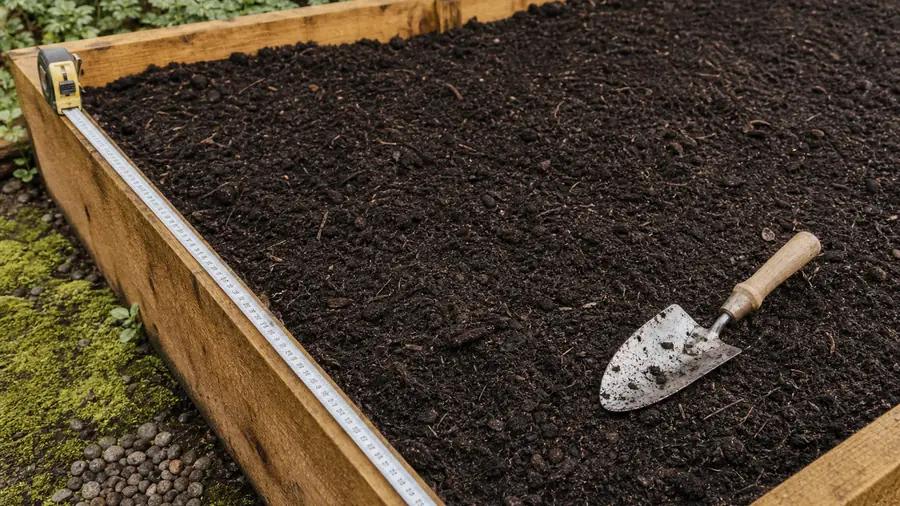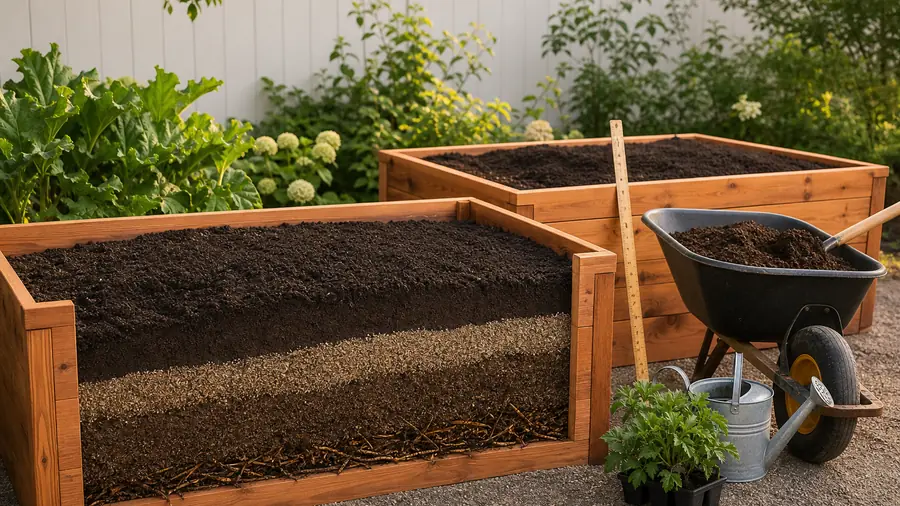

A planted perennial border is not a blank vegetable plot. Digging compost through one may cut roots, while leaving a deep pile on the other may fail to address compacted soil before planting. “Add compost” is incomplete advice until the site, material, and purpose are named.
First decide whether the compost belongs on the surface or within a prepared soil zone. Then use its applied layer, not the full mixing depth, to calculate volume.
Should you topdress with compost or mix it into soil?
Topdress established beds and lawns when digging would disturb living roots. Incorporate finished compost before planting when you need to amend a new or compacted soil zone. The safe amount depends on the compost analysis, soil test, site, crop, and application history. Composted manure needs fertilizer treatment, not an automatic yard-waste compost rate.
Calculate the chosen compost layerTopdressing and incorporation solve different jobs
Topdressing places compost on an existing surface. Incorporation distributes it through a measured depth of soil before planting or renovation.
Oregon State University Extension separates new garden beds from annual maintenance. Its guide describes a larger pre-plant layer incorporated into a defined soil zone, while existing beds receive a thinner yearly surface application. These are application contexts, not universal settings for every compost product.
The choice is not a contest between “natural” and “traditional” gardening. It is a site decision. Existing roots, bare ground, compaction, turf cover, drainage, and the product analysis are observable facts that can support it.
Choose the method from the site condition
Use the least disruptive method that still addresses the physical problem you can identify.
| Site now | Likely method | Check first |
|---|---|---|
| Established planted bed | Thin surface topdress | Roots, stems, crowns, soil test |
| New bare bed | Incorporate before planting | Native soil, drainage, compost analysis |
| Compacted soil | Targeted incorporation may help | Compaction depth and soil moisture |
| Established lawn | Fine, thin topdress | Turf canopy and screened product |
| New turf area | Incorporate before seeding or sod | Finished grade and prepared depth |
This table selects a method, not a rate. Soil and compost testing can show whether repeated applications would add nutrients that are already abundant. University of Minnesota Extension advises treating composted manure as fertilizer because its nutrient role differs from non-manure compost.
Existing planted beds usually favor a surface application
Place finished compost over the soil where it can be spread without cutting through established root systems.
Wisconsin Extension describes compost as a mulch option in no-till or partially tilled vegetable gardens. It advises leaving space between the material and plant bases. Keep stems, tree trunks, and perennial crowns visible rather than banking compost against them.
A surface application still needs a measured average depth. Rake the compost evenly, break up clumps, and avoid burying low foliage. If old mulch is present, inspect the remaining layer instead of automatically stacking a fresh compost layer on top.
Do not claim that one thin dressing will correct every soil problem. A soil test may point to a nutrient concern, while a field inspection may reveal drainage, compaction, or grade problems that surface compost alone cannot fix.
New or compacted beds can justify incorporation
Mix compost before planting when the goal is to change the prepared soil zone and roots are not yet occupying it.
Oregon State describes spreading 3 to 4 inches for a new garden bed and incorporating it into the upper 8 to 12 inches, subject to soil testing and site needs. Penn State gives a more conservative 1-to-2-inch example mixed into the top 6 to 8 inches for garden soils or new turf. The difference is a reason to keep source, material, and scenario together, not an invitation to average the numbers.
University of Minnesota Extension discusses incorporating 1 to 2 inches into 6 to 8 inches for flower and vegetable gardens, especially where soil is compacted. It also recommends hand tools and reduced tillage where practical. Avoid working saturated soil, which can smear and compact rather than improve the bed.
Incorporation means a reasonably even blend through the intended zone. It does not mean filling a raised bed with compost alone. For a new box, use the raised-bed soil mix guide to choose documented components before calculating each share.
New and established lawns need separate plans
Incorporate compost while preparing bare soil for new turf; topdress an established lawn thinly enough to keep grass exposed.
Penn State Extension describes incorporating 1 to 2 inches of compost into 4 to 6 inches of soil for new turf establishment. For established turf it describes a thin application of about one quarter inch, with aeration and dragging used to move material into the canopy.
More is not automatically better. Penn State warns that repeated thick surface layers can create an organic-rich layer near the top, restrict rooting, and leave shallow roots vulnerable to drying. Use screened material suitable for turf and stop if the dressing would cover grass blades.
The same bed can require four times the compost
A 12-by-8-foot bed needs 4 cubic feet at one-half inch, but 16 cubic feet at 2 inches. Both results are raw volume before any allowance.
| Scenario | Calculation | Raw volume |
|---|---|---|
| Surface example | 96 ft² × 0.5 in ÷ 12 | 4 ft³ = 0.15 yd³ |
| Pre-plant example | 96 ft² × 2 in ÷ 12 | 16 ft³ = 0.59 yd³ |
The half-inch example follows University of Minnesota's non-manure compost example for flower and vegetable gardens. The 2-inch example sits within Penn State's pre-plant incorporation context. They demonstrate the purchasing effect of a decision; they do not prescribe either rate for your bed.
Enter the chosen applied depth in the Compost Calculator. If the project is a deeper mineral fill rather than a compost amendment, calculate that volume separately with the Soil Calculator. The material comparison guide can help separate those jobs. If one order covers turf and planted areas, the compost for lawns versus garden beds guide keeps their products, depths, and quantities in separate zones.
Check the compost and soil before setting a rate
Confirm feedstock, maturity, screening, soluble salts, and nutrient analysis, then compare those facts with a current soil test.
“Compost” describes products made from different inputs under different processes. A finished, screened yard-waste compost, a manure-based compost, and an immature homemade pile should not inherit one application rate. Ask a bulk supplier for a recent analysis and the intended uses of the exact product.
A soil test is especially useful before repeating compost in the same place. Penn State and University of Minnesota guidance both connect application choices with testing. If the test or product report is unclear, ask the testing laboratory or local Extension service to interpret it for the planned crop and site.
A short field checklist prevents the common mistakes
Record the site, method, source, applied layer, and material before buying.
- Mark whether the area is planted, bare, turf, or compacted.
- Choose topdressing or incorporation before measuring depth.
- Keep compost away from stems, trunks, and plant crowns.
- Do not use total mixing depth as compost depth.
- Keep manure-based compost rates separate from non-manure compost.
- Save the soil test, product analysis, dimensions, and calculation.
Recheck the surface after spreading. A bed with low pockets or a lawn with exposed piles does not have the intended average layer, even when the delivered cubic yards were calculated correctly.
Compost application questions
Can I leave compost on top of garden soil?
Yes, finished compost can be used as a measured surface dressing in established beds. Keep it away from stems and crowns, and use soil and product information to choose the amount.
Should I mix compost into a new vegetable bed?
Extension sources describe incorporation before planting, but their example layers and mixing depths differ. Match the guidance to your soil, compost, and test results.
Does compost need to be tilled in?
No. Established beds and lawns often receive surface applications. When incorporation is justified in bare soil, hand tools may provide enough disturbance for a small bed.
Which depth goes in the calculator?
Enter the compost layer spread before mixing or raking. Do not enter the full depth of the amended soil zone.
Sources and decision boundary
- Oregon State University Extension: How to Use Compost in Gardens and Landscapes, for new and existing bed contexts.
- University of Wisconsin–Madison Extension: Making and Using Compost in the Garden, for surface and pre-plant methods.
- Penn State Extension: Using Composts to Improve Turf Performance, for new and established turf.
- Penn State Extension: Home Composting, for testing and incorporation context.
- University of Minnesota Extension: Soil Testing for Lawns and Gardens, for non-manure examples and the manure boundary.
- University of Minnesota Extension: Living Soil, Healthy Garden, for compacted soil and reduced disturbance.
Change log: Published July 28, 2026 with a two-method cross-section, site decision table, checked same-area comparison, and compost-analysis boundary.
Last updated 11 November 2026