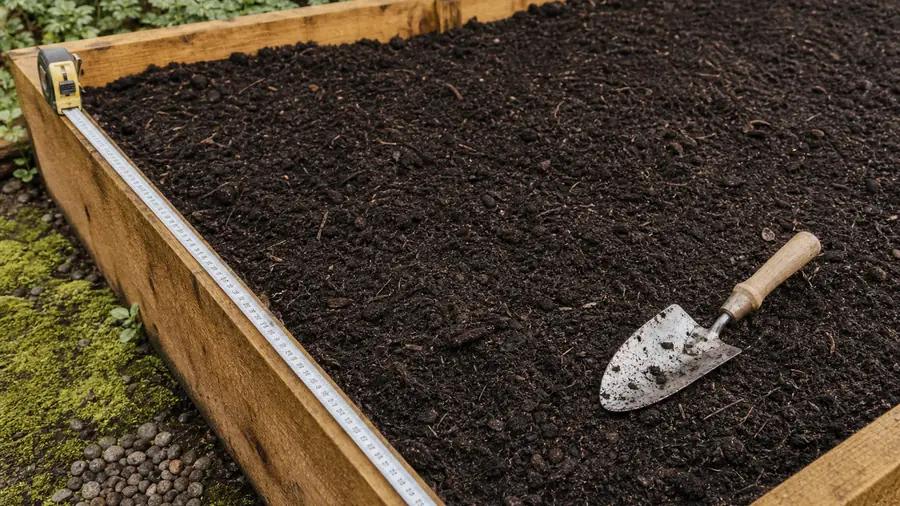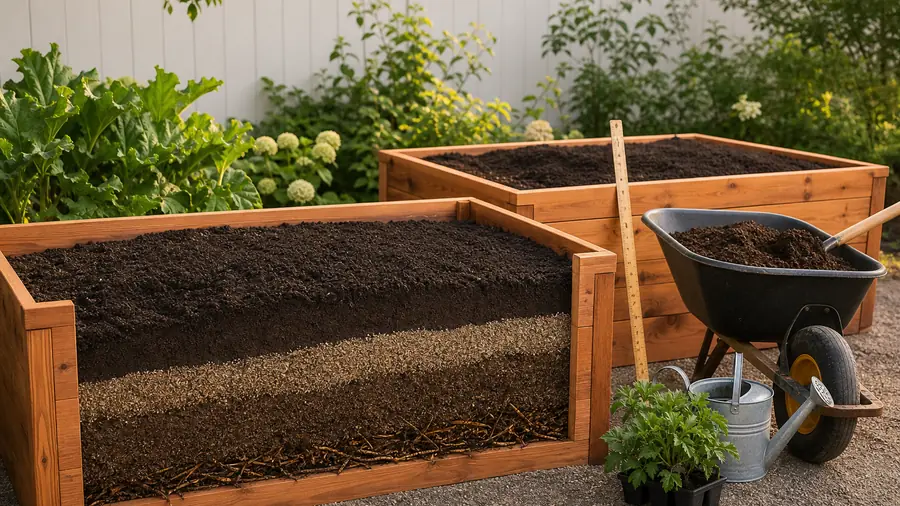

A pile of compost can serve both a lawn and a garden bed, but the two areas should not inherit one blanket rate. An established lawn has a living canopy over the soil. An existing bed has crowns, stems, and roots to protect. Bare ground for a new lawn or bed allows incorporation before planting.
Define those site states first. Then match the compost, spread depth, preparation, and calculation to each one.
What changes when compost goes on a lawn or garden bed?
Use fine, mature, screened compost in a shallow, even layer on established turf; use a soil-tested, use-appropriate compost on beds at the rate and method justified for a new or existing bed. Do not use a deep garden-bed layer on living grass, fill a new bed with compost alone, or assume compost will level a lawn. Measure lawn and bed zones separately even when they share a delivery.
Calculate each approved compost zoneStart with four site states, not two labels
Separate established lawn, new lawn, existing bed, and new bed before deciding how compost will be placed.
On established turf, compost must pass through the canopy and contact the soil without burying the grass. Oregon State University Extension describes mowing, removing clippings, core aerating, and spreading a shallow layer as an established-lawn workflow.
A new lawn has no canopy yet, so compost can be incorporated into prepared soil before seed or sod. A new garden bed likewise allows whole-area amendment. Texas A&M AgriLife Extension advises amending the entire bed rather than concentrating organic material in isolated planting holes.
An existing planted bed returns to a surface decision because digging can damage roots. The compost topdressing-versus-mixing guide covers that method choice in detail. This guide applies it to the lawn-and-bed order.
Established lawns need a fine, shallow, even topdress
Choose compost that can settle between grass blades and spread it thinly enough that the turf remains visible.
Oregon State University Extension recommends compost without large particles for lawns and gives a one-quarter- to one-half-inch topdressing range in its regional guidance. The US Composting Council also describes a finer screened grade for lawn topdressing. These are source-specific starting ranges, not permission to use any product at any site.
Ask how the material was screened and inspect a representative sample. Large wood pieces can bridge over turf instead of moving toward the soil. Unfinished material, excessive salts, debris, and clumps that cannot be spread evenly are reasons to pause.
Core aeration can create openings for compost and reduce the temptation to apply a thick layer. Match timing to the grass species, active-growth period, local climate, overseeding plan, and extension guidance. Avoid spreading onto stressed, frozen, saturated, or drought-dormant turf merely because a general calendar says it is time.
New lawns allow incorporation before grass is present
On bare soil, compost can be distributed through a prepared root zone before final grading and establishment.
Oregon State University Extension describes a one- to two-inch compost layer incorporated during new-lawn preparation. Colorado State University lists the same one-time layer context with a six-inch incorporation depth for low-salt compost. Local soil, compost analysis, drainage, grade, and establishment specifications still govern the actual plan.
The entered compost depth is the loose layer spread before mixing, not the full depth of amended soil. If one inch of compost is incorporated into six inches of native soil, calculate one inch of compost. Entering six inches would overstate the compost volume sixfold.
Finish drainage and grade decisions before ordering. Compost adds organic matter; it is not a substitute for the mineral soil needed to correct a deep depression. The lawn-leveling versus garden-fill guide separates shallow surface work from structural fill.
Existing and new beds also require different rates
Existing beds usually receive a modest surface application; new bare beds can be amended across a planned soil depth.
Oregon State University Extension gives one-quarter to one inch per year for an existing garden bed and three to four inches incorporated into a new bed. Colorado State University distinguishes the same annual-maintenance and one-time establishment contexts. Those ranges presume compost appropriate to the use and must be reconciled with a soil test, crop, history, and local conditions.
Repeated compost can accumulate phosphorus, potassium, salts, or other nutrients beyond what plants need. More depth is not automatically more soil improvement. The EPA notes that feedstock, method, rate, receiving soil, season, climate, and terrain all affect whether compost suits a project.
Keep a surface application away from stems, trunks, and plant crowns. For a new bed, mix across the area instead of making a compost-rich pocket around each transplant. A raised bed also needs a suitable soil mix; compost alone is not a universal growing medium.
Choose the product by use, analysis, and particle size
One delivery may need two products when the lawn and bed have different texture, nutrient, salt, or maturity requirements.
| Zone | Placement | Product check | Main mistake |
|---|---|---|---|
| Established lawn | Shallow surface layer | Fine, screened, mature, spreadable | Burying grass with a deep or chunky layer |
| New lawn | Incorporated before establishment | Analysis fits soil and seed or sod plan | Using compost to solve deep grade problems |
| Existing bed | Surface around plants | Analysis fits crop and application history | Piling against crowns, stems, or trunks |
| New bed | Whole-area incorporation | Soil-test fit and suitable maturity | Filling the root zone with compost alone |
Use the compost quality buying guide to verify feedstocks, batch analysis, maturity or stability, soluble salts, contaminants, sample condition, and delivery identity. An earthy smell and dark color are useful observations, but they cannot establish every safety or performance property.
Calculate lawn and bed quantities as separate zones
Multiply each area by its own approved depth, then add only compatible product subtotals.
Suppose a written plan uses a one-quarter-inch layer on an established 1,800-square-foot lawn and a one-half-inch layer on a 240-square-foot existing bed. These depths are illustrative inputs within the Oregon State ranges, not recommendations for an untested site.
The lawn requires 1,800 × 0.25 ÷ 12 = 37.5 cubic feet, or 37.5 ÷ 27 = 1.39 cubic yards. The bed requires 240 × 0.5 ÷ 12 = 10 cubic feet, or 0.37 cubic yard. Their mathematical subtotal is 47.5 cubic feet, or 1.76 cubic yards.
Do not round each zone up and then round the combined result again. Record exact subtotals, decide whether the same approved product serves both zones, and only then apply a justified contingency or supplier increment. If the lawn needs a finer product, keep the orders separate.
| Zone | Area | Depth | Exact volume |
|---|---|---|---|
| Established lawn | 1,800 sq ft | 0.25 in | 37.5 cu ft / 1.39 cu yd |
| Existing bed | 240 sq ft | 0.5 in | 10 cu ft / 0.37 cu yd |
| Subtotal | Two measured zones | Kept separate | 47.5 cu ft / 1.76 cu yd |
Build the order from evidence, not leftover pile size
Confirm the job, product, rate, and spreading access before converting the subtotal into bags or a bulk delivery.
Measure only the true treatment area. Subtract patios, paths, buildings, ponds, and untreated planting islands. Split irregular areas into simple shapes and keep notes showing which measurement belongs to which rate.
Enter every approved zone in the Compost Calculator. Compare the result with bag labels or the supplier's delivery increments. Estimated bulk weight is not a vehicle-loading guarantee; moisture and bulk density vary, so obtain current supplier information when transport capacity matters.
Finally, plan where the material will be placed, how far it must be moved, and whether weather will delay spreading. A correct quantity is still a poor order if the product cannot be protected or applied evenly when it arrives.
Compost for lawns and garden beds questions
Can I use the same compost on a lawn and a garden bed?
Sometimes, if its analysis, maturity, particle size, and intended-use guidance fit both sites. A lawn may require a finer screened grade than a bed.
Should compost cover the grass completely?
No. An established lawn topdressing should be shallow and even enough that grass blades remain exposed. Follow local turf guidance for the species and season.
Can compost level a bumpy lawn?
Compost can topdress turf, but it is not structural fill for deep depressions. Diagnose the grade or drainage problem and choose a suitable soil or blend.
Can I fill a new garden bed entirely with compost?
No general rule supports pure compost as a complete root-zone soil. Use a soil mix designed for the bed, crop, drainage, and local conditions.
Sources and application boundary
- Oregon State University Extension: How to Use Compost in Gardens and Landscapes, for new and existing beds, new lawns, established-lawn preparation, screening, and depth contexts.
- Colorado State University Extension: Choosing a Soil Amendment, for soil testing, salt cautions, and application contexts.
- US Environmental Protection Agency: Benefits of Using Compost, for benefits and site-specific use considerations.
- Texas A&M AgriLife Extension: Utilization of Compost, for whole-bed amendment, established beds, and lawn topdressing.
- University of Nebraska–Lincoln Extension: Uses of Compost in the Landscape, for amendment, volume, raised-bed, and turf context.
- US Composting Council: Guidelines for the Use and Application of Compost, for use-specific lawn and garden product characteristics.
Change log: Published July 28, 2026 with a four-state site diagram, product decision table, and checked two-zone order example.
Last updated 11 November 2026