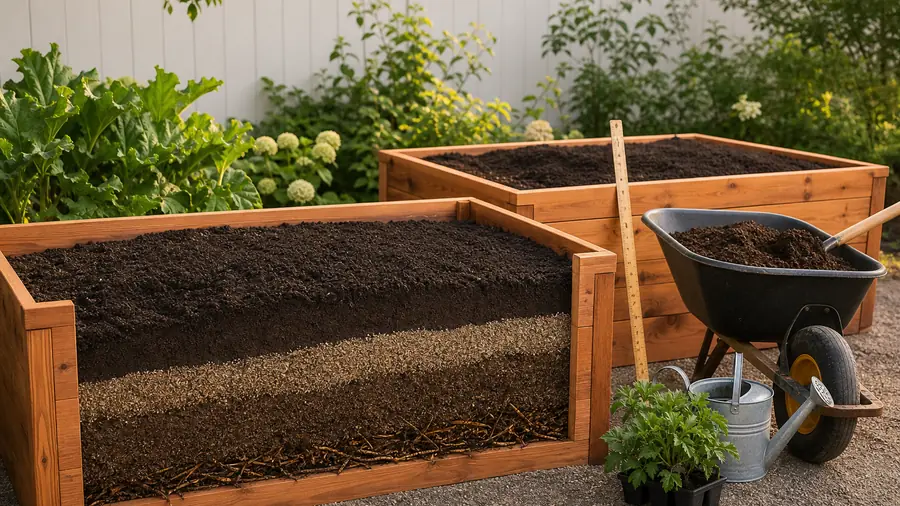

The useful question is not whether bagged or bulk compost is generally better. It is which acceptable product reaches this garden in the required volume, at the lower complete cost, through a delivery and handling plan that can actually work.
Start with the project volume and compost specification. Convert both offers to cubic feet or cubic yards, round each by its real sales rule, add every channel-specific cost, and then test access, storage, carrying distance, and application timing.
Should you buy bagged or bulk compost?
Bags often fit small, staged, or access-limited jobs; bulk often becomes competitive as volume rises and a safe delivery site is available. That is a starting pattern, not a rule. Compare the same suitable compost by purchased volume and landed cost. Reject either option if its batch evidence, delivery access, storage, or handling plan does not pass.
Calculate the compost volume firstAre the bagged and bulk products actually comparable?
Compare price only after both products meet the same intended-use requirements. A shared word such as “compost” does not make two batches equivalent.
Oregon State University Extension notes that purchased compost varies with raw materials and production method. The U.S. Composting Council likewise treats test results as product characteristics that still need interpretation for the intended use.
Put the intended application, producer, product name, feedstocks, screen size, batch or lot evidence, and allowed substitution on each quote row. If one seller provides a current analysis and the other offers an unnamed stockpile, the worksheet is not comparing equal evidence.
Use the compost quality buying guide to review maturity, salts, nutrients, contaminants, representative sampling, and delivery identity. This article begins after the candidate products pass that gate.
How much compost will you actually purchase?
Preserve the raw project need, then apply whole-bag rounding or the supplier's confirmed bulk minimum and increment separately.
Calculate volume as measured area × application depth, with all dimensions in compatible units. Oregon State states that 1 cubic yard equals 27 cubic feet. It also gives a useful check: one 1-cubic-foot bag covers 12 square feet at 1 inch.
The raw need is not always the billed quantity. A 1.5-cubic-foot product comes in indivisible bags. A bulk yard may be sold in quarter-yard, half-yard, full-yard, or other local increments and may have a minimum order. Ask; do not install a default.
| Option | Raw need | Sales rule | Purchased volume |
|---|---|---|---|
| Bagged | 59.4 ft³ | 1.5 ft³ whole bags | 40 bags = 60 ft³ = 2.2222 yd³ |
| Bulk | 2.2 yd³ | Illustrative 0.5 yd³ increment | 2.5 yd³ = 67.5 ft³ |
The extra volume differs: the bag option buys 0.6 cubic foot beyond the raw need and provides 2.2222 cubic yards in total, while the illustrative bulk quote buys 8.1 cubic feet beyond it. Excess is not automatically waste, but it needs an approved use and storage plan before it counts as value.
How do you compare compost prices in one unit?
Convert both product quantities to the same volume unit, then calculate price per cubic foot or cubic yard from the quantity actually purchased.
National Institute of Standards and Technology unit-pricing guidance emphasizes accurate, usable comparisons among packaged commodities. For this decision, divide each material subtotal by its declared purchased volume. Do not compare one bag price with one cubic-yard price by sight.
Eighteen 1.5-cubic-foot bags equal 27 cubic feet, or 1 cubic yard. Twenty-seven 1-cubic-foot bags also equal 1 cubic yard. Use the exact net quantity on the label, because a product name or familiar bag shape is not a volume measurement.
Keep weight outside the conversion unless both sellers price the product by verified weight. Moisture and bulk density affect weight and handling, so a generic tons-to-yards factor can distort the comparison. Declared volume against declared volume is the cleaner starting point here.
What belongs in the landed-cost comparison?
Add every amount required to place the acceptable compost at the agreed handoff point. Keep optional labor values and unresolved fees visible instead of burying them in one estimate.
| Cost field | Bagged offer | Bulk offer |
|---|---|---|
| Material | Whole bags × bag price | Billed yd³ × price per yd³ |
| Transport | Pickup cost or bag/pallet delivery | Delivery fee and zone surcharge |
| Handling | Pallet deposit, equipment, or stated help | Wheelbarrow route, equipment, or stated help |
| Other disclosed terms | Tax, deposit, return, or disposal | Tax, minimum, waiting, split-load, or cancellation |
Bagged landed cost = whole bags × price per bag + required bag-channel costs. Bulk landed cost = billed cubic yards × price per cubic yard + required bulk-channel costs. Use the same tax treatment and handoff boundary on both rows.
Do not assign a pretend dollar value to your time. If carrying 40 bags or moving a pile matters, record the trips, distance, steps, tools, helpers, and time window. Add a monetary value only when you choose and disclose one.
Worked example: when does the bulk delivery fee erase the saving?
A break-even calculation identifies the maximum bulk-only fee before a stated bag quote becomes cheaper on price.
Suppose the measured need is 2.2 cubic yards, or 59.4 cubic feet. A hypothetical 1.5-cubic-foot bag costs $8.50. The calculation is 59.4 ÷ 1.5 = 39.6, so the purchase requires 40 bags. The bag material subtotal is 40 × $8.50 = $340.
Suppose a different acceptable product is quoted at a hypothetical $52 per cubic yard in half-yard increments. The billed quantity is 2.5 cubic yards, so its material subtotal is 2.5 × $52 = $130. A $95 delivery fee makes the stated bulk subtotal $225.
Before other channel-specific costs, the break-even bulk delivery fee is $340 − $130 = $210. Below $210, this bulk quote costs less; above $210, this bag quote costs less. A changed bag price, bulk increment, tax rule, surcharge, or product invalidates that result and must be recalculated.
These prices and the half-yard increment are checked illustrative arithmetic, not market data. They prove the workflow, not what compost should cost in your location.
Why do economic and logistics thresholds differ?
The economic threshold says when one quote becomes cheaper. The logistics threshold says whether that order can arrive, remain contained, and reach the beds safely.
A bulk order may win the price calculation but fail because the truck cannot use the route, the driver cannot cross a curb or utility, or no approved pile location exists. Bags may cost more but pass through a narrow gate and allow the project to proceed in stages.
The reverse also occurs. Forty individually handled bags may be unrealistic for a gardener with limited lifting capacity, while a close, approved bulk drop and appropriate moving equipment reduces repeated carrying. Oregon State explicitly tells buyers to consider physical ability as well as cost.
| Project condition | Likely starting option | Required check |
|---|---|---|
| Small, precise, staged job | Bagged | Whole-bag excess and per-volume price |
| Larger one-time application | Bulk quote | Minimum, increment, fee, and safe drop |
| No loose-load location | Bags or pallet | Pallet position, package handling, and permission |
| Limited repeated lifting | Site-specific | Handoff distance, tools, helpers, and load size |
| Strong batch-evidence requirement | Either | Choose the channel that documents the accepted product |
How should delivery, storage, and application timing change the choice?
Order close enough to the application date that the product has a controlled location and a realistic movement plan from handoff to garden.
For loose bulk material, confirm the vehicle, overhead and ground clearance, legal drop boundary, pile footprint, surface protection, drainage controls, weather plan, and who authorizes unloading. The bulk delivery checklist provides the site workflow, while the supplier question guide covers quote and delivery terms.
Bags also need a plan. Confirm whether they arrive loose or on a pallet, where the carrier may leave them, whether the package may remain outdoors, and how torn or wet bags are handled. Follow the product label and seller instructions rather than assuming every package provides long-term weather protection.
Mark the path from handoff to each bed, including width, slope, steps, soft ground, doors, and carrying distance. A neat price table cannot move compost uphill. Schedule tools and help before delivery rather than discovering the bottleneck beside a pile.
Myth versus reality: is bulk compost always cheaper?
No. Bulk often has a lower material price per unit, but the final result depends on product equivalence, billed quantity, fees, excess volume, and a feasible handoff.
| Shortcut | Reality | Better action |
|---|---|---|
| Bulk always costs less | Fees, minimums, and increments can reverse a small-job result. | Calculate landed cost. |
| All compost is comparable | Feedstocks, processing, testing, and suitability vary. | Approve both products first. |
| Bags create no leftovers | Whole-bag rounding still creates excess. | Record purchased volume. |
| A lower quote is the winner | Access, storage, or handling can make it unusable. | Run the logistics gate. |
Pallet pricing or a shared delivery can narrow a difference, just as a remote delivery zone can widen it. The Royal Horticultural Society notes that bulk bags or loose loads can offer good value and that neighbors may share delivery, but your written quote must establish the result for your project.
What should the final comparison sheet contain?
Preserve enough evidence that another person can reproduce the decision and see which unresolved term could change it.
Record measured area and depth, raw volume, intended use, accepted product and batch evidence, declared package or bulk unit, purchased quantity, material subtotal, every fee, tax treatment, handoff location, access confirmation, storage location, application date, and leftover destination.
Mark unknown values as unknown. Do not silently enter zero for an unquoted delivery surcharge, pallet deposit, minimum, or equipment need. Request a revised written quote when product name, quantity, units, delivery boundary, or price changes.
If the application itself is unresolved, use the lawn-versus-garden-bed compost guide before calculating. If labels use different bag units, the bag-size comparison guide explains exact volume conversion and final whole-bag rounding.
Bagged and bulk compost questions
How many 1.5-cubic-foot bags are in one cubic yard?
Exactly 18 bags, because 18 × 1.5 = 27 cubic feet and 27 cubic feet equals 1 cubic yard. Use the exact net volume on the product label.
At what amount should I switch to bulk compost?
There is no universal volume. Find the price break-even point from real quotes, then test the bulk minimum, increment, access, drop, storage, and handling plan.
Should I compare compost by weight or volume?
Compare declared volume when both products are sold by volume. Do not convert tons to cubic yards with a generic factor; moisture and bulk density can change weight.
Is bagged compost higher quality than bulk compost?
Packaging does not prove suitability or quality. Compare the exact product, feedstocks, analysis, batch traceability, physical condition, and intended use.
Sources and calculation boundary
- Oregon State University Extension: How to use compost in gardens and landscapes, for product variation, bagged and bulk context, physical-ability considerations, coverage arithmetic, and the 27-cubic-foot yard.
- National Institute of Standards and Technology: SI Units — Volume, for the volume measurement boundary.
- NIST Special Publication 1181: Unit Pricing Guide, for comparable and usable unit-price principles.
- U.S. Composting Council: STA Certified Compost program foundation and Guidelines for the Use and Application of Compost, for standardized testing context and use-specific suitability.
- Royal Horticultural Society: How to mulch with organic matter, for bulk-delivery value context and safe handling cautions.
All prices and the half-yard sales increment in the worked example are explicitly hypothetical. Recalculate with the written product labels and supplier quotes available to you.
Change log: Published July 28, 2026 with a four-gate buying diagram, equivalent-volume worksheet, landed-cost formula, break-even example, logistics decision table, and myth review.
Last updated 11 November 2026